Showing posts with label school. Show all posts

Tuesday, May 01, 2007

Reflections on Buddhism and Peace Corps


Today Robert and I attended a discussion of The Tibetan Book of the Dead (TBD) at my father’s church. I don’t know much about Tibetan Buddhism, but I did live surrounded by Thai Buddhism for two years, so it was interesting to share perspectives and make comparisons.

In a nutshell: The TBD was probably first created around the 7th or 8th century AD. According to the introduction in our translation, it is read to a dying person as they are making their exit from this world. The book describes the challenges they will face as they transition towards either nirvana or reincarnation, and attempts to help guide the person towards a meditation on nothingness, or enlightenment. (Forgive any glaring errors in my summary; as I said I am no export!) It is clear from the text that enlightenment is the preferred outcome, but also that it is very difficult to attain, and made even more so by the karma that the person has earned during their life.

Robert and I had many discussions about our experience with Buddhism while we were in Thailand, especially in comparison with our own background and experience as Christians. What most stood out to us, consistently, was the Thai Buddhist preoccupation with making merit by giving to the temple in order to store up a good account for the next reincarnation, or afterlife, in contrast with our modern Catholic/Episcopal traditions of social justice here on earth to make life better for other humans, with faith that we’ll be in heaven after this life.

In other words, the Thais that we met were concerned not with the plight of fellow humans, but with their own next life, which was unrelated. In fact, Buddhism says that to ignore worldly concerns is the way to attain enlightenment. We, as Christians, have faith that we don’t need to worry about life after death – that’s already been taken care of, more or less, by the resurrection of Jesus – and we are encouraged to go out and do good works in the meantime. Although many Americans are not Christian, I nonetheless think that the constant desire and motivation for personal and societal improvement that is part of Christianity is also part of modern American culture.

I think that this opposite worldview, as evidenced by a comparison of religious traditions, had a direct impact on our Peace Corps experience. Robert and I were motivated – by a variety of factors – to want to do the best that we could for our students, most of whom we saw as the less privileged members of society in terms of their poverty and lack of opportunity. We saw improved education, health awareness, and access to advanced skill development as the best ways of helping our students. Our Thai counterparts, on the other hand, did not show much interest in these issues. In their worldview, the students were born into their current status, and a focus on change or improvement was an unnecessary distraction. This is not to say that they didn’t want to help the students at all; I knew many of good teachers who wanted their students to be able to read, write, do math, and brush their teeth properly, out of a genuine concern for the students’ well-being. But if the goal changed from maintenance to improvement, most of the Thai educators we knew lost interest.

Disclaimer: This blog entry is not intended to be a criticism of Buddhism. It is merely a reflection on how religion might influence one’s worldview and desire for improvement.

Monday, April 23, 2007

What's Inside...


Way, way back, during our Peace Corps training, one of our Thai training directors commented on the sad state of Thai education. “I see schools spending huge sums of money to have a beautiful sign made,” he said. “But when you go inside the school, there’s no teaching going on. I think this is what needs to change in Thailand.” We were still idealistic at that point, and didn’t know how hard it was going to be to promote “student-centered learning” in Thailand. But the comment stuck with us, and two years later in Minnesota, I’m still thinking about it.

Much of Thai society operates this way. A gleaming structure is beautiful to look at but has nothing of substance inside. A student from a school wins numerous awards, bringing honor to the school, but none of the other kids in his class can read. A shiny new airport is built at the cost of billions of dollars, but the runway is on top of a swamp and starts to sink. A ceremony is held for a new library, but there’s no books inside that kids actually want to read. Where is the thought? Where is the deliberation? Where is the meaning? Where is the real benefit?

This photo shows me sitting with three neighborhood kids outside the local elementary school in our training village. From the sign, and perhaps even from the nice plants behind it, you’d think that this school is a well-run, attractive spot, probably with some good education happening inside. In reality, class sizes were in the 40s and kids had few materials. Teachers often didn’t show up for class. And this was one of the better-run public schools that we saw in Thailand.

It’s often said about Thailand that the people there value social harmony and evenness. They don’t like having debate, disagreement, or anything that isn’t “beautiful.” (“Beautiful” was one of the words we heard most often in Thailand, right after “delicious.”) While this has its benefits, it also has some drastic consequences, because circumstances or situations that should be challenged are not. Airports are built on swamps, and teachers go shopping instead of teaching.

I’m now reading The Lexus and the Olive Tree by Thomas Friedman, a book published in 2000 about globalization. My understanding of globalization is vastly different after two years in Thailand than it was before I went, and I’ll probably have several blogs on this topic. I chose to write about the school signs today, though, because of a particular quote in the book. While discussing the Southeast Asian economic crash of the late 1990s, he writes, “[The SE Asian countries] had replicated the outward configurations of the Western financial systems, but in many cases in was replication by rote. There was something missing inside.” In other words, while Thailand and other countries had appeared to transition to a free-market economy, in actuality there was no substance behind the change, and the transition failed. The fancy sign was on display, but no teaching was going on.

Friday, March 23, 2007

Airport Farewell


We left our site for the final time yesterday morning, in style and with an escort. For two years, we've traveled to Bangkok by riding a songtaew or bus into the capital of Lampang province, then boarded another bus or train for an 8-12 hour ride. For our last trip out, we were driven to the city in an air-conditioned van, and taken to the airport instead of the bus or train station (thanks mom!).
Our landlord, Robert's principal, had arranged for a large group of teachers to see us off. I think about twenty people in all, including Ajaan Warangkana and Pi Noy, were there. We were presented with jasmine wreaths and necklaces (14 total) and stood for dozens of photos. Since we arrived at the airport a full two hours before the flight, there was plenty of time for chatting and saying goodbye to those who had joined us.
When our boarding was finally called, and we walked through the door to the security screener, it was a little difficult to wave goodbye for the last time.

Friday, March 16, 2007

Bittersweet


If I were to do my Peace Corps Thailand service over again, and I could design my own project, I would be not an English teacher but a public health worker. I would be based not at schools, but at the local hospital. And much as I have loved and enjoyed my two co-teachers over these past two years, my counterparts would be the women in this picture, nurses in our town.

Last night this group of four single women, all of whom work at the hospital in town, took us out for dinner in the city. It was a fantastic evening, in part because we don’t usually get to go “to the city” for the evening, but mostly because they are a wonderful group of people. We first met three of them when they came to our house about a year and half ago asking whether we were available to teach them some evening English lessons. We taught them and a few others for about two months, and they were a great group. The fourth we met when we tried getting involved with the local HIV/AIDS organization, as she is the hospital’s liaison to that group.

These women understand the problems facing Thai society more than anyone we’ve talked to in our two years here. They’re dedicated to working with real people and real situations, not just filling in their time cards. Much of the evening was spent talking about alcohol problems, domestic abuse, teenage abortion, drug addiction, suicide, and of course AIDS, all problems rampant in our district but ones that teachers at our schools are generally not interested in discussing.

It was a rather bittersweet night, as we spent time with people who cared about the same issues we do, and who actually try to do something about it, and we wondered how our two years here would have been different if our assignment had been to work with them instead of in schools. Of course, we did try on numerous occasions to get involved with the hospital for “secondary project” work, but for a variety of reasons it never seemed to work out, and we continued teaching English. With just five days remaining in town, all I can do is hope that at some point in the future I’ll be doing a job in America that matters, and that Peace Corps will send another volunteer with the purpose of working with nurses like these. They’ve got great ideas and motivation on their own, but every little bit helps.

Sunday, March 11, 2007

My Husband, the Teacher


I’ve featured several people on this blog lately, all of them important in my life here in Thailand, and today I’ve decided to feature Robert. He’s pretty important, too!

Mostly I just want to show off a photo of him teaching. I think he does an excellent job. Like me, he teaches at two schools. Mondays and Tuesdays he goes to the big school in our town. Class sizes are in the 30s and 40s, and most of the kids are relatively wealthy for this area (which isn’t very wealthy, but it’s still noticeable). Wednesdays he is at the office with me, and Thursdays and Fridays he teaches at his village school. It’s three kilometers from our house – not all that far, but much farther than I want to ride a bike in 100 degree heat! It’s a very small, very poor school, and the kids have been just thrilled these last two years to have Robert there.

In December of 2005, the village school organized a little birthday party for Robert. The kids brought in gifts from their homes, including a bath towel, a mug, some potato chips, and a big bottle of Sprite – the last being collectively purchased and offered by a group of enthusiastic young boys, as shown in the second photo. (The other farang in the photo is our friend Calin, who was here visiting at the time.) Robert: a loveable guy!

Wednesday, March 07, 2007

Bouquets


In typical Thai national education fashion, the end of the school year is filled with dramatic schedule changes. My last day at my Monday-Thursday school was supposed to be tomorrow, but my co-teacher, Warangkana, was suddenly summoned (along with many other teachers) to a 12-day workshop in Chiang Mai. So my last day at that school was, actually, last week. So much for saying goodbye! Warangkana will be back just in time to help drive us to the airport on the day we leave town.

The unexpected departure of nearly 30% of the teachers at our schools means that going-away parties that were originally planned for next week have instead already happened. Last night was the first, and tonight another. Both were dramatic stories in and of themselves that I don’t have the energy to tell, but I did want to highlight some beautiful gifts we were given.

If you look closely at the flowers in these bouquets – Robert is being given one by our landlord, his principal, in the first photo, and I’m getting one from Warangkana in the second – you’ll notice that they are made of... money. Thai baht bills in different denominations. Teachers at each school folded them into lovely flowers of different varieties. We’ll be leaving Thailand with a bit more cash than we expected! They are so pretty that I’ll hate to unfold them when the time comes, but we were repeatedly reminded to "spend the money" and not let it get mistakenly thrown away!

Thursday, March 01, 2007

A Little Project Completed


The world map project at my Monday-Thursday school is finally finished! It took a good three months, due to numerous school cancellations and schedule adjustments, but now it’s all painted and framed. Well, to be honest, there’s one small island that has yet to be labeled... a small island that has a large number of people wanting independence from the large country to whom the small island currently belongs... we still need to write that island’s name up there. And there are a few other small island nations that didn’t get drawn or labeled, due to a variety of circumstances. But aside from those items, it’s finished! (And with far fewer mistakes than last year’s map...)

So, the kids might not have learned too much English during my time here, and the teachers may or may not have picked up too many new teaching methods. But at least I can say I did some world maps. Now the kids can find all the countries that play in the World Cup soccer tournament each year.

Thursday, February 15, 2007

"Ngan" Means Both "Work" and "Party" in Thai...

It was one of those days...

Wednesdays are our "office days" at our site. We are based at the school district office, where we might make teaching materials or plan a teacher training. Sometimes we make visits to schools in the district that don’t usually have foreign teachers. This past Wednesday happened to be the "Corporate Civil Service Sports Day and Banquet" for various local employees. Since we were given free shirts to match the school district employee team, we thought we ought to attend.

The high school had cancelled classes for the day to allow the sports day celebrators to use its facilities. (Yes, you read that right.) We headed up there at 8am with Pi Noy, and then waited around for an hour until most of the rest of the participants arrived. All the teams lined up for the opening parade. Robert and I were given flags to carry in the school district section. As we listened to the marching band practice and watched the various drum majors and majorettes twirling their sticks, we agreed that it felt rather like being in high school again.

Robert and I, in matching shirts, with one of our majorettes:


Our friend At as drum major:


The parade finally began; we marched in formation across the field and listened to the remarks made in the opening speeches. We were reminded that to be healthy requires that we exercise 30 minutes per day, 4-5 days per week, and so on. The flag was raised, the runner completed his lap around the field and lit the torch, we did a last march around the field, and finally we were in the shade of our tent.

After just one short hour of foot races and volleyball, the partying started! By 11am, the karaoke music was playing, the grilled chicken was passed around, and the whiskey was flowing.


Some of the women started mixing up the lunch food, and Pi Noy hurried to make a vegetarian version for me. The main dish – in addition to the grilled chicken – was Yam Woon Sen, a spicy noodle salad. Most people ate it with a variety of processed meat slices. The photo shows my veggie tray on the far left, the regular Yam next, with crispy baked pig skin in the middle. Above the chicken is some green mango with chili dipping sauce, and on the far right is a large plastic cup of sticky rice. There was also spicy papaya salad (not pictured) made with crab cream for those who enjoy it, and oranges for dessert.


During lunch, Robert was called upon to fill out the men’s relay race team, so he willingly obliged. Here he is running down the field with a water balloon!


We left shortly after lunch because we had lots of work to do back at the office – we’re planning an English camp for 8 schools next week – and spent the afternoon in relative quiet. Pi Noy picked us up again at 6pm to take us to the banquet dinner. Of course, it was a Chinese meal, so she had brought along some salad for me to eat. Robert enjoyed the spicy grilled fish and the peanuts, and he said the vegetables with bacon weren’t bad. He did not like the boiled pork, the spicy fried meat salad, or most of the cold appetizers. He was too full for the chicken soup, and we managed to convey our tiredness well enough that we were taken home before the fried rice with pork arrived. Here’s a picture of him eating a well-flavored hot dog with chopsticks:


In addition to food, the banquet included karaoke, trophy presentations, and much conversation. All in all, yet another interesting day in the Thai education system.

Monday, February 05, 2007

Competition . . . Part II


Today we spent the day at the school-district-wide subject area competitions. They took place an hour north of town, at one of the high schools, so we had to leave at the unusually early hour of 6:45am in order to be there in time for the opening parade.

Despite my previously noted dislike for the Thai educational system’s focus on competition, I am nonetheless rather proud to announce that Donut, a 6th grader I’ve taught for two years at my Monday-Thursday school, won the English speaking competition for upper elementary school. For several months I was rather hoping he’d at least win the local competition (which he did, last week) but I hadn’t quite expected him to win overall.

The reason I wanted him to win is a bit difficult to explain. As I said, I don’t really believe there should be a competitionl. However, although I often feel like I don’t accomplish much as a Peace Corps volunteer in Thailand, I am particularly proud of the work I’ve done at this one school. For two years, Ajaan Warangkana and I have built a solid co-teaching foundation. We have a fairly consistent classroom routine (for Thailand) and have done a decent job of building new knowledge on top of skills the students have previously mastered (unusual, for Thailand). The kids actually like speaking English, in random but appropriate bursts, outside of class.

So, I felt like having Donut (his nickname) win the contest would be an external vindication that student-centered teaching pays off in the long run. It might not be the fastest or the most shiny – in terms of having lots for teachers to "show off" after a short period of time, as teachers in Thailand are wont to do – but it’s the most effective, and, I hope, permanent. Donut had a good speech, which he had practiced for several days as all the students do. According to the judges, though, what set him well ahead of the competition was his ability to understand and answer questions he was asked that he hadn’t had the opportunity to prepare for ahead of time. I like to think that this is because student-centered learning allowed him to learn to actually USE English, instead of just memorizing or repeating it.

So, even though I would have thought my work at this school was somewhat successful even if he hadn’t won, the fact that he did win will perhaps mean that some other teachers in the district might be interested in knowing how it was done. And for that they’ll have to go to my co-teacher, since I’m leaving soon. I compliment myself, a bit, for trying to bring new teaching techniques to the school. I compliment Donut, of course, for working hard and being brave enough to compete. But mostly I compliment Ajaan Warangkana, for being willing to try them for two years and adapting them with a sort of Thai-Warangkana flair. Hopefully, she’ll keep teaching with that flair, even after I leave. She was pretty excited after Donut won today, so I’m hopeful.

Robert would like me to note that even though none of his English students won medals, they did come up and ask "How are you?" when I saw them at the competition today. And they could answer when I asked in return. ("I am cold," because at 55 degrees, it was really freezing.)

[The photo is from several months ago. The boys are showing off a guava tree. Donut is second from left in the back row.]

Saturday, February 03, 2007

Charity, Service, and Giving


Yesterday we attended a couple of ceremonies thanking the American Chamber of Commerce for their donations to two local schools, including one at which I co-teach. The 2005 flood destroyed the school’s library, and the ACC, with some individual and business partners, gave 60,000 baht (about $1500) to help buy new books and furniture. The event gave Robert and I a number of topics to discuss over dinner.

One thing Robert observed, considering yesterday’s event and other opportunities we’ve had to see charitable organizations in action, is that charity seems to work best when it’s designed close to home. World Vision, which I described in an earlier blog, has an office located right in our town and staffed by local people who know exactly what the needs of the community are. As a result, it’s extremely effective at using its available resources to target real needs for the students.

The ACC donation was a joint effort between local school staff and ACC staff in Bangkok. Our principal, realizing a need for library improvement, requested a grant, and American Chamber of Commerce provided the funds. School teachers then used the money to order books, furniture, and supplies. I would like to say that this was also an example of effective targeting of needs, however, in my opinion (which is just, of course, my opinion), while a school library is essential, many of the books purchased with the money are actually not suitable for young children or middle schoolers. But that’s just a small quibble.

Our Peace Corps project is an interesting subject. After spending nearly two years in our town, in schools with students, I have a pretty good sense of what their needs are. I would prioritize education about sanitation, health, nutrition, and life skills (critical thinking, decision-making), especially those that are effective in HIV prevention. English teaching would be near the bottom of my list, after math, Thai, and geography. I have frequently attempted to move in a few different directions. But, the Thai Ministry of Education, located hundreds of miles away in the tall buildings of Bangkok, determines our project goals, and they prefer that we teach English. The teachers have to conform to official requirements. And so we do.

Then, of course, there are the heavily funded and not necessarily effective organizations such as UNICEF that seem to spend lots of money on conferences and fancy cars for select groups of people, with little benefit trickling down to local communities. I can’t say that I know a lot about this, as I haven’t witnessed it first-hand, but I do know that a fancy car for NGO staff doesn’t do my kids a whole lot of good.

What does all this mean? I suppose those of us who give to charity just need to try to make sure that our money is being spent as we intend it to be, to the best of our ability. Sometimes there isn’t much we can do – if local school teachers decide to purchase boring Thai history books without any pictures with their library funds, against the recommendations of their Peace Corps Volunteer, you have to let it be. But I do think that most of us like to think that our money is not being wasted.

Which brings me to my final point. As a line of students was coming forward to receive their free notebooks and pencils from a computer company, the Thai woman next to me – an employee of the Office of Basic Education Commission – turned to me and said, "I don’t understand why foreigners give money to Thai school children. Why don’t rich Thai people do the same thing?" The woman in front of her, a Thai employee of the ACC, turned around and agreed. I wonder it too. I have heard that this is typical of Asian societies: providing assistance or charity to one’s own family is acceptable, even expected, but aiding strangers is seen as downright strange. What is it about Americans – and other classes of foreigners – that makes many of us want to reach out to people we have never or will never meet, to share a bit of what we have? A recent study found that American charitable giving correlates not with political affiliation or liberal/conservative ideology, but with religious participation. Is there something about religion in America that encourages us to be charitable? And why isn’t the same true in Thailand? I have my own ideas... but I’ll save them for another time.

Monday, January 29, 2007

Competition... Again?


Before I came to Thailand, I had no idea that there could be so much formal competition in one school year. In America, of course, we have spelling bees, geography bees, and numerous sports and games during various seasons. For the most part, however, these take place outside school hours – especially the practices – and teaching continues as usual.

Not so here. The school year runs from May to March, and includes a bewildering assortment of contests. December is when things really get going, though. At each school, students representing the different grade levels (pre-school, grades 1-3, and grades 4-6) are selected to represent their school in a multitude of subjects and activities. English, Thai, math, and science, of course. Art (clay sculpture, drawing, painting, fruit sculpture, etc), garden design, and poetry. Thai pop singing, English pop singing, Thai traditional dance, and pop dancing. And of course, sports (soccer, volleyball, betong, dakrow, and track), which require their own competition days.

Student spend day after day practicing at school. Classes are cancelled, of course, and at many schools this means that those students who aren’t competing in any subject spend their time running around the playground. Teachers don’t teach, because they are coaching the competitors or attending meetings to get information about contest details.

Finally, the local level academic and sports competitions take place. Last week, our town schools competed from Wednesday through Friday. This week, the village schools are competing today and tomorrow. It’s a fairly large operation. (These days did not include the sports.) Winners will go on next week to compete at the school district level. Winners from there will compete at the provincial level, and up on until reaching the national level.

On the one hand, perhaps there’s nothing wrong with encouraging some competition in education. Kids who are skilled can get some recognition and experience. Parents can cheer for their kids and their community. On the other hand, it seems ridiculous to me to essentially stop teaching as early as January. Also, some of the contest categories are, in my opinion, completely inappropriate for elementary school students. Namely, the "dancer" competition.

I think it’s great that a large number of students learn traditional Thai dancing. However, in recent years, kids are learning and competing in a new style of dance. A style that, if I had a small daughter, I wouldn’t want her to do in her own house, much less on a stage in a skimpy costume in front of half the neighborhood. Thai people call this style of dancing "dancer," which I guess is some adapted language from America, except that in America, no school child could dance like this at anything remotely resembling a school event.

So, last Friday, I suffered through a good six hours of watching young girls (ages 5-12) shake their hips seductively. Most of them don’t have hips yet, of course, but you wouldn’t have known that from the costumes. I’m not sure why I didn’t just walk out, but my school was participating, after all. At one point, during a particularly disturbing dance by a group of 6th graders, I asked my co-teacher, "When your daughter gets to be that age, will you want her to dance like this?" "Of course," she responded. "Thai people aren’t good at showing their emotions. This helps girls learn confidence." Since the music was blaring, I really had no good response.

[The photos here are actually from the 2006 town school sports competitions. Lest anyone think I’m overreacting, let me make it clear that these costumes are nothing compared to the "dancers."]

Sunday, January 28, 2007

Meditation


Both my schools are "Buddhist Way" schools. "Buddhist Way" is a current educational initiative in Thailand aimed at teaching students about moderation, thoughtful action, and diligence. It has a variety of interesting implementations.
At both schools, as well as at both of Robert's schools (which are not actually "Buddhist Way" schools), students participate in daily meditation. After lunch and noon hour recess, they gather in the hallways for several minutes of silent reflection, legs crossed and hands in the proper position.
Because Thai kids are pretty much like kids anywhere, though, many of them enjoy this opportunity to make faces at their friends and throw little bits and pieces of things at each other if the teachers aren't watching. I usually enjoy the opportunity to open Newsweek for a few minutes.

Wednesday, January 17, 2007

Teachers' Day: A Time for Reflection and Revelry...


Today, January 16, was Teachers’ Day in Thailand. This yearly holiday includes merit-making and fun for educators all across the country. It was our second Teachers’ Day here, and no less interesting than the first.

The merit-making ceremony was scheduled to begin at 8:00, and since we were wearing fancy clothes and hauling two large bags of oranges, our landlord (a prominent local principal) picked us up a few minutes beforehand. We arrived at the school district office and laid out our wares next to the other teachers’ offerings. When the group of 51 monks arrived, they circled the tables, and each teacher carefully placed one of their pre-prepared food items into the alm’s bowl of each monk. Although as non-Buddhists we felt no need to make merit for our future reincarnations, Robert placed our oranges into the bowls while I took photographs, in order to show some participation.

When the monks were finished with their rounds and the white canvas bags were bulging with sticky rice, fruit, ramen noodles and canned sardines, we all moved into the large meeting hall for the next ceremony. To begin, the monks did some chanting and prayers for about an hour, and the crowd of teachers sang a solemn song enumerating moral virtues. This was followed by an awards ceremony. I am pleased to report that both of my co-teachers received awards, one for excellence in teaching social studies and the other for library reading program development, but I didn’t have anything to do with either.

Thais love to take photographs, and the advent of the digital camera has only increased their enthusiasm. Since there was about an hour-long gap between the conclusion of the awards ceremony and the serving of lunch, that time was of course filled with a hyper, crazy photo session. Every possible combination of teachers, principals, teachers and principals, teachers and Peace Corps volunteers, teachers and principals and Peace Corps volunteers, principals and Peace Corps volunteers, and on and on, was duly recorded on memory chips.

Finally, it was time for lunch, and a good thing because I was quite hungry. But oh, disappointment! It was a Chinese party meal of which I could eat nothing (description to follow tomorrow). Oh well. The whiskey was poured, the young hired women in increasingly revealing outfits began singing karaoke, and the atmosphere turned into one of loud revelry. We escaped with my co-teacher at 1pm and I came home to eat a cheese sandwich, but when Robert went to the market just before 5pm to buy our vegetables for dinner, he ran into a few inebriated teachers who were just leaving the festivities. They reported that the party was still rolling.

Sunday, January 14, 2007

Children's Day


Yesterday was National Children’s Day in Thailand. I think the original purpose was to focus on kids: their potential, their right to be treated well, their child-like qualities, etc. I attended celebrations at my school on Friday and at the local government office yesterday.

Many of the activities were pleasant to observe. Kids might volunteer to go up on stage and answer questions, such as, "How do you help out at your house?" or "What do you want to be when you grow up?" They always got prizes for being brave enough to give an answer. A group of my fifth and sixth grade boys did a traditional northern Thai dance at the government office on Saturday morning that I thought was very impressive. Not only were they good dancers for being so young, but they also showed that they had been working hard on it. (See photo.)

Other activities were less enjoyable. Many of the kids’ performances involved heavily made-up girls in mildly provocative outfits, lip synching to Thai pop music and shaking their hips far too suggestively. I don’t know why this is so popular in Thailand, and I don’t know why it is done at elementary school. (With some reluctance, I’ve put up a photo of one of these groups of girls. I don’t really like to promote it in any way, but I wanted to show an example. It’s from among the less suggestive outfits I’ve seen.)

On the whole, though, it was nice to see kids in Thailand getting a little more recognition and approval than they usually do. At school, teachers often treat kids as an afterthought or even a nuisance – school is really more about the status of the teachers than about the education of the students. (Some schools are worse about this than others.) But on Children’s Day, it seemed like for one day the kids got to be front and center. That was a refreshing change.

Thursday, January 11, 2007

Sponsorship


Before I say anything, let me emphasize that this is NOT a sales plug! My goal is just to inform.
Back in the USA, I often saw commercials on late-night television for charitable organizations of one sort or another, trying to convince viewers to sponsor a child in a third-world country. I never really bought into those things, because who knows where the money ends up?
But as it turns out, there is an office of the Christian organization World Vision here in our little northern Thai town, and they do a lot of good work. At my Monday-Thursday school (pictured), all of the students are sponsored by families through World Vision. At my Tuesday-Friday school, about two-thirds of the students are sponsored.
What does this mean for my kids? Every year, World Vision buys their notebooks, pencils, and other basic supplies. World Vision pays for their school uniforms. If you look closely at the boys' black and orange jackets, you'll see that they have a World Vision label -- the sponsored kids sometimes get additional items of clothing for certain types of weather. World Vision buys books and sometimes even furniture for the school library and other rooms. Last year, when my Tuesday-Friday school was extensively damaged by the flood, World Vision paid for many replacement items.
Additionally, World Vision will occasionally pay for a field trip for the students. Last year I went with 6th graders from six different local schools to a number of sites around our province, with all fees, transportation, and meals paid for by World Vision. They give scholarships to several students every year for study at high schools in our provincial capital. And, my co-teacher informed me today, they hold a World Vision football (soccer) competition every year.
I'm not trying to convince anyone to sponsor a kid through World Vision. However, I did want to point out that if anyone was considering doing so anyway, I can vouch that it really does work!

Tuesday, January 09, 2007

Just for Fun


For a little glimpse of what I do on a typical school day, here are some shots of flashcards and student work. The flashcards, as I'm sure is obvious, are "People Adjectives." The kids have a lot of fun with these.
The student work has photos that the kids selected from a folder of magazine cut-outs. After choosing a photo, they "interview" the person in the picture in English. Thus, if you were able to read some of the questions and answers, you might see that the skier's favorite sport is "skiing" and Queen Elizabeth II's favorite food is "chocolate."

Thursday, January 04, 2007

A Great Group of Kids


There are times when being a Peace Corps volunteer in Thailand starts to feel rough. Emotionally... It's a difficult culture to adapt to, the weather is challenging (whether hot or cold), and sometimes I don't feel like I'm accomplishing all that much at my "job."
But the 5th and 6th graders at my Monday-Thursday school never fail to bring my spirits up a bit. Perhaps they'll insert random English words we've studied into an otherwise Thai conversation in an amusing way. Perhaps they'll joke about the "kaab moo" (baked pig skin) that Robert offered them one day. Perhaps they'll make fun of my daily breakfast -- oatmeal -- which they find to be amusing both gastronomically and linguistically.
Or perhaps, like today, during a lesson on comparative adjectives, they'll repeatedly insist that OF COURSE I am more beautiful than Tata Young, the Thai singer. And they'll laugh when I tell them that's worth a few bonus points. But they said it even without the bonus points... so there!
The photo was taken on our field trip to the Mae Mo Power Plant in November. Ajaan Warangkana, my co-teacher, is posing in front of the yellow flowers with the kids.

Saturday, December 16, 2006

Christmas Visit


I invited students from my Monday-Thursday school over to see our Christmas decorations this Saturday afternoon, and it was a big hit!
Robert's cousin Karin sent us a singing wreath, which welcomed the kids when they arrived on the porch. They found it hilarious and spent a lot of time over the course of the next hour and a half trying to figure out how the motion sensor worked -- trying to sneak past it without setting it off. It played pretty constantly anyway.
They admired the presents under the tree, played butting heads with the musical reindeer antlers, and ate some chocolate pieces I had found at the store up the street. When they had seen enough of Christmas, they moved on to exploring the rest of our house -- books, magazines, photos, large-sized shoes, shortwave radio, Western bathroom, and maps.
It was fun to be able to share a little Christmas cheer with someone in our town!

Wednesday, November 29, 2006

Signs Again


In a typical five day work week, our Peace Corps project has us working in 2 primary schools apiece, 2 days a week, for a total of four regular days in school per week. They may or may not be full days, for example, I usually don’t leave for my Monday-Thursday school until about 9:30am because we don’t teach English until 10:00. The fifth day of the week, Wednesdays in our case, is flexible. We might work at the school district office, or help judge an English competition, or do official paperwork or reports for Peace Corps, or visit a school that we don’t usually attend. Today we did a school visit.

It was a very delightful day. The school was located about 15 kilometers north of town in a small village. It was clear to us that this community takes a lot of pride in their school – the grounds were well cared-for and decorated, and teachers enjoyed showing us various student projects including agriculture, basket-making, and raising fish and pigs. In the morning, we did a 90-minute English lesson with the 1st, 2nd, and 3rd graders, and in the afternoon with did the same with 4th, 5th, and 6th.

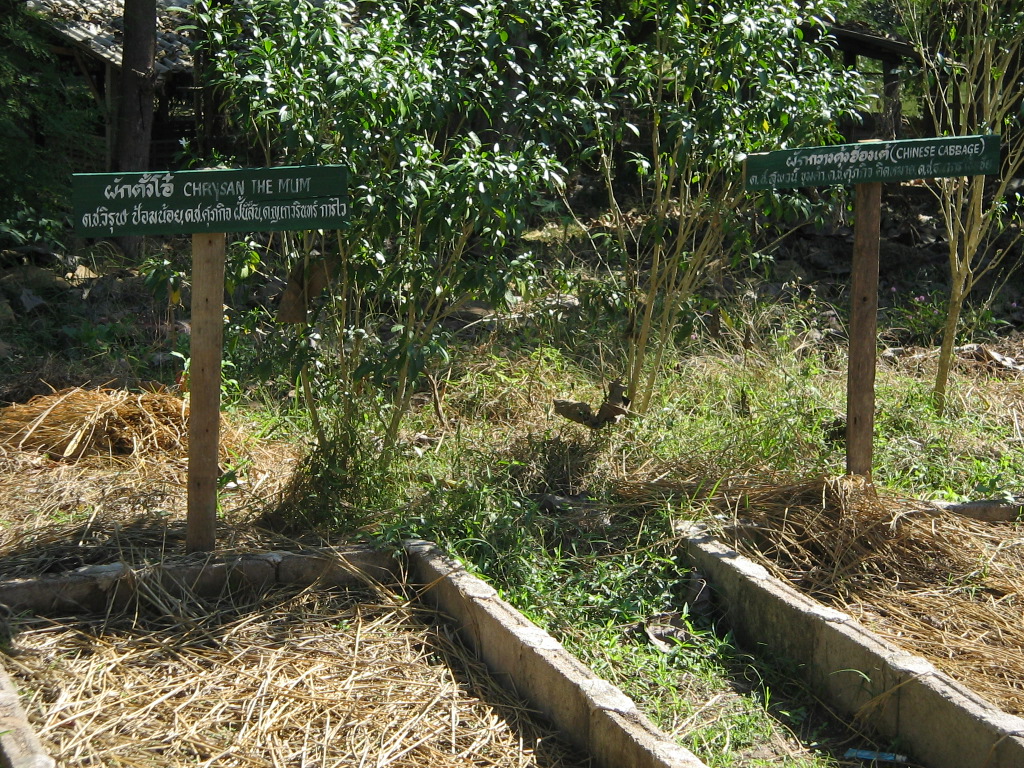
One of my favorite things about this school was the abundance of signs with interesting sayings nailed to the trees. This is a very Thai phenomena – I have seen it at other schools and temples. Usually they remind the reader to live in moderation or take time to reflect on their life. Some of the signs at this school, however, had some unexpected sayings... Take the time to enlarge the photos and see what you can read!

When we asked about the "villains" saying, we were given a long complicated explanation about people who grow up in poor villages, then suddenly become rich, and eventually forget who they are and where they came from. We weren’t sure about the English translation.

Tuesday, November 28, 2006

World Map #2


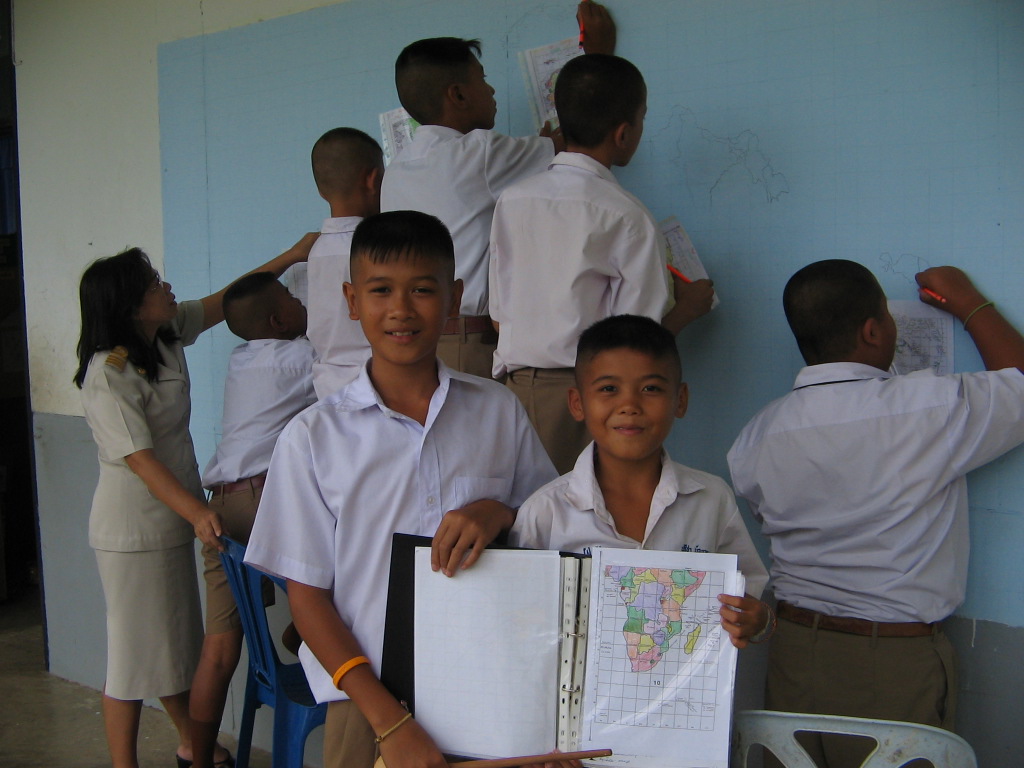
It’s that time of year again. Last year I did a World Map project at my Tuesday-Friday school. This year we’re doing one at my Monday-Thursday school. It’s great fun! This year’s World Cup got kids particularly interested in knowing where different countries are, especially the ones with good soccer teams.

We do it the old-fashioned way. Using a guide from Peace Corps, I made color-coded guide sheets for each sector of the map. We drew a grid on the wall, and the kids used the grid and guide sheets to draw all the countries in pencil first. (I had to fix Europe and part of Africa, but on the whole they did a nice job.)

Now we are painting. So far we’ve done yellow, green, and red. Aside from a few paint-related issues (too much water added at first, not enough containers for leftover paint), it’s going well and starting to look nice. I do spend a lot of time patching up border areas, but I find it to be fulfilling work!