Showing posts with label food. Show all posts

Tuesday, June 12, 2007

No Chopsticks with Rice!


We returned to the United States in mid-April, and it was seven weeks before we ate Thai food. Astonishing!

But before we left Washington last week, Robert's parents took us to a "northern" Thai restaurant in Everett. It wasn't very "northern" at all, but the food was still quite good. It made me feel excited about eating Thai food again!

At one point, I looked around the restaurant and noticed that nearly all of the other diners were eating their food with chopsticks. This both surprised and amused me. Here is the truth:

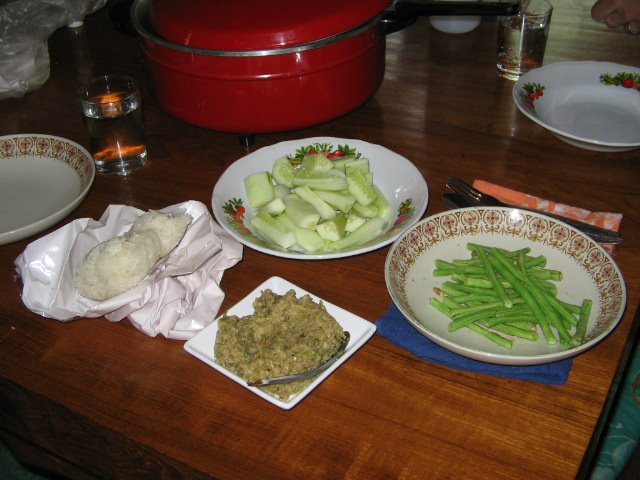
In Thailand, people do not eat rice with chopsticks!!! They eat it with their hands (if it's sticky rice), or with spoons (if it's regular white rice). NO CHOPSTICKS. Chopsticks are used only for noodle dishes -- primarily soups -- and Chinese food. Not with Thai rice dishes. If you used chopsticks to eat rice in Thailand, people would think you were very strange. (As proof, I have provided a photo of a meal in a Thai home, at which we are clearly not using chopsticks.)

To be fair, when our food was brought to the table, the waiter offered us chopsticks. I imagine this was done because so many diners ask for them. Also, our place settings originally included just knives and forks. Thai people don't use knives at the table, and they don't put forks in their mouths -- only spoons. We had to ask for spoons at the restaurant. I would not have been comfortable eating Thai dishes with a fork after living in Thailand for two years!

Also, to be fair, I think that I myself used to use chopsticks when I went to Thai restaurants, because I thought that was how it was supposed to be done, and I thought it was cool. But now I know.

Friday, May 18, 2007

McDonalds


Before I joined the Peace Corps, I lived in a great neighborhood in St. Paul, Minnesota. Within walking distance from my house I could find Thai, Nepalese, Vietnamese, Afghani, and Italian restaurants. If I hopped on a bus, I could reach Greek, Mexican, Kurdish, Cuban, and many more. I enjoyed being able to eat food from all over the world. I also enjoyed living in a city with a large immigrant population. I thought this spoke well of Minnesota – that motivated people could come from other countries and build themselves a new life there. And of course, those immigrants had no trouble finding food from their own countries, even there in St. Paul.

The term “globalization” is thrown around a lot these days, often in a negative way. Many people blame “globalization” for job losses in America, because American corporations often hire workers overseas to save money. Other people worry that “globalization” results in a loss of local culture, because more and more people adopt a common lifestyle or consume the same products.

When I taught social studies in Minnesota, I tended to side with these arguments. Living in Thailand and witnessing some of the other effects of “globalization,” however, changed my understanding of the term and its real-life meaning.

While I in no way would want a local culture to lose touch with the elements and traditions that make it unique, I think there’s also something to be said for the spread of positive behaviors and traits from one culture to another. For example, the idea that women have rights and should be educated has a very visible and, in my opinion, positive effect on life in Thailand. I knew many strong, smart women there who benefitted from this relatively new development, and I thought about it often when observing my female students.

The fast food industry is often held up as an example of the less positive effects of globalization. Both in American neighborhoods and in other societies around the world, fast food restaurants are a symbol of a rather sterile, homogenized environment, in which individuality and variety are replaced by standardization and sameness. I don’t frequent fast food restaurants in the United States, primarily because I don’t eat meat and I prefer healthier options (though I’ve recently discovered that Burger King makes a fine veggie burger, good for a quick meal during an airport layover). There are times, though, when there’s something to be said for being able to walk into a place and knowing what to expect. I’ve been known to choose Pizza Hut after a long day of driving rather then venturing into an unfamiliar neighborhood in search of vegetarian food.

I wasn’t sure what to think when I discovered that Thailand, particularly in the cities, has no shortage of American fast food. KFC and Dairy Queen are easy to find in almost any province, and select areas have plenty of Starbucks, McDonalds, and Sizzler to choose from. Did this mean that American culture was “invading” Thailand and displacing the locals? Were the Thais who ate at such places being “forced” to do so as a result of local economics, or were they doing it by choice?

Thomas Friedman writes in The Lexus and the Olive Tree that globalization involves both “push” and “pull.” He describes a Taco Bell in Qatar as being appealing to locals on account of its “clean bathroom, international sanitation standards, smiling service and quality controls – all at a cheap price they could afford.” Kentucky Fried Chicken in Malaysia was popular because it symbolized “modernity.” While McDonalds in Thailand was certainly more expensive than a typical bowl of noodles on the street, it was also cheaper than many of the full-service sit-down Thai restaurants I visited with co-workers during my two years. And it was, most of the time, cleaner. Local people around the world have their own reasons for choosing American fast food, and who is to say their reasons aren’t valid?

I consider myself a world traveler, and certainly a USA traveler. I’ve been lucky enough to visit lots of different places and cultures. I know I won’t have the chance to go everywhere, though. I’ll probably never get the opportunity to see Ethiopia, for example. Does that mean I should never have a chance to experience Ethiopian culture, on any level? I don’t think so... and fortunately for me, there’s a few Ethiopian restaurants right here in Seattle to choose from. Friedman quotes a Malaysian describing attitudes in her country: “‘Elites here say, ‘You should not have McDonalds,’ but for the little people, who don’t get to travel to America, they have America come to them.’” Perhaps its overly elitist for any of us to say that those “little people” shouldn’t have that opportunity if they want it.

When we were visiting Malaysia, one of our last nights in a quiet beach town we chatted with a family from Sweden. The parents talked about how Indonesian beach resorts had been “ruined” by the arrival of tourist-oriented business, including fast food, and how they expected Malaysia to go down the same path before too long. I agree that serious efforts should be made to keep beautiful natural places from being spoiled by uncontrolled development. At the same time, those of us who are wealthy enough to go on vacation at beach resorts ought to recognize that other people have the right to improve their own economic situations, and perhaps they see starting a McDonalds franchise as their best opportunity for doing so. Do we deny them that opportunity? Friedman writes, “[Fast food franchises] proliferate because they offer people something they want, and to tell people in developing countries they can’t have it because it would spoil the view and experience of people visiting from developed countries would be both insufferably arrogant and futile.”

In summary: globalization is maybe not all bad.

Friday, May 11, 2007

Funny Toast

I haven't posted in a while, as we've been busy getting settled in Seattle and buying a car. The lovely cold weather, both in Minnesota last week and in Washington now, have been wonderful. This is the time of year that Jae Hom, our town in Thailand, breaks 100 degrees nearly every day. Yikes! I don't know how I survived.

Anyway, I was flipping through photos from this time last year. We had just spent a week on the beach of Ko Chang, Thailand, with Robert's cousin Karin. One morning at breakfast, we enjoyed this funny toast. Nothing like being greeted by a cat on your plate!

Sunday, March 18, 2007

The Perfect Lunch

When we return to America, I'll be able to make some of my favorite Thai foods at home, and find many of the others in restaurants. I'm sure they just won't taste the same as they do here, though.

Since school has ended we've had lots of time at home (packing, mostly), and it has meant that we've been able to go out and get one of my favorite foods for lunch nearly every day. Som tam, or papaya salad, is usually made from shredded raw papaya. It's pounded up with garlic, chili peppers, tomatoes, green beans, peanuts, and tamarind. Non-vegetarians might add shrimp, crab, or fermented fish paste. I just go for salt or soy sauce.

It's perfect eaten with sticky rice, and in this case, with some Diet Pepsi on the side. At night, it's great with a beer!

Thursday, March 15, 2007

The Perfect Size


One thing Thailand does right is Dairy Queen Blizzard Sizes. There's a DQ at the Big C in our province, so every time we go to stock up on supplies I indulge in a little ice cream goodness.

This is a Thai small, for twenty-five baht, or about 76 cents in American money since the dollar dropped over the past few months. It's big enough to make you feel like you've had a real treat, but not so big that you're worried about calories or uncomfortably stuffed afterward!

You can get an "American" small-size DQ Blizzard in Thailand. It's called a "large"!

A little update on our air quality situation: yesterday morning the Peace Corps office called us to ask if we needed to evacuate. We declined, since we have too much to do during our last six days in our town, but I thought it emphasized the seriousness of the situation! I didn't see any ash falling yesterday, but the air isn't noticeably improved.

Monday, March 05, 2007

Kao Man Gai


We’ve lived in Thailand for almost two years now, and there are still things that are new to us, even in places we’ve visited many times before. This weekend we made a final shopping trip to Chiang Mai, where we met up with some fellow volunteers who introduced us to a fantastic little restaurant that we must have walked past dozens of times on previous trips. If only we had known!

On a similar note, a new food craving has taken over my last weeks in Thailand. It’s a food I saw other people eat frequently over the past two years, but only recently did I encounter a vegetarian version, and suddenly... the world seems different! I like it so much that I’m going to post the recipe, here, today.

In Thai, it’s called "Kao Man Gai." [And now, I must insert a sentence or two explaining how, after writing just the previous two paragraphs, I was seized with an overwhelming desire to eat some kao man gai sauce now, immediately, with some cucumber slices. So I’ve gone and arranged that and am now munching as I type.] "Kao" means rice, "man" means oil or fat, and "gai" means chicken. So, translated into English, this dish would be called something like "Chicken with rice cooked in chicken fat." Of course, I make it with tofu, so that’s what I’ll describe.

Start by mincing up large quantities of garlic and ginger. Boil the tofu, sliced, along with some minced garlic, ginger, and soy sauce, for about ten minutes. Remove the tofu, save the flavored water, and set both aside.

Saute some more of the minced garlic and ginger in your preferred fat. I was told by Pi Noy to use margarine, but the margarine around here frightens me with its ability to stay very solid in 90+ degree heat, so I go with liquid vegetable oil. (In America, I’ll probably use my preferred canola oil.) Add uncooked rice, still dry, and saute for several minutes. When the rice starts to change color, add the saved water from the boiled tofu, and more water as needed to cook. Cover and cook until soft.

For the sauce, put more heaps of minced garlic and ginger in a food processor. Add a couple of small fresh chili peppers (the ones that are about an inch or two long, and quite narrow). Add fermented soybean sauce, which comes in a bottle with cooked beans and looks orange or brown in color – I imagine it would be easy to find at an Asian grocery store. Add soy sauce and a bit of sugar, and hot water for thinning as needed. Puree it all together and test for flavor.

Slice a bowl full of cucumbers, and chop another bowl full of cilantro and green onion. Arrange all dishes on the table and let diners arrange their desired proportions on individual plates. Yum!

Sunday, February 25, 2007

Personal Feature: Pi Noy


A few weeks ago I wrote about how our friend at the school district office, Pi Noy, enjoys making lunch for us sometimes on Wednesdays. Today I’ll write a little more about Pi Noy herself.

Pi Noy, whose real name is Payom, was born one of six children in a village just outside of our town. Her father worked in and eventually owned an orchard nearby. Their house was on the same piece of land on which Pi Noy currently lives. She attended school in town, and grew to adulthood developing a very strong sense of values, including modesty, moderation, and responsibility towards home and family.

After finishing high school, Pi Noy attended teacher college in Isaan – the northeastern region of Thailand – and earned a teaching degree. While working in a school district office, she met a tall young teacher named Weera. Friends assured her it was the perfect match, as they shared the same powerful sense of responsibility and traditional values. They were married and had two sons, O and A, before moving back to Pi Noy’s home village. Today he is a principal at one of the local schools, and she works in the Policy & Planning department of the district office. Their sons, now teenagers, attend school far away, though one is close enough to visit many weekends.

I first met Pi Noy in April of 2005 at the office. She came to me with a list of Thai phrases she wanted help translating into English. We soon received a lunch invitation to her home, and she’s been cooking delicious Thai vegetarian food for me every since.

I have known few people as genuinely generous as she. She has welcomed nearly every one of our American guests for dinner at her home, and many have said it was one of their favorite meals in Thailand. When our flood happened in September of 2005, her house was not affected, but she went all out helping others who were. She came to our house on the second day, looked at our piles of muddy clothing, and without a word shoveled it all into the back of her pickup truck and sped home. I later learned that it took her up to ten hand rinses for each batch before enough mud was out of the clothing for it to go into the washing machine. Last year, Pi Noy and Por Or Weera hosted Chanon, a high school exchange student from Norway, for ten months. She so enjoyed being able to take care of someone, and guide them through Thai culture, that they’re hoping to do it again during the next school year.

Many years into the future, I know that I’ll look back at my time in Thailand and some of my fondest memories will be dinners at Pi Noy’s house. And we get to go again tomorrow, hooray!

[The first photo shows me with Pi Noy in her beautiful kitchen. The second shows Robert, Por Or Weera, and Pi Noy eating the specialty noodles of another northern province. The things that look like little meatballs are, for them, little pork meatballs, and for me, little vegetarian meatballs.]

Sunday, February 18, 2007

Chiang Mai Wedding (Bai Tiow Part I)


The son of a teacher at one of Robert’s schools was getting married yesterday in a small village in Chiang Mai province, so we arose at 5:30am in order to travel there with our landlords. We arrived just after 10:00am, too late to see the monks doing the religious blessing or the groom’s family presenting the dowry to the bride’s parents for approval.

We were, however, able to participate in the community blessing portion of the wedding day. One by one or in pairs, guests approach the couple on knees and present an envelope with the wedding gift. The "puean jow sow" and "puean jow bao" – roughly equivalent to best man and maid of honor – collect the envelopes and give each guest a piece of white string. The guests then tie the string around the wrists of the bride and groom while giving blessings and hopes for the future.

We had met the groom twice before: once at his monk ordination in our town last April (with my sister Annie) and once at the World Garden festival in Chiang Mai city in December, for which he helped us purchase our tickets (with our friend Leah). As I tied string on the wrist of the groom and Robert tied it on the bride, he spoke our wish for them to have happy experiences. I added a wish for good health.

After all the guests had an opportunity to tie string, the meal was served: green curry with fish balls, spicy minced pork "laab" salad, stir-fried chicken with cashew nuts, "Yam Woon Sen" noodle-meat salad, and fresh fruit. The bride and groom visited each table to take photos and hand out favors – keychains with the King’s picture. Several of the retired female teachers at our table enjoyed singing karaoke, and they even convinced Robert to give a performance of "I Just Called to Say ‘I Love You.’" Shortly before 1pm, we changed our clothes, got back into our landlords’ car, and headed out for some sightseeing. (To Be Continued...)

Thursday, February 15, 2007

"Ngan" Means Both "Work" and "Party" in Thai...

It was one of those days...

Wednesdays are our "office days" at our site. We are based at the school district office, where we might make teaching materials or plan a teacher training. Sometimes we make visits to schools in the district that don’t usually have foreign teachers. This past Wednesday happened to be the "Corporate Civil Service Sports Day and Banquet" for various local employees. Since we were given free shirts to match the school district employee team, we thought we ought to attend.

The high school had cancelled classes for the day to allow the sports day celebrators to use its facilities. (Yes, you read that right.) We headed up there at 8am with Pi Noy, and then waited around for an hour until most of the rest of the participants arrived. All the teams lined up for the opening parade. Robert and I were given flags to carry in the school district section. As we listened to the marching band practice and watched the various drum majors and majorettes twirling their sticks, we agreed that it felt rather like being in high school again.

Robert and I, in matching shirts, with one of our majorettes:


Our friend At as drum major:


The parade finally began; we marched in formation across the field and listened to the remarks made in the opening speeches. We were reminded that to be healthy requires that we exercise 30 minutes per day, 4-5 days per week, and so on. The flag was raised, the runner completed his lap around the field and lit the torch, we did a last march around the field, and finally we were in the shade of our tent.

After just one short hour of foot races and volleyball, the partying started! By 11am, the karaoke music was playing, the grilled chicken was passed around, and the whiskey was flowing.


Some of the women started mixing up the lunch food, and Pi Noy hurried to make a vegetarian version for me. The main dish – in addition to the grilled chicken – was Yam Woon Sen, a spicy noodle salad. Most people ate it with a variety of processed meat slices. The photo shows my veggie tray on the far left, the regular Yam next, with crispy baked pig skin in the middle. Above the chicken is some green mango with chili dipping sauce, and on the far right is a large plastic cup of sticky rice. There was also spicy papaya salad (not pictured) made with crab cream for those who enjoy it, and oranges for dessert.


During lunch, Robert was called upon to fill out the men’s relay race team, so he willingly obliged. Here he is running down the field with a water balloon!


We left shortly after lunch because we had lots of work to do back at the office – we’re planning an English camp for 8 schools next week – and spent the afternoon in relative quiet. Pi Noy picked us up again at 6pm to take us to the banquet dinner. Of course, it was a Chinese meal, so she had brought along some salad for me to eat. Robert enjoyed the spicy grilled fish and the peanuts, and he said the vegetables with bacon weren’t bad. He did not like the boiled pork, the spicy fried meat salad, or most of the cold appetizers. He was too full for the chicken soup, and we managed to convey our tiredness well enough that we were taken home before the fried rice with pork arrived. Here’s a picture of him eating a well-flavored hot dog with chopsticks:


In addition to food, the banquet included karaoke, trophy presentations, and much conversation. All in all, yet another interesting day in the Thai education system.

Friday, January 26, 2007

Wednesday Lunches


Sometime during our early weeks at our site, I was sitting at a desk at the school district office and a woman came up to me. She introduced herself as "Pi Noy" and asked me a list of rather complex English questions. Upon further conversation, and discovering that I was a vegetarian, she invited Robert and I to her home for a vegetarian lunch. I can't remember what it was, but it was absolutely delicious.
For nearly two years now, Pi Noy has from time to time made lunch for us on Wednesdays, our office day. She never makes the same food twice. We've had kao soi curry, spicy tofu "laab" salad, "rad na" (noodles with gravy) over omelettes, and lots of other fancy dishes. Shown in this photo is a recent meal of eggrolls with peanut sauce. Pork-filled for Robert, and tofu-filled for me. I ate way too many!

Thursday, January 18, 2007

Chinese Celebration Meal

As I mentioned in yesterday’s blog, a Chinese meal was served for the Teachers’ Day lunch. Chinese meals of a certain style are often served at important social functions in Thailand – weddings, housewarming parties, etc. They are very different from what a typical Thai meal for a similar occasion might be.

Last year, I asked my co-teacher if she liked the food served at these meals. She told me that she doesn’t, and that most people in our area don’t. When I asked her why it was served, then, if people would prefer to eat Thai or northern Thai food, she replied that it had to do with status – the Chinese meal is a sign of wealth, so serving one gives the impression that you are well off. (This would explain the 100 baht per person price tag for yesterday’s lunch, which all the teachers were expected to pay. Peace Corps volunteers were served free.)

Anyway, here is a description of yesterday’s meal, which is fairly typical of what you would find at such an occasion:

The first course includes a plate of appetizers, mostly different types of meat. Yesterday, it included pork dumplings, processed pork, baked jerky-style pork, picked eggs, and some pineapple and pickled ginger in the center. Robert says that the jerky-style pork and the dumplings were "pretty good." I refrained from eating any of it, though I did try a pickled egg once about a year ago at the command of a teacher from Robert’s school. I thought it was pretty nasty.

Yesterday’s second course, not pictured, was called "fish stomach soup." However, my co-teacher explained that these days it no longer includes real fish stomach. Instead, it had chicken and pig skin. Robert thought it was "pretty good."

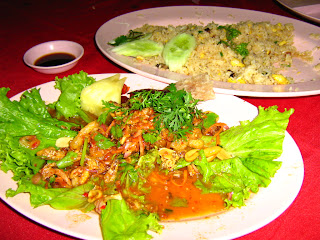
The third course included two dishes: fried rice with pork, and spicy shrimp and pig skin salad. The fried rice was called "American fried rice" because it had raisins added. (I told my co-teacher that we don’t put raisins in fried rice in America, and she laughed.) I should point out here that all of the courses are served on one large plate in the center of the table, and diners serve themselves into small bowls using chopsticks or spoons. Robert says that the spicy shrimp and pig skin salad was "tasty, with a nice mix of flavors and a crunchy texture," and the fried rice "did justice neither to fried rice nor to raisins."

Next came a plate of stir-fried vegetables with shrimp and a flaming pot of tom yam soup. "Tom yam" is a spicy soup made with lemongrass and kaffir lime leaf. It is traditionally made with seafood but can be made with other meats, or mushrooms or tofu, as well. Yesterday’s tom yam included squid, fish meat, and processed fish balls. Robert isn’t a big tom yam fan, and thought that one bowl was enough. (I like it when it’s made vegetarian.)

A whole steamed fish, also on a flaming plate, came next, which Robert reports was "ok." And last came a plate of sliced fruit, including guava, papaya, and orange sections. This, finally, I did enjoy a small bit of. I really like guava.

So there is a description of what you might find at a Chinese celebration meal in Thailand. To our great relief, this one did not include Robert’s all-time least favorite food here: chicken feet!

Tuesday, December 12, 2006

Party Meat


Before coming to Thailand, I expected it to be something of a vegetarian’s paradise. All those fresh fruits and vegetables! Plenty of soy and tofu! Just like at the Thai restaurant down the block from our apartment!

In reality, though, I have found the Thai people to be some of the most gung-ho meat eaters I’ve ever known. No meal is considered complete, it seems, without a large portion of pork, beef, or chicken. In most northern Thai dishes, in fact, the meat is the main component of the meal – simply chopped and seasoned with locally grown herbs, and eaten with sticky rice. Tofu, if eaten, is usually mixed with fish or pork. I have yet to meet another vegetarian in our town. The closest I have come was about 20 months ago, when I met a teacher from another school district who eats vegetarian on "Buddhist days" – approximately once every eight days, according to the cycle of the moon.

When I say that I am vegetarian, most people assume that either a) I eat meat most of the time, excepting a special days, or b) I am probably crazy. When I tell them that I haven’t eaten meat for over 11 years, they look momentarily befuddled, and then decisively pronounce that that’s why I have such good skin.

On Sunday evening, we celebrated Robert’s birthday at the house of some school district friends. The meal was a typical Thai celebration meal for a large group of people, called "sukiyaki." (I think the concept originally comes from somewhere else in East Asia.) A large cooking device, slightly resembling a wok, is kept constantly heated. Diners sit in a circle around the heat source. Different bowls are scattered about containing a variety of ingredients, usually including raw pork, thin rice noodles, chopped vegetables, and chili sauce. Each diner has their own mini-bowl and set of chopsticks. Diners take turns using their chopsticks to arrange the meat on the heat source for cooking. A large bowl of broth is also kept constantly on the heat source, and diners will add scoops of noodles or vegetables as they desire. When satisfied as to doneness, diners will transfer cooked ingredients to their own bowl and then eat them with the chili sauce. It’s a very festive way to eat!

Sunday night, the main ingredients included fresh pork, processed pork balls, processed fish "tofu," processed shrimp "tofu," eggs, rice noodles, cauliflower and water spinach. I had my own separate bowl of pre-mixed noodles, boiled vegetables, and regular soy tofu (not shown in photos). It was a chilly night, so the heat in the middle of the mat kept us warm as we talked and ate for over three hours!

Thursday, November 30, 2006

Love Those Dried Bananas


Several years ago, as part of a drive to improve the Thai economy at the local (village) level, the OTOP program was started. OTOP stands for "One Tambon, One Product," a tambon being a unit of local government approximately equal to a township. Every tambon has the opportunity to specialize in one or more products, and these locally-made products, when approved, will have a special label on their packaging marking them as OTOP. They can also be rated with a certain number of stars (1 to 5) indicating their quality. Examples of OTOPs in our area include cloth weaving, banana chips, and sweetened rice cakes. OTOPs I have seen from other parts of the country include dried mushrooms, wood carving, silk weaving, and all sorts of sweets and snacks.

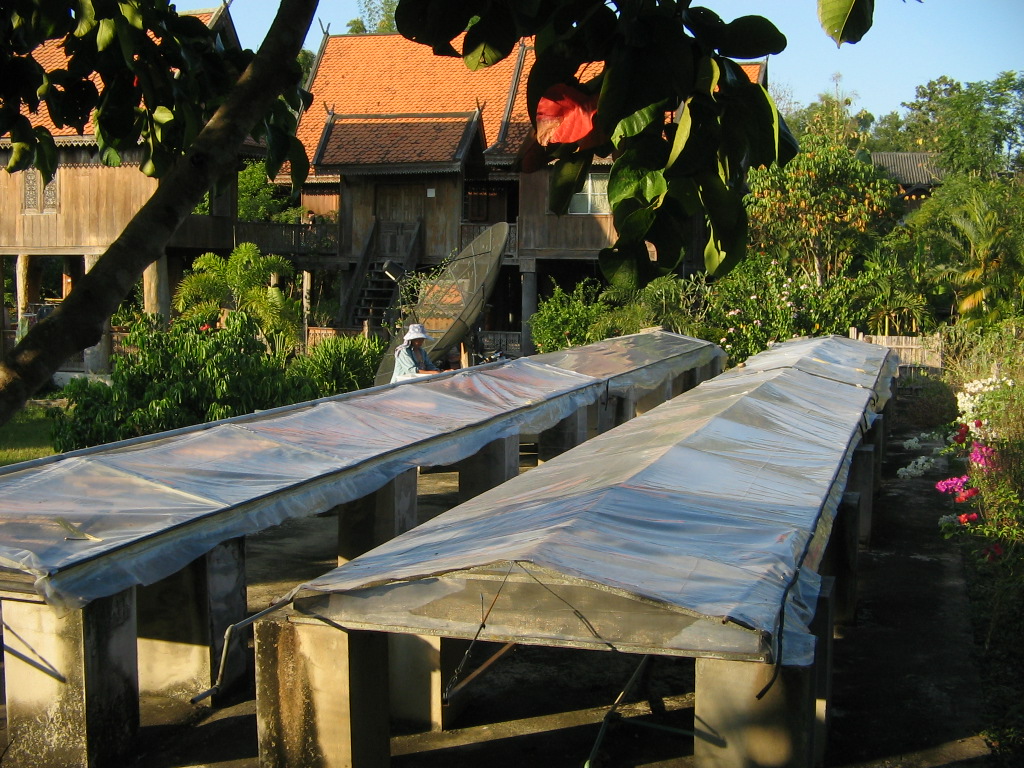
After our school visit to a village north of town yesterday, we were taken by Pi Nongnut – a very enthusiastic woman who is part of that area’s governing council – to visit the local OTOP makers. We were taken to a lovely piece of property with a very large and beautiful traditional northern Thai house. Outside the house were two long tables covered in plastic. Looking under the plastic, we were able to see rows of "sweet water" bananas (a popular variety) drying in the warm sun, protected from bugs. We also went inside the packing building, where Pi Nongnut showed off the clean facilities and machines for sealing the bananas in plastic packaging.

Not only did we get to taste several of the delicious bananas fresh from the drying tables, but we were given ten boxes to take home with us! Our refrigerator is now very, very full.

Sunday, November 26, 2006

A Pocket of Nice on the Mekong


Having just returned from a rather calamitous four-day weekend trip to Chiang Rai province, which perhaps I’ll describe another day, I’m trying to remember that it’s the little things in life that can bring us joy. Not every vacation will be fun, even when you’re using two of your precious Peace Corps vacation days. Not every "must see" in Thailand will be seen during our two years here, even if it is only 7 hours by three vehicles away. But even when a four-day weekend turns out to be just a lot of money spent to sit on buses for nothing, there are still a few small pleasures to be celebrated.

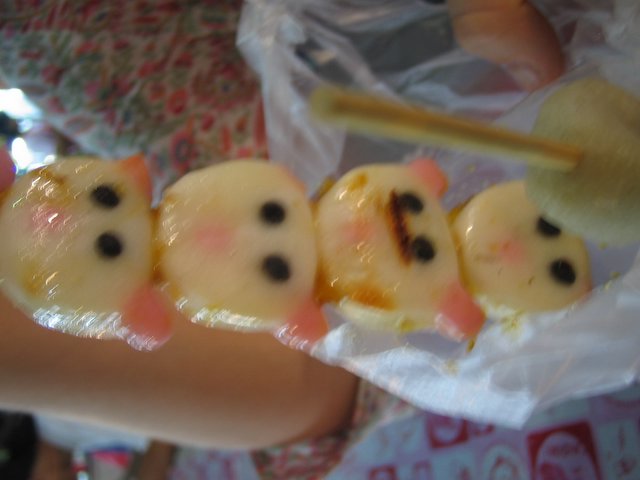
Although I’ve considered myself to be vegetarian for over ten years now, I did start to eat some fish in particular circumstances about five years ago. Being vegetarian in Thailand has saved me from many an unpleasant dining experience – I don’t have to worry about being served raw meat, processed fish shaped like mouse faces, or other such "delicacies." But I know that it has also meant that I’ve missed out on trying a lot of the local cuisine, which is very much meat-based.

On occasion, when far away from anyone who might recognize me, I do take the opportunity to try a little fish if it’s prepared in a special "local" way. In Laos, I tried some of Robert’s fish "laab" – minced fish salad with spices and herbs. Last April, I enjoyed grilled mackerel on the beach. And Friday night, one of the few parts of this weekend vacation that worked out, I enjoyed "fish steamed in bamboo", a local specialty of Chiang Saen town in Chiang Rai, while sitting at a little table overlooking the Mekong River after sunset. It was positively a delightful meal – also including sticky rice and spicy papaya salad – and despite the various disappointments of the weekend, I am still left feeling quite fond of the Mekong and its culinary offerings.

Wednesday, October 11, 2006

Boys and Milk


About ten years ago, someone in Thailand looked at students from Europe and America and observed that they are, on the whole, taller than Thai students. This someone also observed that in Europe and America, many kids drink milk every day. So the connection was made: milk = tall, maybe.

As a result, the Thai government now provides daily milk for all students in the country. Every day kids line up at the big cooler for their bag, or carton, and drink up. My students all say that they like to drink it, which is notable considering that Thai adults can’t drink milk without getting stomach aches. I guess the new policy has changed Thai digestion. However, they do all agree that soymilk is more delicious. (A non-milk-drinker myself, I agree with the soymilk lovers.)

Regarding floods, our house is still dry. We haven’t had much rain in the last couple of days – I think most of it is falling further south – but I make no predictions about what happens next!

Thursday, August 24, 2006

Mushroom Sticks


We visited America – Minnesota and Washington – for two wonderful weeks earlier this month. It was great to reconnect with family, friends, and familiar landscape. The trip made me excited to return home next April, but also made me feel that "home" – my life in the USA – is not as far from Thailand as I thought it was.

One question we were asked several times while visiting home was, "Is the food you eat every day just like the food in a Thai restaurant?" The answer is, "Yes and no." Thai restaurants in America primarily serve central Thai food (from the central region of the country). Living in the north of Thailand as we do, a lot of our food is "northern Thai" food. So the logical next question is, "How is northern Thai food different from central Thai food?"

After some reflection, I think I’ve come up with the right answer. In central Thailand, with its miles upon miles of well-irrigated, flat fields, cuisine is based on agricultural foods: farmed vegetables, domesticated animals, etc. Northern Thai food, by contrast, is made from vegetables, leaves, grasses, and animals that grow on their own or are gathered from the forests and mountains: water spinach, mushrooms, bugs and frogs. Although it is now possible in our town to get food from all over the country, 20 years ago that wasn’t the case and most people ate what they could find in their own backyards.

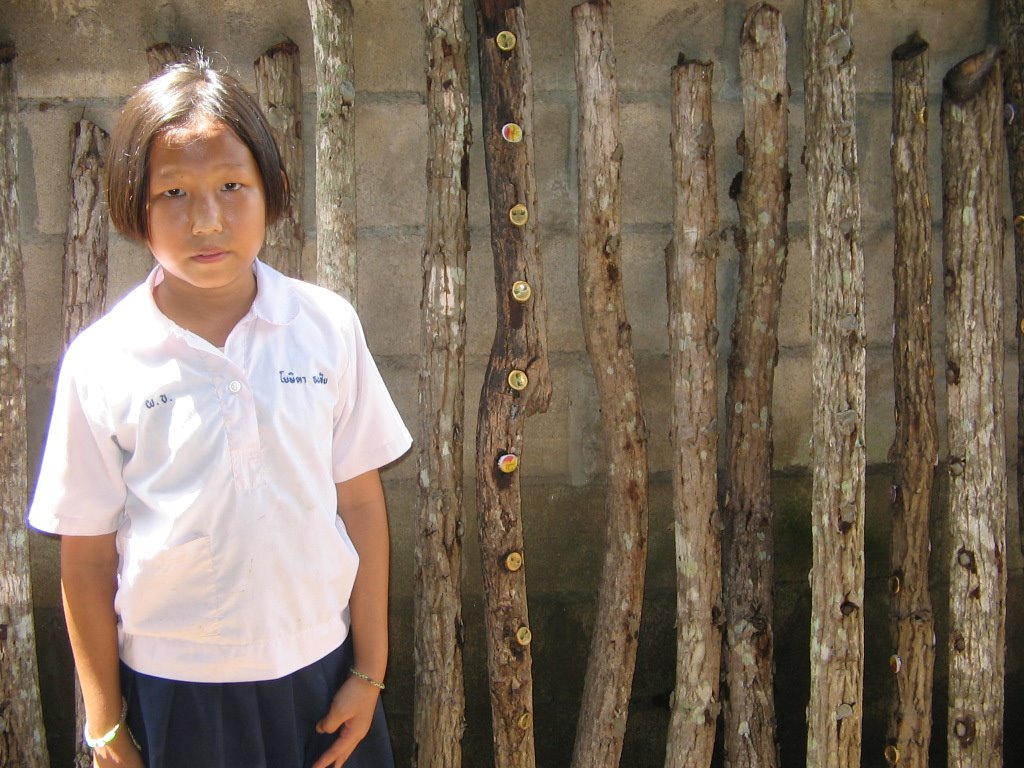
Mushrooms grow mostly during the rainy season, though, so what do you do when you want mushrooms and it hasn’t rained for 4 months? You grow your own on a stick, of course. Here is Yosita, age 12, showing some mushroom sticks at the home of another student. They can be watered to help the fungus grow. The bottle caps, it was explained to me, give an extra boost to the speed of growth as they rust.
Sunday, July 23, 2006

Planting Rice


Way back when we first heard we were coming to Thailand, I got it into my head that I wanted to plant rice. Not necessarily often or regularly, but at least once. The thought of living in a country where there is truly a "staple food" made me think that I ought to experience how that staple food is produced.

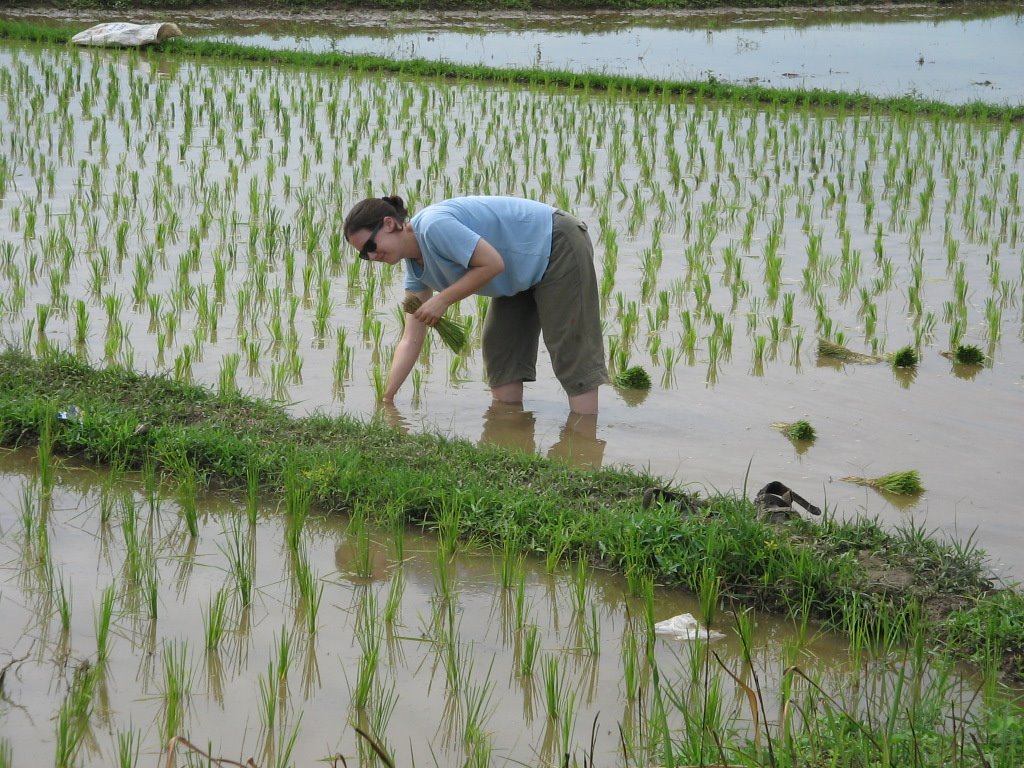
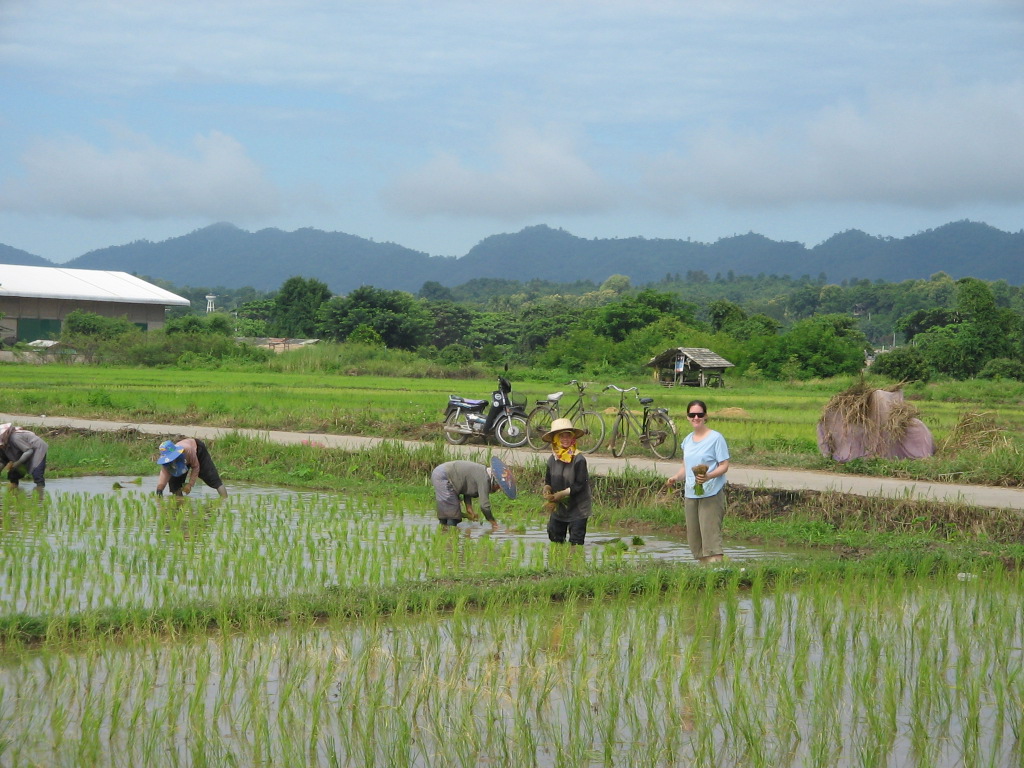
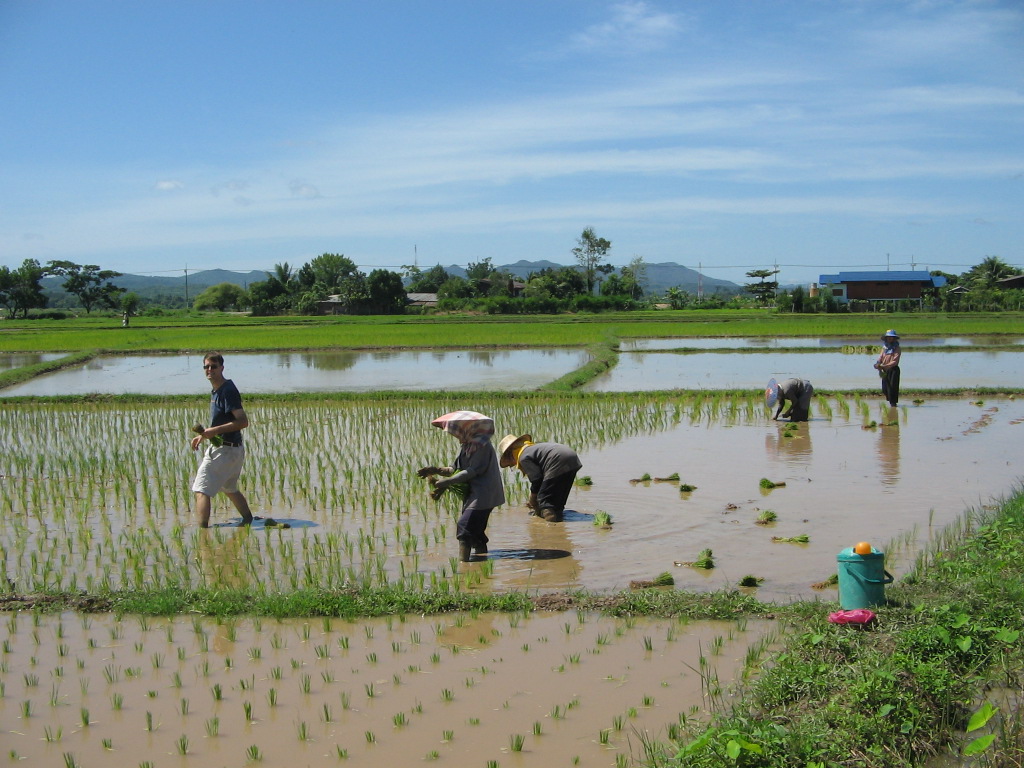
Today, a hot, sunny day near the end of the planting season, after over 19 months of living in Thailand, I finally had my chance. Robert and I got up around 8am, ate some oatmeal, jumped on our bikes and rode a little ways north of town. We found a spot along the road where a few people were planting, got off our bikes and looked around hesitantly. As I expected, within 20 seconds there were calls to "come help plant!" We said, "Ok!" and they laughed.

Not knowing quite what to do for proper footwear (and having a healthy fear of Asian liver fluke and whatever else might be in there), we encased our feet with plastic bags, socks, and rubber bands. Finally set, we waded in and immediately sank several inches in the mud. The rubber bands helped the bags stay up to our ankles, though, so at least the soles of our feet were protected!

The four women – one of whom is a grandmother of a 2nd grader that I teach, it turns out – showed us how to carefully take a few stalks of rice out of a bundle and stick them into the mud in neat rows. I wasn’t surprised to find that it’s harder than it looks to get it right, but eventually I got into a slow groove. The women, of course, flew by Robert and me and occasionally came to help us finish a row or a section. They seemed happy to have us, though, and kept up a lively conversation. I could see how rice planting is a community activity.

The current wage for a full day’s labor planting rice is 100 baht, or about $2.50. For perspective, a bowl of noodles is 20 baht, a bus ride to the provincial capital is 30 baht, and an electric rice cooker is 400 baht. We lasted only 90 minutes, at which point I was sure I had sweat out all my sunscreen. Three hours later, after a good scrub and some lunch, my legs are still tired from pushing through the thick mud.

As we were leaving, the women said we should come back in October to help with the harvest. I’m looking forward to it!

Thursday, July 20, 2006

Sandwich Gone Strange


Thai cuisine is becoming increasingly famous throughout the world. When we received our invitation to join Peace Corps Thailand, we were very excited to know we were going to live somewhere which such great food. Thai cooking is said to have blended elements of Chinese and Indian styles and ingredients. This fusion is what gives it such great flavor.

On occasion, however, we discover that "fusion" has gone in strange directions, particularly when Thai and American or European cuisines are blended. Case in point: the sandwich. In America, sandwiches are commonly found made with bread (often whole grain or nicely flavored), a protein filling (meat, peanut butter, cheese, etc.), some veggies or fruit spread, and perhaps a flavoring (butter, mayo, special sauce, etc.).

In Thailand, however, the concept of what makes a good sandwich has been completely changed. Here, only white bread (of the Wonderbread style) is used. The protein filling, if there is one, is likely to be fuzzy pork (think cotton candy, but made of meat) or red bean paste. I don’t think I’ve ever seen a vegetable filling. Instead, you often come across red or green fruity-flavored gels such as the one shown in the photo. I read recently that Thailand is the country with the world’s highest per capita sugar consumption. I’m not sure it’s verifiably true, but my experience would attest to it, and the "sandwich" is a great example.

This particular sandwich was brought home from school from school by Robert, a little "gift" from his co-teacher that day. (Yes, it’s got four pieces of bread. Count them.)

Tuesday, July 04, 2006

Pineapple Glut


You know you’re living in a tropical country when...

As you exit the windy road through the mountains and ride along the west side of our valley, you can look out the window of your vehicle at hills covered in pineapples. Actually, you can just see the sprouty tops, because the fruit grows underground. These hills are very pretty, but even though I came to Thailand anxious to eat lots and lots of fresh pineapple, I’ve had more than my fill lately.

Apparently, pineapple growing was so profitable in our province for a while that many people started growing it who hadn’t done so before. As can be expected, the supply has outgrown the demand. About a month ago there were protests in our provincial capital by farmers claiming that the government owed them money for having grown all this pineapple. I don’t know all the details, but I do know that the governor, anxious to stop the protests, agreed to buy the pineapple from the farmers at the price of 80 satang per kilogram.

Now, 80 satang per kilogram is pretty much nothing at all. There are approximately 40 baht to the dollar, and 100 satang to 1 baht. So, 80 satang comes out to be about 2 cents. 2 cents, for 2.2 pounds of fresh pineapple. But even at that rate, and even with the primary schools taking advantage of the low price and buying it like crazy, they still can’t sell all the pineapples so they’re being thrown into big holes. (This is the story I am told.)

Last Friday at our English camp, lunch included stir-fried pineapple for the main course, with fresh pineapple for dessert. I felt a little high on sugar by the end of the meal! The teachers were surprised that I wanted to take a picture of pineapple. They were even more surprised when I explained that it’s a very expensive fruit in the United States.

(Other food items in the photo include red curry, rice and rice noodles, and fish sauce with chilies.)

Wednesday, June 21, 2006

Nam Prik Het


Most of the time, I don’t make Thai food when we’re in our house. I know I should be practicing for when we return to the USA and I want to make it myself, but it’s just not as delicious when made by me as it is when made by people in our town! But last week the teachers at my school helped me learn to make one of my favorite dishes, and since then I’ve made it at home three times.

"Nam Prik" translates literally as "chili water," and there are dozens of varieties of it in northern Thailand. Nam Prik Num is a basic chili dip made primarily with green chilies and garlic, and sometimes fish sauce or fermented fish sauce. Nam Prik Ong, Robert’s favorite, has the addition of tomatoes and pork. But my favorite is Nam Prik Het, made with forest mushrooms that spring up from the ground when the rains are heavy.

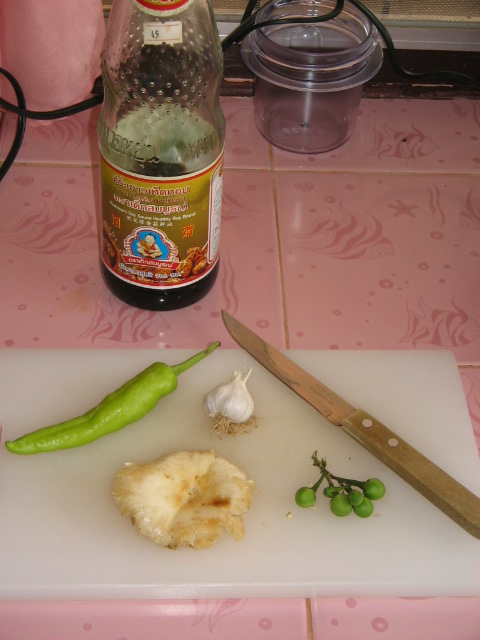
The ingredients in Nam Prik Het include: the forest mushrooms mentioned above (I don’t know the name of the variety in English, but I’m sure that other large soft mushrooms could be substituted); fresh green chilies; a bunch of garlic cloves; some small round green things that grow on a stem (I have no idea what they’re called, either, sorry!); and a little soy sauce.

First, you roast the chilies until they are soft and a bit blackened. I do this in the wok. Next, you grill or roast the mushrooms until most, but not all, of their water is gone. Then, take the chilies, garlic, and little green things and smash them up in a mortar (if you’re traditional) or a blender attachment (if you’re me). Add in those warm mushrooms and some soy sauce, keep smashing a bit more, and you have a tasty dip. We like to eat it with sliced cucumbers, green beans, boiled eggplant (not pictured), and sticky rice.