Showing posts with label travel. Show all posts

Saturday, July 07, 2007

Personal Feature: The Family Next Door

I've written several times about our neighbors. We were surrounded by many good folks who looked after us during floods, storms, illness, and household maintainance. Some were very loud, true, but for the most part we enjoyed our living situation. The family next door was very important to us throughout our time in Thailand, so I'll write about them today.

Who lived there, just a few feet south of our windows? The list included Ann (red sweater, in photo), her husband Rat, their son Nong Dae, Ann's mother Moon (flowered shirt), her father Som, her nephew Lek, and her older brother Boon. That list varied from time to time, because Rat is in the military and was often off at his post, and Ann sometimes went to join him for a month or two.

Ann was just a year younger than me. She came over to introduce herself on the day we moved in, and was pleased that we would be neighbors. At that time she worked a low-level job at the school district office. Nong Dae was not quite a year old, and he stayed home with his grandmother during the days. But when he started walking and became too much work for his grandmother to handle, Ann quit her job and had to find new ways of making money. During the course of our two years in town, she tried many different projects: making crepes to sell on the street and at local events, taking in laundry, making roasted corn and eggrolls to sell in the town where her husband was posted, raising fish, signing up with Amway to sell household products and cosmetics to the women in town... (It's true, I became an Amway member while I was living in Thailand as a Peace Corps Volunteer. I bought the detergent.) She never seemed to be able to break even, though, and was often stressed about money and how to care for her family. When we left, she was about to start a bread-baking business. We sold her our oven for a very low price, and I tried to find some recipes on the internet that could be modified for Thai ingredients.

Rat was originally from northeastern Thailand. He was one of the nicest Thai men we ever met. He didn't drink alcohol and was quite devoted to his family. He and Ann met in Bangkok and were married several years ago. He was usually gone for 2-3 weeks at a time, and when
he came home he would do all sorts of household projects -- building fences, stairways, and other quality-of-life remodels. He worked hard and didn't get much rest.

We had many happy times with Ann & Rat. Our first Songkran in Thailand, they took us to the parade in town, and guided us home when the drunken teenagers got too rough. Our first New Years, they invited us over for a beer at midnight. We helped celebrate Nong Dae's second birthday, and watched him grow from a crawling baby into an active three-year-old with a strong personality.

This past New Years, we traveled with several Peace Corps friends to Pai, a town in Mae Hong Sorn province that is popular with tourists. It also happens to be where Rat is stationed, as it's near the border with Burma. Ann, Nong Dae, and Mae Moon were living with him at the time, so we were able to all meet for a day and do some touring together. The photo was taken at a park nearby.

There isn't much about life in Thailand that I miss, but I do think often about the people that we knew there. I wonder how they are doing, if Ann has managed to make any money, if Nong Dae has gotten bigger, if there is a threat of flooding this year.

Friday, April 20, 2007

Home

We returned home on Sunday and have been spending several days recovering from jet lag and enjoying American food. Here is a short list of things we’re happy to be experiencing once again:

– spring weather, cool temperatures, and sweaters
– quiet traffic (hardly any motorcycles!)
– cereal and bagels for breakfast
– being able to state our opinions
– dry bathroom floors
– running paths
– family and friends!

I’ve started a new blog for descriptions and photos of our Cambodia-Malaysia trip. You can visit it at Kate's Travel Blog. I’ll continue to write more about Thailand at this site.

Thursday, April 12, 2007

Monkey Attack!

Ok, so it didn't actually succeed at attacking me, but it would have if the water hadn't been just a couple of feet away!

Today we rented a double-seated kayak for three hours, and eventually found ourselves on the most lovely little beach ever. We were the only people there. After some fish-watching, cookie-eating, and sunscreen-re-applying, we ducked back into the crystal clear water for a final swim before returning the kayak.

Suddenly, I saw a monkey come out of the trees and head straight for our stuff. When this happened on Tuesday at a more populated beach, I just walked out of the water toward the monkey and it ran away. Today, no such luck. I exited the water and walked towards it, assuming it would run. Instead, it bared its fangs and lunged towards me!

Shocked, I spun around and ran back into the sea. Apparently monkeys don't like getting wet, because it stopped shortly before reaching the water. It then returned to peruse our stuff.

After some quick consultation, we decided that it wasn't going to give up access to our things without a fight, so we came up with a weapon: rocks. From our position down at the water, we began throwing rocks at it. It bared its fangs a few more times, but didn't charge again and instead crept back into the trees. We then took turns standing guard while reassembling our belongings. The last we saw of the monkey, it was smuggling a coconut from the water's edge into the jungle.

Tuesday, April 10, 2007

Enjoying Malaysia

We've continued to have a fantastic time on our post-Peace Corps travels here in Malaysia. After leaving the Cameron Highlands, we visited the island of Penang in the northwest. Penang has an interesting history of British colonialism combined with Chinese settlement (as do other parts of Malaysia), which we enjoyed learning about at a couple of museums and by walking through town. We tried some local cuisine, including "laksa" -- a spicy, sour fish curry, as well as a rather bizzare potato/tofu mix covered in red sauce and eaten cold. I'll describe more when I can post pictures!

Now we're settled at the beach for a couple of days. It's a little rainy at times, but still very beautiful and relaxing.

Here are a few things we like about Malaysia as compared to Thailand:

1. People here drive more slowly and less crazily.
2. This is a truly multicultural society, with Chinese, Indians, and Malays all interacting and socializing.
3. There are multiple cuisines to choose from.
4. It is green and clean, compared to the dusty dry place we left in March!
5. Things seem to work pretty well here on the whole.
6. There is usually soap in the public bathrooms.

It's a great place to be!

Friday, April 06, 2007

Beautiful

We're now in what must be one of the most beautiful places on earth -- the Cameron Highlands of Malaysia. Sadly, our internet cafe doesn't have USB ports so I can't put up any photos yet. That will have to wait until we return home.

In the meantime, however, we're having a wonderful couple of days hiking, looking at roses, drinking tea and eating scones. The weather is remarkably cool, so we wear sweatshirts and socks and shoes. Vacation is good.

Wednesday, April 04, 2007

Kuala Lumpur

We've landed in another world. Yesterday we arrived in Malaysia, and the differences between here and Thailand (and Cambodia) are almost overwhelming! It's Southeast Asia, but then again, it's not the Southeast Asia we've become familiar with over the past two years. I have to say that we are enjoying it very much!

Today we toured some of Kuala Lumpur, the capital city. It's an amazingly clean and green city -- filled with parks, well-maintained streets, and beautiful buildings. Perhaps we just haven't seen the more run-down parts, but it has really been lovely to us.

We started with the Petronas Towers, of course, because how could you visit Malaysia and not stop by the world's tallest buildings? They didn't really look all that tall to me, but it was fun for taking photos anyway.

From the towers, we rode subways and monorails to the starting point of the Lonely Planet's "colonial district" walking tour. British and Islamic architecture combine to make some fantastic buildngs. We also visited the National Mosque, where we learned a lot about Islam in Malaysia. It was really interesting. As you can see, my clothing was not entirely suitable, so I had to cover up a little more. (I had been wearing capri pants and a t-shirt.)

At intervals, we've also enjoyed several delicious Indian meals. The Indian population in Malaysia is about 8% of the total, and I think that's even higher in KL, so finding cheap Indian food is very easy. I can't get enough!

Tomorrow, we'll start exploring more of the peninsula. Stay tuned!

Sunday, April 01, 2007

Cambodia: Place of Contrasts

We've been in Cambodia 5 days now. I'll be writing fuller descriptions with photos of our travels after we return home, but I wanted to at least say a few things while we're still on the road.

To sum up Cambodia, I have to say that it is a place of contrasts. Wealth and spendor (a bit) contrast with grueling poverty. Delicious food contrasts with trash on the roads. The kindness of the people we meet today constrasts with the brutal history they experienced in their immediate past. The vast number of tourists from all different countries here in Siem Riep (site of Angkor Wat) contrasts with our bus rides through the countryside to get here, during which we saw almost no foreign faces. The amazing beauty of Angkor Wat contrasts with the 100+ degree heat that you must move through to explore it.

We have really enjoyed our time here so far, in part because the examination of these contrasts is so fascinating. We have spent most of our time on the beaten path, but did have the opportunity to spend a few hours one evening with a friend from Peace Corps Thailand who has been living and working here for a year. She gave us more of the story behind the scenes that most tourists in Cambodia see. Hearing her real stories of life here, and contrasting those with our tourist experience, reminded me of what it was like to live full-time in Thailand and contrast our experience there with what was usually written in guidebooks and seen by visitors. There's a world of difference between visiting a place and living in it. I'm glad that we've gotten the chance to do both here in Southeast Asia.

Now, we're off to some more good Cambodian food and Angkor Beer!

Tuesday, March 27, 2007

Phnom Penh

This morning Robert and I left Bangkok at an early hour and flew to Phnom Penh, Cambodia. We'll be spending a little bit of time in this new country.

What I can say right now is that it's VERY HOT here. Bangkok was hot, too, but at least had frequent air-conditioning to help keep things feeling semi-normal. Here there doesn't seem to be so much AC. I can also say that there are lots of tasty baguettes. Ah, bread.

We did enjoy our ride from the airport to our guest house. Lots of new sights and sounds -- very different from Thailand! I haven't taken any photos yet, but I'm sure they will be forthcoming soon.

Monday, March 26, 2007

Chinatown


On Sunday, we visited Bangkok's Chinatown with our old Thai language instructor, Pi Lin, from Peace Corps training. Her family is Chinese and lives near Chinatown, so she was able to show us around and explain everything. It was my first time touring a Chinatown, and very fascinating.
We visited two major temples, and we learned that Chinese Buddhism has some differences from Thai Buddhism. For example, Thai Buddhism has just one "Buddha" god, but Chinese Buddhism has many, of which some have female attributes.
The second wat we visited was extremely smoky because so many people were burning large handfuls of incense sticks as they walked around. It made our eyes tear up!
Pi Lin also walked us through several lanes of market stalls. Since it was probably over 100 degrees F yesterday, this was very hot, but at least they were mostly shaded. It was cool to see the different kinds of food -- fish stomachs, large ocean worms, dozens of varieties of teas and mushrooms -- and multi-lingual signs. I recommend Chinatown to anyone who wants a new southeast Asian experience!

Friday, March 23, 2007

Airport Farewell


We left our site for the final time yesterday morning, in style and with an escort. For two years, we've traveled to Bangkok by riding a songtaew or bus into the capital of Lampang province, then boarded another bus or train for an 8-12 hour ride. For our last trip out, we were driven to the city in an air-conditioned van, and taken to the airport instead of the bus or train station (thanks mom!).
Our landlord, Robert's principal, had arranged for a large group of teachers to see us off. I think about twenty people in all, including Ajaan Warangkana and Pi Noy, were there. We were presented with jasmine wreaths and necklaces (14 total) and stood for dozens of photos. Since we arrived at the airport a full two hours before the flight, there was plenty of time for chatting and saying goodbye to those who had joined us.
When our boarding was finally called, and we walked through the door to the security screener, it was a little difficult to wave goodbye for the last time.

Wednesday, February 21, 2007

Doi Pui (Bai Tiow Part II)


After leaving the wedding on Saturday afternoon, we headed out with our landlords for some sightseeing. For about a year, they had been talking about wanting to talk us up into one of the higher mountain villages that dot the north of Thailand. Finally, we had our chance. We headed up past Doi Suthep (overlooking Chiang Mai city) to the Hmong village of Doi Pui,

Over past decades, the royal family of Thailand has sponsored a number of sustainable development projects in northern hill tribe areas. The general goal is to encourage hill tribes to move out of the opium trade and into safer, healthier economies. Doi Pui is one such example.

Up in the village, we visited the small museum and looked at some traditional artifacts and tools. We took photos in the opium gardens. We purchased handicrafts from several of the stalls along the windy roads. We admired the waterfalls.

We opted to skip the opportunity to pay 60 baht to dress up in traditional Hmong clothing for our photos in the gardens, however. Although it was clear that Doi Pui was managed and operated in a sustainable manner by the residents of the village, and not by the Thai government, we felt awkward about some of its elements. At one point, Ajaan Warangkana pulled me into a small structure where a tour group was listening to their guide explain what they were seeing. It seemed to be a replica of a house, and the English-speaking guide was pointing out the various spaces – sleeping area, cooking area, meat smoking area, etc. I couldn’t see much so I just translated the descriptions for Warangkana. When the group moved away and I was able to see inside, however, I realized that it was a REAL HOUSE CURRENTLY IN USE BY ITS RESIDENTS. A woman was cooking. Two kids were lying on a bench watching TV, surrounded by some very used-looking blankets.. Clothes were hanging on the line to dry. There we were, tourists, in someone’s real home. It was a very strange feeling, and Robert and I agreed that we wanted to quickly move back outside.

We couldn’t decide how we felt about the experience overall. On the one hand, in our position as tourists we were clearly supporting the economy of the village. I know that this kind of tourism can in many cases help communities to preserve their traditional cultures, because doing so has an economic benefit. On the other hand, at times it felt a little bit like walking through a zoo, except that the zoo had people instead of animals. I don’t feel comfortable seeing my fellow human beings this way.

As a Peace Corps Volunteer, I’ve had the opportunity to be part of "the real thing" while living in Thailand. I don’t just walk around like a tourist, looking at people’s culture and admiring or analyzing it. No, I’m living it, and wow, it’s real. All the good and bad parts mixed up together for two solid years. Nothing like the guidebooks.

We can’t all have this opportunity, though, and even I will probably only have it with a limited number of communities. (Our trip to Laos was clearly tourism-focused, but highly educational.) And certainly it must be better to have some exposure to other cultures, as a tourist, than to have none at all. Perhaps the best way to look at this issue is to say is that if I could learn something from the experience, and use it to be a better citizen of the world, then it has a value beyond its local economic benefits. And perhaps that’s good enough for me.

Thursday, December 21, 2006

Train Travel


One of our favorite modes of travel in Thailand is the train. We usually ride second class when traveling between Bangkok and our site. It's about a ten-hour trip, but usually fairly comfortable, with air-conditioning and two coffee breaks.
After our day in Bangkok, Leah accompanied us on a train ride north. The photo was taken at Sam Sen station in Bangkok as we were waiting for the train to arrive. You can see a monk waiting nearby, a Thai flag, and if you look closely, some Thai writing. You might also notice that Robert is wearing a sweatshirt -- a cold spell has come across Thailand, and we're freezing! (Leah, coming from America, doesn't find it quite as cold as we do.)

Wednesday, December 20, 2006

Wat Arun


Our friend Leah is visiting us here this week and on Monday we had a pleasant day in Bangkok. The weather wasn't too hot and though we were all tired from our 2am return from the airport, we managed to keep our energy going until after dinner.
As our 15th visitor, Leah knows we've spent lots of time showing family and friends around the major sites of Thailand. She offered to forego a few of the tourist "highlights" so that all three of us would be able to see something new, so we chose Wat Arun, the temple that is featured on the 10-baht coin. We had gazed at it across the river many times and it always looked appealing.
Wat Arun is a Khmer-style wat, and the biggest surprise was realizing that the grey towers we had seen so many times from a distance are actually, when viewed up close, composed of thousands and thousands of tiny colored ceramic pieces. Here are Robert and Leah in front of one of the multi-colored structures. The Chao Praya river and Grand Palace temple are in the background.

Friday, December 01, 2006

Hitchhiking!


Earlier this week, I made reference to our disappointing travel over last weekend. Perhaps I spoke a little too strongly in referring to it as "calamitous," because we got several concerned inquiries from home wondering what happened. I have now edited out that wording, and I will explain a bit more about why we felt it wasn’t our best travel weekend ever. Please know, though, that several days later we have pretty much forgotten all about it!

Thailand is at a fascinating developmental stage, in which large numbers of the population live in poverty – including a majority of the students we teach – while large numbers also live very well, in fact, quite comfortably compared to the United States. In addition, Thailand’s huge tourist industry has quite an impact. Most tourists, of course, are quite wealthy compared with most Thais, and they pour lots of money into the economy.

Our Peace Corps living allowance is designed to enable us to live at the level of the people in our community, in particular the people with whom we work. What this means practically, for us, is that we are much wealthier than the families of most of the students we teach, but nowhere near as wealthy as the teachers we teach with, except the very young teachers who have just started in the civil service. We are "poor" compared with the tourists, even the backpackers, which occasionally causes frustration when we travel because Thai people expect us to have bottomless pockets of cash like the other foreigners they have encountered.

In any case, the area we traveled to last weekend – the Golden Triangle area in northern Chiang Rai province – is not designed for people with limited budgets. We had assumed that, like most places in Thailand, we could use local transportation to make our way between destinations for an affordable price. As it turns out, it’s not worth visiting that area unless you have 1) your own vehicle, or 2) a large budget, useful for renting vans and chartering songtaews. Even the Thai tourists we saw traveled almost exclusively in rental vans, hired complete with driver. Public transportation was infrequent and difficult to find.

As a result, we spent more money than we had planned on last-try transportation, including an extra 100 baht apiece for a "VIP" bus that we hoped would get us to a particular destination on time but didn’t. We walked at least 3 kilometers along highways, not in itself a long distance but one that feels considerably longer when you are walking in the sun with a large backpack on your back. We skipped a couple of meals. And we "hitchhiked" twice, once in the back of a pickup along the Mekong River during the day, and once in the back of a station wagon on the highway back to Chiang Rai at night. And for all that, we never did reach our primary destination: a Chinese mountaintop village.

But, six days later it doesn’t seem as bad as it did then. We did enjoy the Hall of Opium museum, the shiny statues at the Golden Triangle, and of course, our dinner by the Mekong. And we got to see a nice fat rat digging through our bags in the middle of the night at our guest house in Chiang Saen. (Avoid Gin’s House unless you want a similar experience.) So, unpleasant though much of it might have been at the time, I think it will make a good story someday!
[Note: Robert says it was not really hitchhiking because we didn't flag these cars down. We just looked pitiful and they offered assistance, which we accepted. But I think "hitchhiking" sounds more exciting than "accepted help."]

Sunday, November 26, 2006

A Pocket of Nice on the Mekong


Having just returned from a rather calamitous four-day weekend trip to Chiang Rai province, which perhaps I’ll describe another day, I’m trying to remember that it’s the little things in life that can bring us joy. Not every vacation will be fun, even when you’re using two of your precious Peace Corps vacation days. Not every "must see" in Thailand will be seen during our two years here, even if it is only 7 hours by three vehicles away. But even when a four-day weekend turns out to be just a lot of money spent to sit on buses for nothing, there are still a few small pleasures to be celebrated.

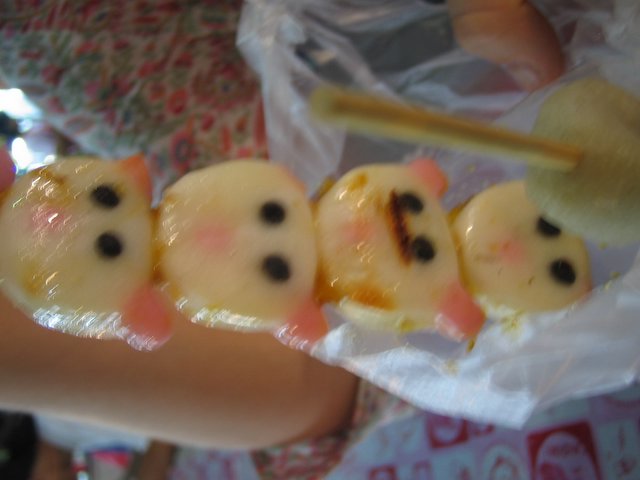
Although I’ve considered myself to be vegetarian for over ten years now, I did start to eat some fish in particular circumstances about five years ago. Being vegetarian in Thailand has saved me from many an unpleasant dining experience – I don’t have to worry about being served raw meat, processed fish shaped like mouse faces, or other such "delicacies." But I know that it has also meant that I’ve missed out on trying a lot of the local cuisine, which is very much meat-based.

On occasion, when far away from anyone who might recognize me, I do take the opportunity to try a little fish if it’s prepared in a special "local" way. In Laos, I tried some of Robert’s fish "laab" – minced fish salad with spices and herbs. Last April, I enjoyed grilled mackerel on the beach. And Friday night, one of the few parts of this weekend vacation that worked out, I enjoyed "fish steamed in bamboo", a local specialty of Chiang Saen town in Chiang Rai, while sitting at a little table overlooking the Mekong River after sunset. It was positively a delightful meal – also including sticky rice and spicy papaya salad – and despite the various disappointments of the weekend, I am still left feeling quite fond of the Mekong and its culinary offerings.

Tuesday, November 21, 2006

Vientiane -- A Relaxing Town


This is the tenth and final chapter of our Laos journey.

To complete our time in Laos, we spent one day in the capital, Vientiane (pronounced "Wiang Chan"). A pleasant city situated on the Mekong River, we found Vientiane to fit with the understanding of Laos we had developed over the week: similar to Thailand in many ways, but calmer and more expensive.

We spent several hours at the Lao National Museum, focusing on the exhibits that included English labels but paying some attention to the Thai and French as well. Most fascinating was the emphasis on the "greatness" of Communism and the strong antipathy towards the "American imperialists." After reading label after label decrying the actions of the United States during the 1970s – most of the strong language probably deserved, though not what I’d expect to find in a historical museum – I began to feel a bit uneasy about my own presence in the country. It was a strange – not fearful, but maybe a little guilty – feeling. I’m very glad we got to see it, though, because I think it was an experience I couldn’t have had elsewhere.

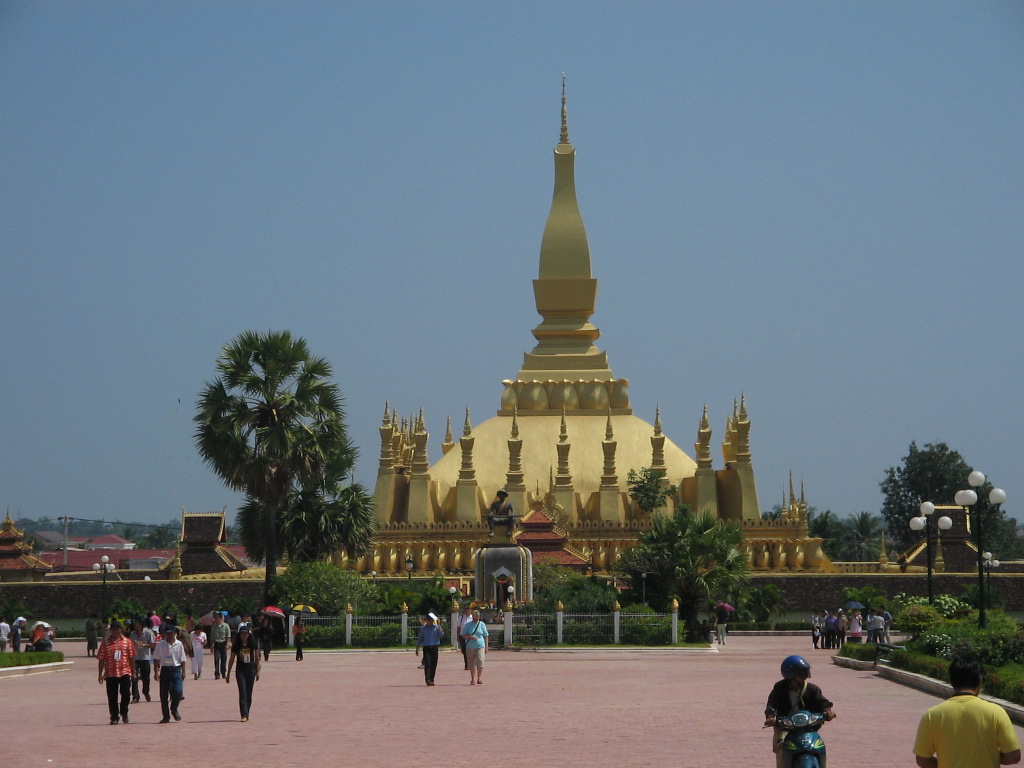
We also visited Laos’s most important temple, Wat Pathat Luang. The gold lotus glinting in the sunlight was hot, but it was fun to see a different design style than we usually find in Thailand. Two major tourists sites were enough for us for one day, though, so we spent the remainder of our time strolling the parkway along the river, eating baguettes, reading, and enjoying one last Beer Lao. It was a true vacation.

Thursday, November 16, 2006

A Day on a Laos Highway


This is Chapter 9 of our Laos journey.

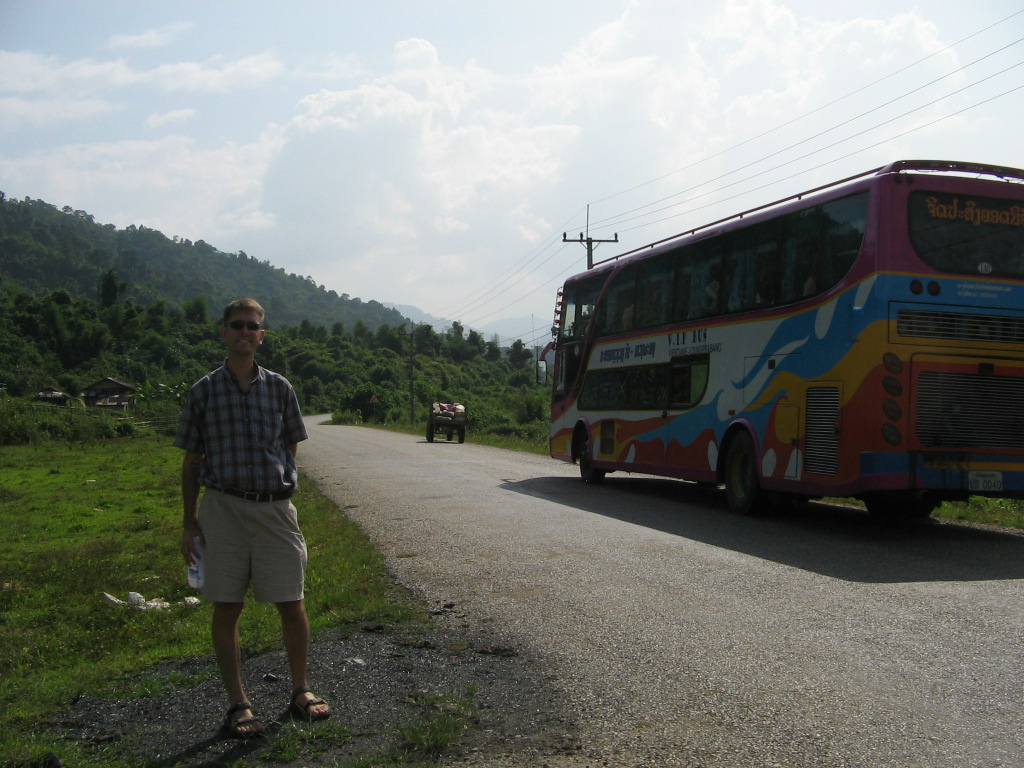
After two lovely full days in Luang Prabang, on Friday morning we boarded a "VIP" bus for the day-long journey to Vientianne, the current capital of Laos. Many people make this journey overnight, but I have to say they don’t know what they are missing. This bus ride – despite the occasional engine caught fire or delay at a police station – was one of the highlights of our trip, and as I sit at my computer several weeks later thinking back on Laos, it is those images we saw from windows of the bus that feature most prominently in my memories.

After leaving the city of Luang Prabang, the bus climbed high and then higher, and higher, and higher. Soon we were above the clouds – at least the low-level mountain clouds – and there we stayed, for five hours, winding our way very slowly and carefully along ridges. We’d look down into huge valleys, sometimes on either side, and marvel at the wildness of it.

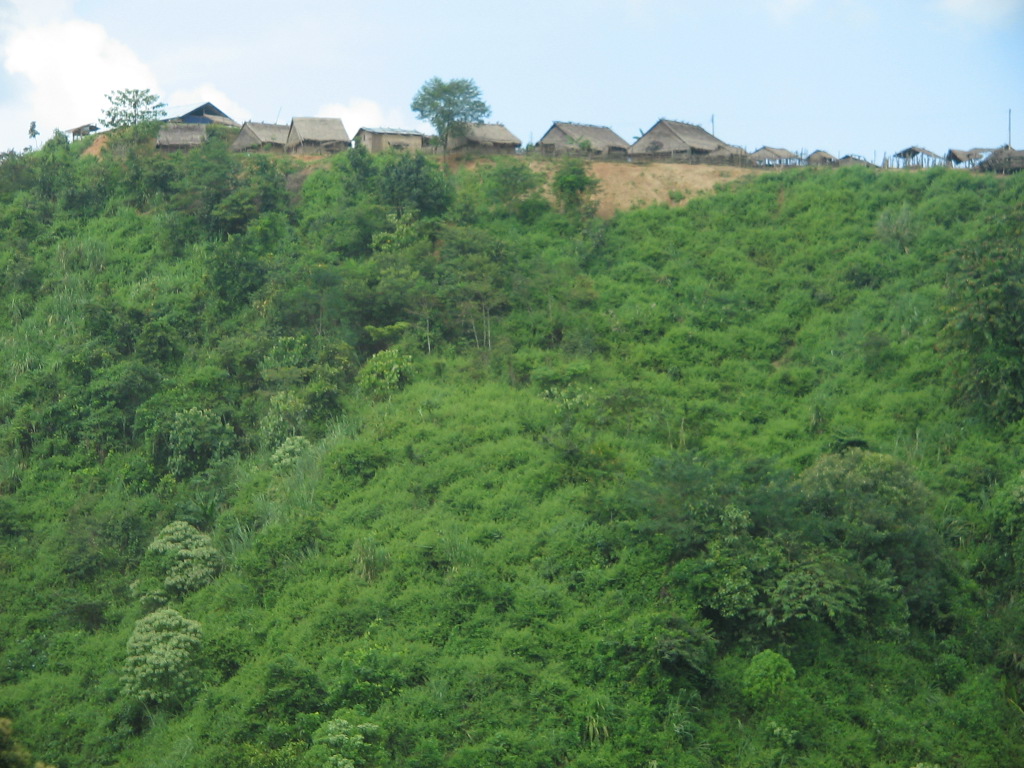
Every five to ten kilometers, we would pass through a tiny village. Thatched-roof houses were built right along the sides of the cliffs. A community water pump stood in the center of each village, and there we would see women washing clothes or children splashing. Mats covered with drying rice or chilies lay in the sunshine. Men, women, and children walked along the road, sometimes steeply uphill, with large bundles on their backs. Even though we were watching it all through the windows of a bus, I felt like we were visitors in another world. Upon a later reading of our guidebook, we learned that this area was "the heart of Hmong country" and the site of many rebel attacks over past decades. If there was one place in Laos I would love to have the chance to go back and explore, this would be it.

About halfway along the trip, the bus was passing through a lowland Lao village and suddenly swerved and hit a wagon. This resulted in a 3-hour delay, during which the three bus employees negotiated with the wagon owners, the police, and other interested locals. The tourists, meanwhile, wandered about and drank sodas. Finally, some money exchanged hands and we were free to leave again. We finished with the high mountain roads but continued to wind along lovely valleys and past tiny villages.

Pulling into the city of Vientianne at night was almost a letdown. We might have been traveling the main highway between two of Laos’s major cities, but it felt like the wilds of Southeast Asia to us.

[Most photos were taken through the windows of the bus, so please forgive any reflections or blurriness.]

Friday, November 10, 2006

Thoughts on the People of Luang Prabang


This is Chapter 6 of our Laos journey. There will be 8 chapters in all.

Our time in Laos was very short, and I don’t claim to be able to describe its peoples or cultures in any comprehensive way like I might about Thailand after being here nearly two years. However, we did make a number of interesting observations during our days in Luang Prabang.

Thailand, being 75% ethnic Thai (including Thai Lao) and 11% ethnic Chinese, has a relatively homogenous culture with some regional variation. National unity is strong, with few exceptions, and conformity is strongly valued. Other ethnic groups – particularly other southeast Asians – are often viewed with suspicion or even distaste.

In Laos, by contrast, only about 50% of the people are ethnic "Lao." The other half of the population is made up of more than 100 different ethnicities, including numerous Thai subgroups, hill tribes, Chinese, and Vietnamese. Although the groups are geographically separated, with the Lao primarily living in the flatter lowlands and other ethnic groups inhabiting the hills and mountains, society as a whole is much more mixed than in Thailand. During our short visit, we speculated that social conformity and unity are less important in Laos.

Economically, the people of Luang Prabang are at an interesting point. The city is geographically isolated – connected to other areas only by a small highway and the Mekong River. Tourism has brought about a recent boom, however, and entire streets and blocks are filled with guest houses and restaurants catering to foreigners. Although most of the city is still residential, it is obvious that tourism is rapidly increasing the living standards of a select group.

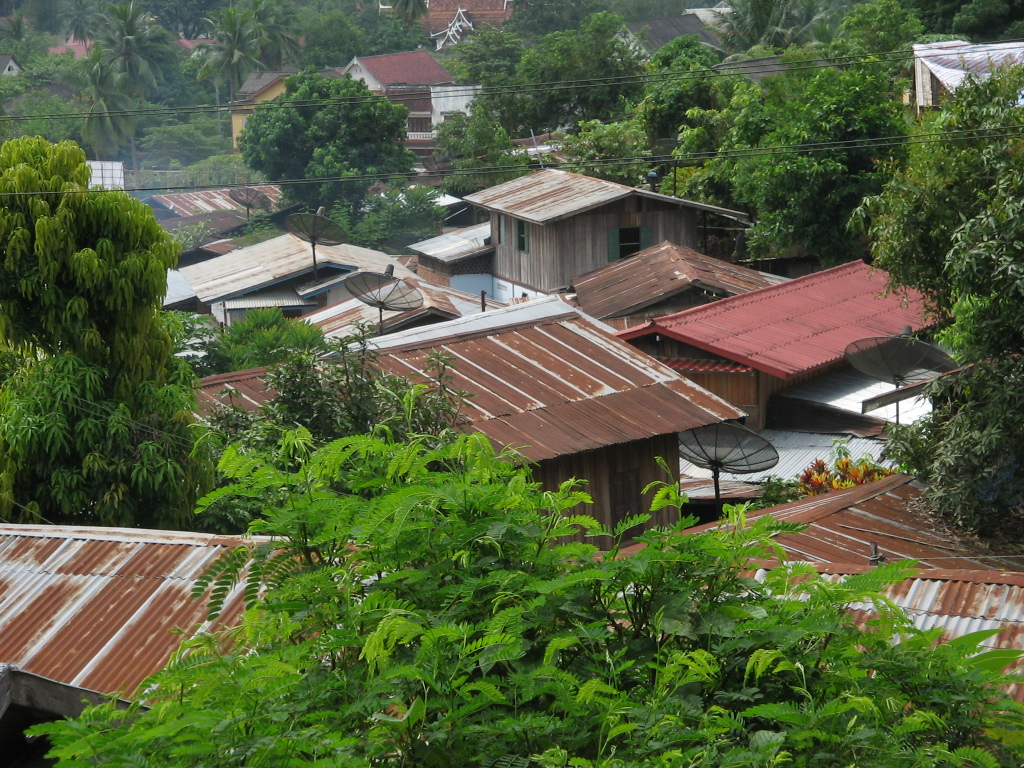
When we hiked up the hill in the middle of town, the path took us through a neighborhood of shabby houses and shacks. The people living there were clearly not wealthy, and their homes had few comforts. What nearly every house seemed to have, however, was a satellite dish. As we rose higher above the roofs of the neighborhood, we could see them poking up to the sky. What are they used for? As far as we could tell, to watch Thai TV. We saw many families watching Thai soap operas, commercials, and music shows. We even saw the Thai national anthem as it was played daily at 6pm.

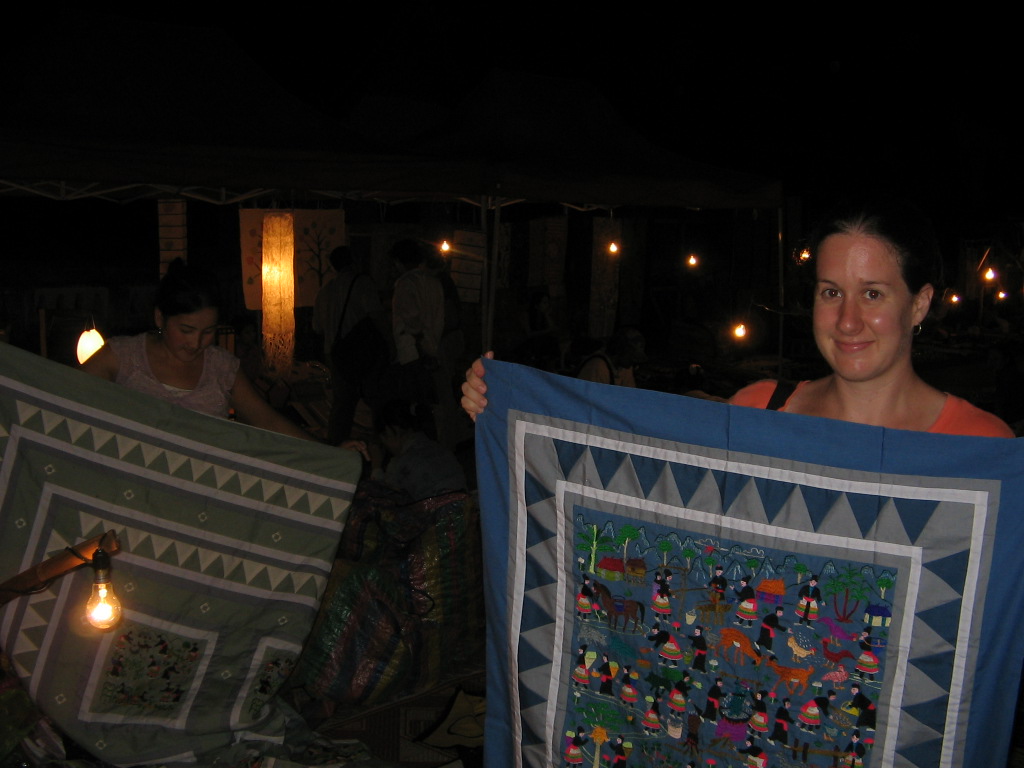
We were struck by the high cost of living in Laos as compared to Thailand. A plate of noodles that would cost 50 cents here was at least 75 cents there. At first we thought it was because we tourists and visiting mostly tourist areas. It became clear, though, that even the residents of Luang Prabang were paying the higher prices. We weren’t sure whether this was because tourism has inflated the prices of basic necessities, or because the isolation of the city means that those necessities are more scarce to begin with, though we were inclined to lean towards the latter explanation. By contrast, however, the price of souvenirs – silk scarves, hill tribe handicrafts, etc – was far cheaper than in Thailand. We were excited to make a few purchases for our future home in America!

Overall, our visit to Laos left us with many questions about its society and culture. I only wish we had more time to travel back and find some answers.


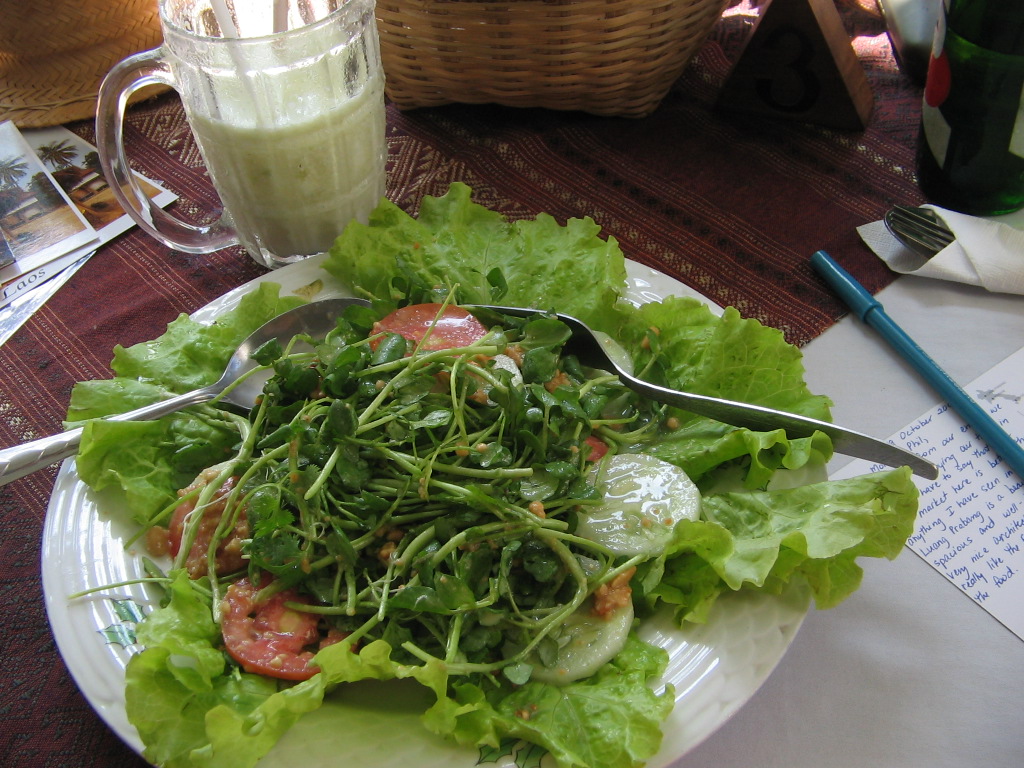
[The photo of the watercress salad is included to show more of the remarkably delicious local food – Lao with French influence – we were able to eat in Laos.]

Friday, November 03, 2006

Tourists in Luang Prabang


This is Chapter 5 of our Laos journey.

Luang Prabang, the former royal capital of Laos and a UNESCO World Heritage site, is set on the Mekong river and surrounded by wild mountains. French colonialism heavily influenced its architecture, and to our delight, its food as well. We had heard reports from other volunteers about its mellow avenues, riverside restaurants, tasty baguettes and strong coffee, and we had been looking forward to experiencing it all ourselves.

Our first evening, we dined on the river, enjoying a medley of local foods, sticky rice, and Beer Lao. A highlight of the meal was the "Salad Luang Prabang," made of watercress that grows along the river and a tangy dressing. We then retired to the Thavisouk Guest House, a pleasant place located in a residential area, away from the main tourist roads. We fell asleep feeling as though we were still floating along the brown waters of the Mekong.

Our two full days in Luang Prabang were spent strolling along its calm, clean, monk-filled streets and visiting a couple of temples. One site, That Chomsi, was situated high on a hill in the center of town. We walked up cool, shady paths, past old statues and stones, to find fantastic views from the top. The Royal Museum, with its gardens and art exhibits along with the usual treasures of an old kingdom, was another highlight. From time to time, we ran into fellow travelers from our two days on the boat, and one evening we dined with Ben & Young. Mostly, however, we just took our time . . . drinking fruit smoothies, writing postcards and journal entries, enjoying the feeling of not having to hurry anywhere or be "on duty" for anyone.

Aside from a few bumps, like Robert’s mild food poisoning that kept him from eating as many baguettes as I did over the course of the week and our realization that being tourists in Lampang was using more of our budget than expected, our days in Luang Prabang convinced us that travel as a twosome is something we ought to have more of in our future.

Tuesday, October 31, 2006

Mekong Slow Boat -- Day 2


This is Chapter 4 of our Laos journey.

We awoke early in Pak Beng after a fine night’s sleep to find that the river was literally underneath our window. We hadn’t noticed it the previous night in the dark. Fog was thick over the water and we watched as boat traffic started moving. After packing up, we walked outside and bought baguette sandwiches from stands along the road to last us through the day. Such luxury!

The second day on the slow boat passed much like the first, except that the scenery was even wilder and the seats more comfortable; due to engine trouble, we had been switched to another boat, much to our happiness. We spent many hours conversing with Young & Ben, a couple about our age who had been traveling through Southeast Asia for several months.

I continued to reflect on the small villages we passed on our way – their smallness, their evident poverty, and their isolation. I also began noticing the relatively large numbers of school-aged children present in the villages. It appeared that these kids were not attending classes of any sort. If they were dressed at all, it usually was not in a school uniform, and most of the villages looked too small to support a school anyway. In Thailand, the primary schools are often not much to speak of, but they do exist and most, if not all, kids attend. Seeing this different situation in Laos made me curious about other ways in which the two countries might differ, despite their physical closeness.

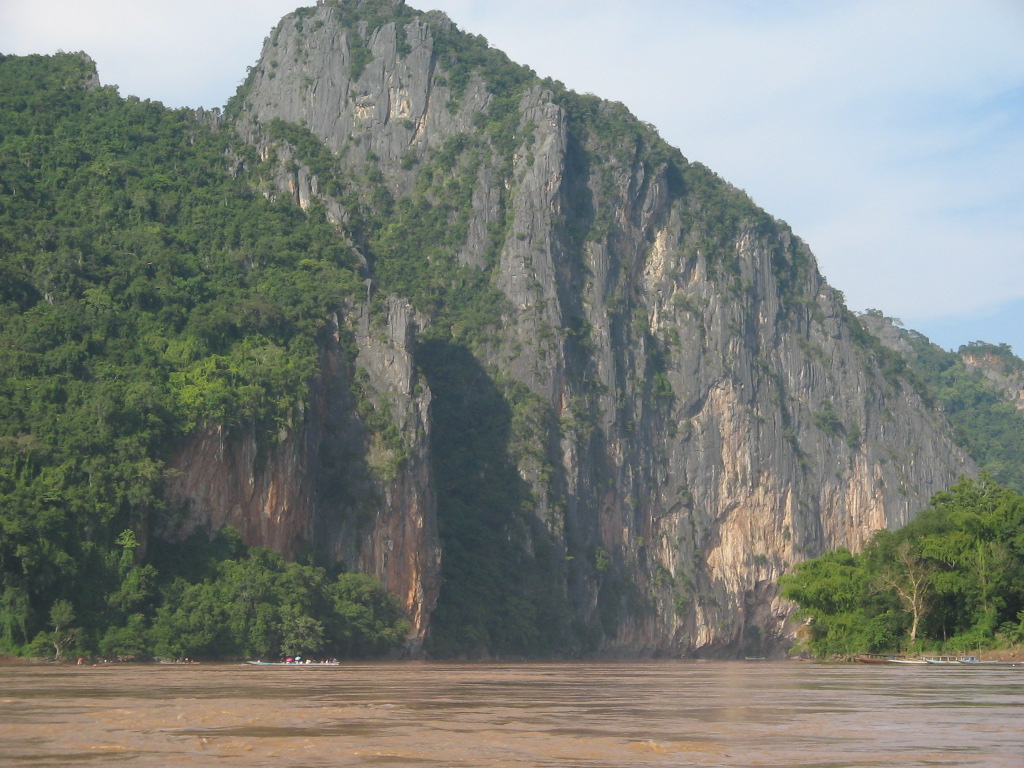
Shortly after 4pm, we turned a corner past some large cliffs and came to the town of Luang Prabang, the former capital of Laos. Although it had been a pleasant trip, we were glad to be off the boat at last and more than ready to settle in for a couple of days. We climbed into a tuk-tuk and headed off to our guest house.