Showing posts with label economy. Show all posts

Saturday, July 07, 2007

Personal Feature: The Family Next Door

I've written several times about our neighbors. We were surrounded by many good folks who looked after us during floods, storms, illness, and household maintainance. Some were very loud, true, but for the most part we enjoyed our living situation. The family next door was very important to us throughout our time in Thailand, so I'll write about them today.

Who lived there, just a few feet south of our windows? The list included Ann (red sweater, in photo), her husband Rat, their son Nong Dae, Ann's mother Moon (flowered shirt), her father Som, her nephew Lek, and her older brother Boon. That list varied from time to time, because Rat is in the military and was often off at his post, and Ann sometimes went to join him for a month or two.

Ann was just a year younger than me. She came over to introduce herself on the day we moved in, and was pleased that we would be neighbors. At that time she worked a low-level job at the school district office. Nong Dae was not quite a year old, and he stayed home with his grandmother during the days. But when he started walking and became too much work for his grandmother to handle, Ann quit her job and had to find new ways of making money. During the course of our two years in town, she tried many different projects: making crepes to sell on the street and at local events, taking in laundry, making roasted corn and eggrolls to sell in the town where her husband was posted, raising fish, signing up with Amway to sell household products and cosmetics to the women in town... (It's true, I became an Amway member while I was living in Thailand as a Peace Corps Volunteer. I bought the detergent.) She never seemed to be able to break even, though, and was often stressed about money and how to care for her family. When we left, she was about to start a bread-baking business. We sold her our oven for a very low price, and I tried to find some recipes on the internet that could be modified for Thai ingredients.

Rat was originally from northeastern Thailand. He was one of the nicest Thai men we ever met. He didn't drink alcohol and was quite devoted to his family. He and Ann met in Bangkok and were married several years ago. He was usually gone for 2-3 weeks at a time, and when
he came home he would do all sorts of household projects -- building fences, stairways, and other quality-of-life remodels. He worked hard and didn't get much rest.

We had many happy times with Ann & Rat. Our first Songkran in Thailand, they took us to the parade in town, and guided us home when the drunken teenagers got too rough. Our first New Years, they invited us over for a beer at midnight. We helped celebrate Nong Dae's second birthday, and watched him grow from a crawling baby into an active three-year-old with a strong personality.

This past New Years, we traveled with several Peace Corps friends to Pai, a town in Mae Hong Sorn province that is popular with tourists. It also happens to be where Rat is stationed, as it's near the border with Burma. Ann, Nong Dae, and Mae Moon were living with him at the time, so we were able to all meet for a day and do some touring together. The photo was taken at a park nearby.

There isn't much about life in Thailand that I miss, but I do think often about the people that we knew there. I wonder how they are doing, if Ann has managed to make any money, if Nong Dae has gotten bigger, if there is a threat of flooding this year.

Friday, May 18, 2007

McDonalds


Before I joined the Peace Corps, I lived in a great neighborhood in St. Paul, Minnesota. Within walking distance from my house I could find Thai, Nepalese, Vietnamese, Afghani, and Italian restaurants. If I hopped on a bus, I could reach Greek, Mexican, Kurdish, Cuban, and many more. I enjoyed being able to eat food from all over the world. I also enjoyed living in a city with a large immigrant population. I thought this spoke well of Minnesota – that motivated people could come from other countries and build themselves a new life there. And of course, those immigrants had no trouble finding food from their own countries, even there in St. Paul.

The term “globalization” is thrown around a lot these days, often in a negative way. Many people blame “globalization” for job losses in America, because American corporations often hire workers overseas to save money. Other people worry that “globalization” results in a loss of local culture, because more and more people adopt a common lifestyle or consume the same products.

When I taught social studies in Minnesota, I tended to side with these arguments. Living in Thailand and witnessing some of the other effects of “globalization,” however, changed my understanding of the term and its real-life meaning.

While I in no way would want a local culture to lose touch with the elements and traditions that make it unique, I think there’s also something to be said for the spread of positive behaviors and traits from one culture to another. For example, the idea that women have rights and should be educated has a very visible and, in my opinion, positive effect on life in Thailand. I knew many strong, smart women there who benefitted from this relatively new development, and I thought about it often when observing my female students.

The fast food industry is often held up as an example of the less positive effects of globalization. Both in American neighborhoods and in other societies around the world, fast food restaurants are a symbol of a rather sterile, homogenized environment, in which individuality and variety are replaced by standardization and sameness. I don’t frequent fast food restaurants in the United States, primarily because I don’t eat meat and I prefer healthier options (though I’ve recently discovered that Burger King makes a fine veggie burger, good for a quick meal during an airport layover). There are times, though, when there’s something to be said for being able to walk into a place and knowing what to expect. I’ve been known to choose Pizza Hut after a long day of driving rather then venturing into an unfamiliar neighborhood in search of vegetarian food.

I wasn’t sure what to think when I discovered that Thailand, particularly in the cities, has no shortage of American fast food. KFC and Dairy Queen are easy to find in almost any province, and select areas have plenty of Starbucks, McDonalds, and Sizzler to choose from. Did this mean that American culture was “invading” Thailand and displacing the locals? Were the Thais who ate at such places being “forced” to do so as a result of local economics, or were they doing it by choice?

Thomas Friedman writes in The Lexus and the Olive Tree that globalization involves both “push” and “pull.” He describes a Taco Bell in Qatar as being appealing to locals on account of its “clean bathroom, international sanitation standards, smiling service and quality controls – all at a cheap price they could afford.” Kentucky Fried Chicken in Malaysia was popular because it symbolized “modernity.” While McDonalds in Thailand was certainly more expensive than a typical bowl of noodles on the street, it was also cheaper than many of the full-service sit-down Thai restaurants I visited with co-workers during my two years. And it was, most of the time, cleaner. Local people around the world have their own reasons for choosing American fast food, and who is to say their reasons aren’t valid?

I consider myself a world traveler, and certainly a USA traveler. I’ve been lucky enough to visit lots of different places and cultures. I know I won’t have the chance to go everywhere, though. I’ll probably never get the opportunity to see Ethiopia, for example. Does that mean I should never have a chance to experience Ethiopian culture, on any level? I don’t think so... and fortunately for me, there’s a few Ethiopian restaurants right here in Seattle to choose from. Friedman quotes a Malaysian describing attitudes in her country: “‘Elites here say, ‘You should not have McDonalds,’ but for the little people, who don’t get to travel to America, they have America come to them.’” Perhaps its overly elitist for any of us to say that those “little people” shouldn’t have that opportunity if they want it.

When we were visiting Malaysia, one of our last nights in a quiet beach town we chatted with a family from Sweden. The parents talked about how Indonesian beach resorts had been “ruined” by the arrival of tourist-oriented business, including fast food, and how they expected Malaysia to go down the same path before too long. I agree that serious efforts should be made to keep beautiful natural places from being spoiled by uncontrolled development. At the same time, those of us who are wealthy enough to go on vacation at beach resorts ought to recognize that other people have the right to improve their own economic situations, and perhaps they see starting a McDonalds franchise as their best opportunity for doing so. Do we deny them that opportunity? Friedman writes, “[Fast food franchises] proliferate because they offer people something they want, and to tell people in developing countries they can’t have it because it would spoil the view and experience of people visiting from developed countries would be both insufferably arrogant and futile.”

In summary: globalization is maybe not all bad.

Monday, April 23, 2007

What's Inside...


Way, way back, during our Peace Corps training, one of our Thai training directors commented on the sad state of Thai education. “I see schools spending huge sums of money to have a beautiful sign made,” he said. “But when you go inside the school, there’s no teaching going on. I think this is what needs to change in Thailand.” We were still idealistic at that point, and didn’t know how hard it was going to be to promote “student-centered learning” in Thailand. But the comment stuck with us, and two years later in Minnesota, I’m still thinking about it.

Much of Thai society operates this way. A gleaming structure is beautiful to look at but has nothing of substance inside. A student from a school wins numerous awards, bringing honor to the school, but none of the other kids in his class can read. A shiny new airport is built at the cost of billions of dollars, but the runway is on top of a swamp and starts to sink. A ceremony is held for a new library, but there’s no books inside that kids actually want to read. Where is the thought? Where is the deliberation? Where is the meaning? Where is the real benefit?

This photo shows me sitting with three neighborhood kids outside the local elementary school in our training village. From the sign, and perhaps even from the nice plants behind it, you’d think that this school is a well-run, attractive spot, probably with some good education happening inside. In reality, class sizes were in the 40s and kids had few materials. Teachers often didn’t show up for class. And this was one of the better-run public schools that we saw in Thailand.

It’s often said about Thailand that the people there value social harmony and evenness. They don’t like having debate, disagreement, or anything that isn’t “beautiful.” (“Beautiful” was one of the words we heard most often in Thailand, right after “delicious.”) While this has its benefits, it also has some drastic consequences, because circumstances or situations that should be challenged are not. Airports are built on swamps, and teachers go shopping instead of teaching.

I’m now reading The Lexus and the Olive Tree by Thomas Friedman, a book published in 2000 about globalization. My understanding of globalization is vastly different after two years in Thailand than it was before I went, and I’ll probably have several blogs on this topic. I chose to write about the school signs today, though, because of a particular quote in the book. While discussing the Southeast Asian economic crash of the late 1990s, he writes, “[The SE Asian countries] had replicated the outward configurations of the Western financial systems, but in many cases in was replication by rote. There was something missing inside.” In other words, while Thailand and other countries had appeared to transition to a free-market economy, in actuality there was no substance behind the change, and the transition failed. The fancy sign was on display, but no teaching was going on.

Monday, March 26, 2007

Chinatown


On Sunday, we visited Bangkok's Chinatown with our old Thai language instructor, Pi Lin, from Peace Corps training. Her family is Chinese and lives near Chinatown, so she was able to show us around and explain everything. It was my first time touring a Chinatown, and very fascinating.
We visited two major temples, and we learned that Chinese Buddhism has some differences from Thai Buddhism. For example, Thai Buddhism has just one "Buddha" god, but Chinese Buddhism has many, of which some have female attributes.
The second wat we visited was extremely smoky because so many people were burning large handfuls of incense sticks as they walked around. It made our eyes tear up!
Pi Lin also walked us through several lanes of market stalls. Since it was probably over 100 degrees F yesterday, this was very hot, but at least they were mostly shaded. It was cool to see the different kinds of food -- fish stomachs, large ocean worms, dozens of varieties of teas and mushrooms -- and multi-lingual signs. I recommend Chinatown to anyone who wants a new southeast Asian experience!

Saturday, February 24, 2007

Organics


The Germans are lucky! Because of Europe’s rules about agriculture, pesticides, and imports, many Thai farmers or food producers who use organic methods are able to export products there. Organic farming is still not too common in Thailand, but those who do it are able to make a nice little profit.

When we lived with our host family in central Thailand, with our developing Thai language skills we were able to discover over a number of weeks that they participate in the export economy. Our host father owns 23 fields of baby corn, grown organically. Every day, truckloads of corn are harvested and brought in a pickup truck to the front of the house. Workers from the surrounding houses come to peel the corn by hand, earning a wage of 2 baht per kilo of peeled corn.

After the corn is peeled, our host parents sort it into three categories: beautiful, less beautful, and not beautiful. Kun Por drives the beautiful corn up the road to the packing plant every evening. The less beautiful corn is sold in Bangkok markets. The not beautiful corn is eaten at home.

We visited the packing plant several times, which was fun. We got to see all the different organic vegetables grown in the area, including asparagus, okra, and chilies. We also watched as the workers used special hand machines to wrap the properly arranged corn in plastic. We were told that the final product is shipped primarily to Japan and Germany.

Last week, we had three trainees from the newest group of Peace Corps Thailand volunteers come to stay with us for a couple of days, to see what the life of "real volunteers" is like. We took them to visit some local income generation projects north of our town, including the dried banana operation that we saw last November. The bananas had been temporarily displaced by huge piles of drying ginger, which smelled absolutely fantastic. The ginger is grown organically in another northern province, then purchased in bulk and brought here. The ladies in the photo are washing every piece by hand before it is sliced and laid out to dry in the sun. Our guide told us that, indeed, it will be shipped to Germany! I say again, those Germans are lucky!

Wednesday, February 21, 2007

Doi Pui (Bai Tiow Part II)


After leaving the wedding on Saturday afternoon, we headed out with our landlords for some sightseeing. For about a year, they had been talking about wanting to talk us up into one of the higher mountain villages that dot the north of Thailand. Finally, we had our chance. We headed up past Doi Suthep (overlooking Chiang Mai city) to the Hmong village of Doi Pui,

Over past decades, the royal family of Thailand has sponsored a number of sustainable development projects in northern hill tribe areas. The general goal is to encourage hill tribes to move out of the opium trade and into safer, healthier economies. Doi Pui is one such example.

Up in the village, we visited the small museum and looked at some traditional artifacts and tools. We took photos in the opium gardens. We purchased handicrafts from several of the stalls along the windy roads. We admired the waterfalls.

We opted to skip the opportunity to pay 60 baht to dress up in traditional Hmong clothing for our photos in the gardens, however. Although it was clear that Doi Pui was managed and operated in a sustainable manner by the residents of the village, and not by the Thai government, we felt awkward about some of its elements. At one point, Ajaan Warangkana pulled me into a small structure where a tour group was listening to their guide explain what they were seeing. It seemed to be a replica of a house, and the English-speaking guide was pointing out the various spaces – sleeping area, cooking area, meat smoking area, etc. I couldn’t see much so I just translated the descriptions for Warangkana. When the group moved away and I was able to see inside, however, I realized that it was a REAL HOUSE CURRENTLY IN USE BY ITS RESIDENTS. A woman was cooking. Two kids were lying on a bench watching TV, surrounded by some very used-looking blankets.. Clothes were hanging on the line to dry. There we were, tourists, in someone’s real home. It was a very strange feeling, and Robert and I agreed that we wanted to quickly move back outside.

We couldn’t decide how we felt about the experience overall. On the one hand, in our position as tourists we were clearly supporting the economy of the village. I know that this kind of tourism can in many cases help communities to preserve their traditional cultures, because doing so has an economic benefit. On the other hand, at times it felt a little bit like walking through a zoo, except that the zoo had people instead of animals. I don’t feel comfortable seeing my fellow human beings this way.

As a Peace Corps Volunteer, I’ve had the opportunity to be part of "the real thing" while living in Thailand. I don’t just walk around like a tourist, looking at people’s culture and admiring or analyzing it. No, I’m living it, and wow, it’s real. All the good and bad parts mixed up together for two solid years. Nothing like the guidebooks.

We can’t all have this opportunity, though, and even I will probably only have it with a limited number of communities. (Our trip to Laos was clearly tourism-focused, but highly educational.) And certainly it must be better to have some exposure to other cultures, as a tourist, than to have none at all. Perhaps the best way to look at this issue is to say is that if I could learn something from the experience, and use it to be a better citizen of the world, then it has a value beyond its local economic benefits. And perhaps that’s good enough for me.

Tuesday, February 06, 2007

Dry Season


Thailand has a 3-season climate. The hot season, with daily temperatures above 100F and nights rarely cooler than 85F, lasts from approximately March-April. Rainy season begins in June, in the north, and goes through September or October. Temperatures are still hot, but more bearable because of the cloud cover.


We're now in the dry season, or cool season as it's also known. It hasn't rained in our town since October. This year is unusually cold, and it's gotten down to 50F almost every night since mid-December. This is very cold if you don't have indoor heating!


The rice was harvested back in November in our area, and many of the fields are lying fallow until the next planting cycle, as shown in the brown-ish colored photo. Others are irrigated to grow other crops, including broccoli, potatoes, and tobacco. These two photos show the fields on either side of the road to my Monday-Thursday school. You can see how irrigation makes quite a difference!

Saturday, February 03, 2007

Charity, Service, and Giving


Yesterday we attended a couple of ceremonies thanking the American Chamber of Commerce for their donations to two local schools, including one at which I co-teach. The 2005 flood destroyed the school’s library, and the ACC, with some individual and business partners, gave 60,000 baht (about $1500) to help buy new books and furniture. The event gave Robert and I a number of topics to discuss over dinner.

One thing Robert observed, considering yesterday’s event and other opportunities we’ve had to see charitable organizations in action, is that charity seems to work best when it’s designed close to home. World Vision, which I described in an earlier blog, has an office located right in our town and staffed by local people who know exactly what the needs of the community are. As a result, it’s extremely effective at using its available resources to target real needs for the students.

The ACC donation was a joint effort between local school staff and ACC staff in Bangkok. Our principal, realizing a need for library improvement, requested a grant, and American Chamber of Commerce provided the funds. School teachers then used the money to order books, furniture, and supplies. I would like to say that this was also an example of effective targeting of needs, however, in my opinion (which is just, of course, my opinion), while a school library is essential, many of the books purchased with the money are actually not suitable for young children or middle schoolers. But that’s just a small quibble.

Our Peace Corps project is an interesting subject. After spending nearly two years in our town, in schools with students, I have a pretty good sense of what their needs are. I would prioritize education about sanitation, health, nutrition, and life skills (critical thinking, decision-making), especially those that are effective in HIV prevention. English teaching would be near the bottom of my list, after math, Thai, and geography. I have frequently attempted to move in a few different directions. But, the Thai Ministry of Education, located hundreds of miles away in the tall buildings of Bangkok, determines our project goals, and they prefer that we teach English. The teachers have to conform to official requirements. And so we do.

Then, of course, there are the heavily funded and not necessarily effective organizations such as UNICEF that seem to spend lots of money on conferences and fancy cars for select groups of people, with little benefit trickling down to local communities. I can’t say that I know a lot about this, as I haven’t witnessed it first-hand, but I do know that a fancy car for NGO staff doesn’t do my kids a whole lot of good.

What does all this mean? I suppose those of us who give to charity just need to try to make sure that our money is being spent as we intend it to be, to the best of our ability. Sometimes there isn’t much we can do – if local school teachers decide to purchase boring Thai history books without any pictures with their library funds, against the recommendations of their Peace Corps Volunteer, you have to let it be. But I do think that most of us like to think that our money is not being wasted.

Which brings me to my final point. As a line of students was coming forward to receive their free notebooks and pencils from a computer company, the Thai woman next to me – an employee of the Office of Basic Education Commission – turned to me and said, "I don’t understand why foreigners give money to Thai school children. Why don’t rich Thai people do the same thing?" The woman in front of her, a Thai employee of the ACC, turned around and agreed. I wonder it too. I have heard that this is typical of Asian societies: providing assistance or charity to one’s own family is acceptable, even expected, but aiding strangers is seen as downright strange. What is it about Americans – and other classes of foreigners – that makes many of us want to reach out to people we have never or will never meet, to share a bit of what we have? A recent study found that American charitable giving correlates not with political affiliation or liberal/conservative ideology, but with religious participation. Is there something about religion in America that encourages us to be charitable? And why isn’t the same true in Thailand? I have my own ideas... but I’ll save them for another time.

Thursday, January 11, 2007

Sponsorship


Before I say anything, let me emphasize that this is NOT a sales plug! My goal is just to inform.
Back in the USA, I often saw commercials on late-night television for charitable organizations of one sort or another, trying to convince viewers to sponsor a child in a third-world country. I never really bought into those things, because who knows where the money ends up?
But as it turns out, there is an office of the Christian organization World Vision here in our little northern Thai town, and they do a lot of good work. At my Monday-Thursday school (pictured), all of the students are sponsored by families through World Vision. At my Tuesday-Friday school, about two-thirds of the students are sponsored.
What does this mean for my kids? Every year, World Vision buys their notebooks, pencils, and other basic supplies. World Vision pays for their school uniforms. If you look closely at the boys' black and orange jackets, you'll see that they have a World Vision label -- the sponsored kids sometimes get additional items of clothing for certain types of weather. World Vision buys books and sometimes even furniture for the school library and other rooms. Last year, when my Tuesday-Friday school was extensively damaged by the flood, World Vision paid for many replacement items.
Additionally, World Vision will occasionally pay for a field trip for the students. Last year I went with 6th graders from six different local schools to a number of sites around our province, with all fees, transportation, and meals paid for by World Vision. They give scholarships to several students every year for study at high schools in our provincial capital. And, my co-teacher informed me today, they hold a World Vision football (soccer) competition every year.
I'm not trying to convince anyone to sponsor a kid through World Vision. However, I did want to point out that if anyone was considering doing so anyway, I can vouch that it really does work!

Friday, December 01, 2006

Hitchhiking!


Earlier this week, I made reference to our disappointing travel over last weekend. Perhaps I spoke a little too strongly in referring to it as "calamitous," because we got several concerned inquiries from home wondering what happened. I have now edited out that wording, and I will explain a bit more about why we felt it wasn’t our best travel weekend ever. Please know, though, that several days later we have pretty much forgotten all about it!

Thailand is at a fascinating developmental stage, in which large numbers of the population live in poverty – including a majority of the students we teach – while large numbers also live very well, in fact, quite comfortably compared to the United States. In addition, Thailand’s huge tourist industry has quite an impact. Most tourists, of course, are quite wealthy compared with most Thais, and they pour lots of money into the economy.

Our Peace Corps living allowance is designed to enable us to live at the level of the people in our community, in particular the people with whom we work. What this means practically, for us, is that we are much wealthier than the families of most of the students we teach, but nowhere near as wealthy as the teachers we teach with, except the very young teachers who have just started in the civil service. We are "poor" compared with the tourists, even the backpackers, which occasionally causes frustration when we travel because Thai people expect us to have bottomless pockets of cash like the other foreigners they have encountered.

In any case, the area we traveled to last weekend – the Golden Triangle area in northern Chiang Rai province – is not designed for people with limited budgets. We had assumed that, like most places in Thailand, we could use local transportation to make our way between destinations for an affordable price. As it turns out, it’s not worth visiting that area unless you have 1) your own vehicle, or 2) a large budget, useful for renting vans and chartering songtaews. Even the Thai tourists we saw traveled almost exclusively in rental vans, hired complete with driver. Public transportation was infrequent and difficult to find.

As a result, we spent more money than we had planned on last-try transportation, including an extra 100 baht apiece for a "VIP" bus that we hoped would get us to a particular destination on time but didn’t. We walked at least 3 kilometers along highways, not in itself a long distance but one that feels considerably longer when you are walking in the sun with a large backpack on your back. We skipped a couple of meals. And we "hitchhiked" twice, once in the back of a pickup along the Mekong River during the day, and once in the back of a station wagon on the highway back to Chiang Rai at night. And for all that, we never did reach our primary destination: a Chinese mountaintop village.

But, six days later it doesn’t seem as bad as it did then. We did enjoy the Hall of Opium museum, the shiny statues at the Golden Triangle, and of course, our dinner by the Mekong. And we got to see a nice fat rat digging through our bags in the middle of the night at our guest house in Chiang Saen. (Avoid Gin’s House unless you want a similar experience.) So, unpleasant though much of it might have been at the time, I think it will make a good story someday!
[Note: Robert says it was not really hitchhiking because we didn't flag these cars down. We just looked pitiful and they offered assistance, which we accepted. But I think "hitchhiking" sounds more exciting than "accepted help."]

Tuesday, July 04, 2006

Pineapple Glut


You know you’re living in a tropical country when...

As you exit the windy road through the mountains and ride along the west side of our valley, you can look out the window of your vehicle at hills covered in pineapples. Actually, you can just see the sprouty tops, because the fruit grows underground. These hills are very pretty, but even though I came to Thailand anxious to eat lots and lots of fresh pineapple, I’ve had more than my fill lately.

Apparently, pineapple growing was so profitable in our province for a while that many people started growing it who hadn’t done so before. As can be expected, the supply has outgrown the demand. About a month ago there were protests in our provincial capital by farmers claiming that the government owed them money for having grown all this pineapple. I don’t know all the details, but I do know that the governor, anxious to stop the protests, agreed to buy the pineapple from the farmers at the price of 80 satang per kilogram.

Now, 80 satang per kilogram is pretty much nothing at all. There are approximately 40 baht to the dollar, and 100 satang to 1 baht. So, 80 satang comes out to be about 2 cents. 2 cents, for 2.2 pounds of fresh pineapple. But even at that rate, and even with the primary schools taking advantage of the low price and buying it like crazy, they still can’t sell all the pineapples so they’re being thrown into big holes. (This is the story I am told.)

Last Friday at our English camp, lunch included stir-fried pineapple for the main course, with fresh pineapple for dessert. I felt a little high on sugar by the end of the meal! The teachers were surprised that I wanted to take a picture of pineapple. They were even more surprised when I explained that it’s a very expensive fruit in the United States.

(Other food items in the photo include red curry, rice and rice noodles, and fish sauce with chilies.)

Monday, May 22, 2006

Big C


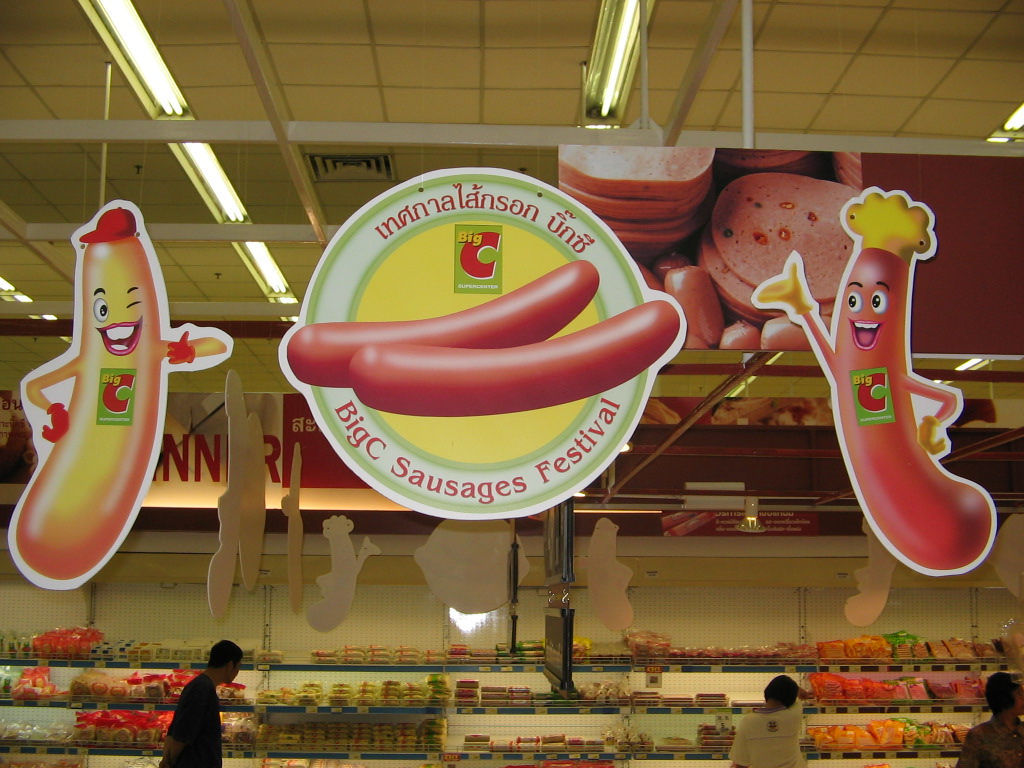
On Saturday we visited Big C. It’s kind of like Target, but on a super-sensory, Thai-style level. We go there about once a month to stock up on supplies not available in our town, like raisins, cheddar cheese, Energizer digital batteries, and internet cards.

A typical day trip to Big C, including preceeding and follow-up events, looks something like this:
Sleep in, go for a jog, eat breakfast and shower. Walk to the town bus/songtaew stop. Wait for a vehicle to depart. Ride over many hills and around many curves until arrival in the city. (Usually, Robert looks out the window while Kate reads a book.)
Upon arrival at Big C, to settle the stomach, head for the cash machine and then the lunch counter. Eat a quick and cheap Thai lunch. Attack the aisles, trying to avoid the massive display piles, the young women advertising various products with loud stereos and megaphones, and the crowd of teenagers clustered around the skin-whitening deodarant selections.
After forking over a large portion of PCV monthly stipend (peanut butter is expensive here!), head down the escalator for a recovery stop at the DQ, where mini-blizzards are available in all the usual flavors for less than a dollar. Walk with ice cream out to the parking lot, where a songtaew will be waiting for a full complement of other commuters. Ride that songtaew to the songtaew stop for our town, board it with all the bags of groceries, and ride for another 80 minutes or so to the gate of our house.
Upon arrival at home, lie on the bed for at least 20 minutes to get over car-sickness or songtaew exhaust poisoning before starting to make dinner. Enjoy a relaxing evening that includes at least one food purchase from the day!

Thursday, April 20, 2006

Unwanted Luxury

One of the things we haven't been able to understand about Peace Corps Thailand is why, when we have official conferences and trainings, they insist on putting us up at the most expensive hotels in town. We arrived in Bangkok yesterday (yet again, we're so sick of this city!) for our Mid-Service Conference. All the Volunteers who came to Thailand with us will be gathering this weekend and next week to evaluate where we are at and what we would like to do during the next eleven months. When we got to our hotel -- primely located along the banks of the Chao Praya river -- I was a bit taken aback by the level of luxury and service in the lobby area. In fact, I felt rather out of place in my sweaty travel clothes. Our room is less ostentatious, but unnecessarily fancy all the same. (Do we really need hand towels AND finger towels in the bathroom?)

While we enjoy luxury, and don't usually have much access to it in Thailand (though we're comfortable enough in our town, despite the heat), we don't think that this is a good use of Peace Corps resources. It also often has unpleasant effects on us. For example, the laundry prices at the hotel are sky-high. We had originally hoped to wash clothes frequently, so we packed light for this 12-day expedition (we're also hitting the beach one more time after the conference ends). But, because washing one pair of Robert's pants at the hotel costs 110 baht (about 5 meals), we'll have to change that plan. I think I'll do a lot of laundry in the sink -- something I had hoped to avoid.

We Volunteers would be comfortable enough at a less expensive hotel. We have stayed at several of them in Bangkok, so we know they exist. It's as though the Peace Corps wants to impress us -- and the guest speakers at the conference -- so they pick the fanciest place possible. I would be embarassed if the people in our town, the students in my schools, saw me at this hotel. We try hard to keep a low profile up north -- to not act rich, to not have a lot of expensive possessions, to live simply. Spending a week in ostentatious luxury makes me question the goals and activities of Peace Corps as an organization even more than I already do.

Saturday, March 11, 2006

Potato Pickers


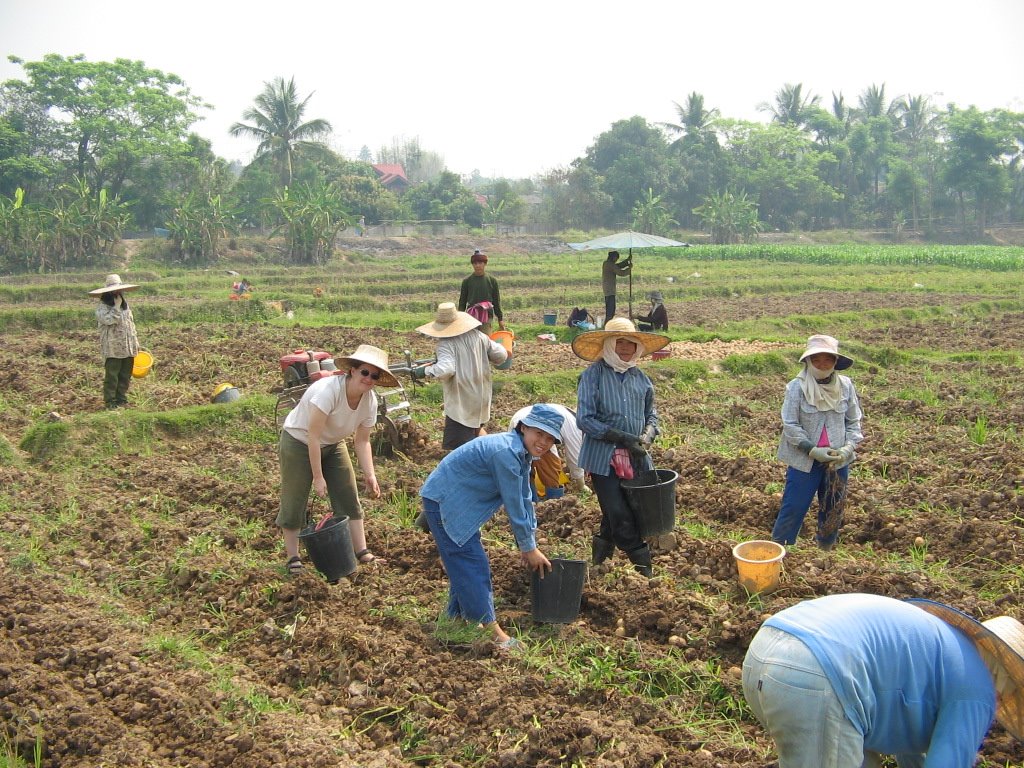
One of my goals in Thailand has been to join in some farming activities. How could I say I had really been here otherwise? Yesterday I finally got my chance.

Rice, of course, is Thailand's staple crop and staple food. A majority of the fields around our village are rice fields for a good portion of the year. But after the rice is harvested in November and December, potatoes are planted. Potatoes, being a "New World" food, are clearly not indigeneous to Thailand. However, with increasing globalization comes Western snack food, and Thailand is now full of potato chips. We can buy Lays not 20 feet from our front door.

This month the potatoes are being harvested. They aren't sold in the markets in our town, but are sold to Lays and other chip factories a couple of hours west. One of my co-teachers, Waewnapa, lives in a house bordering the fields a few kilometers north of our house. We rode our bikes up there in the morning and spent a little over an hour helping to pick.

It was a fun process -- as observed by someone who only had to do it for one hour, of course, as a full day's labor I'm sure it's backbreaking. A machine called a kuboda (not a Thai word) was operated by the owner of the field. It turned the rows of potatoes inside out, so that the potatoes were lying on top of the dirt instead of underneath. The pickers (paid 100 baht per day, or about $2.50) followed behind with buckets, gathering all the sellable ones and discarding the rest. (Rotton ones were tossed to the edge of the field, while ugly but edible ones were put into pockets.)

You might notice the difference between the Thai people's clothing and the foreigners'! Thai people don't like the sunlight because it makes your skin darker, so they wear multiple layers to make sure that no skin is exposed. I would wilt in one of those outfits after 15 minutes, so I compromise with a t-shirt (must cover shoulders) and mid-length pants. The hats were lent by my co-teacher's mother, and although I first hadn't wanted to wear it, I realized quickly that it was very useful. The Thai women were very concerned about my white skin turning dark in the sun, but I assured them I had put on plenty of "cream." They seemed a bit skeptical.

In the photo on the left, the mountains are nearly invisible because of the heavy smoke in the air that I mentioned in an earlier post. In the photo on the right, Waewnapa is dressed in blue next to me in the field.

At the end of the morning, everyone broke for lunch. We rode off with a large back of potatoes in my bicycle basket. Last night's dinner was baked potatoes, canned baked beans, and salad!