Showing posts with label temple. Show all posts

Tuesday, May 01, 2007

Reflections on Buddhism and Peace Corps


Today Robert and I attended a discussion of The Tibetan Book of the Dead (TBD) at my father’s church. I don’t know much about Tibetan Buddhism, but I did live surrounded by Thai Buddhism for two years, so it was interesting to share perspectives and make comparisons.

In a nutshell: The TBD was probably first created around the 7th or 8th century AD. According to the introduction in our translation, it is read to a dying person as they are making their exit from this world. The book describes the challenges they will face as they transition towards either nirvana or reincarnation, and attempts to help guide the person towards a meditation on nothingness, or enlightenment. (Forgive any glaring errors in my summary; as I said I am no export!) It is clear from the text that enlightenment is the preferred outcome, but also that it is very difficult to attain, and made even more so by the karma that the person has earned during their life.

Robert and I had many discussions about our experience with Buddhism while we were in Thailand, especially in comparison with our own background and experience as Christians. What most stood out to us, consistently, was the Thai Buddhist preoccupation with making merit by giving to the temple in order to store up a good account for the next reincarnation, or afterlife, in contrast with our modern Catholic/Episcopal traditions of social justice here on earth to make life better for other humans, with faith that we’ll be in heaven after this life.

In other words, the Thais that we met were concerned not with the plight of fellow humans, but with their own next life, which was unrelated. In fact, Buddhism says that to ignore worldly concerns is the way to attain enlightenment. We, as Christians, have faith that we don’t need to worry about life after death – that’s already been taken care of, more or less, by the resurrection of Jesus – and we are encouraged to go out and do good works in the meantime. Although many Americans are not Christian, I nonetheless think that the constant desire and motivation for personal and societal improvement that is part of Christianity is also part of modern American culture.

I think that this opposite worldview, as evidenced by a comparison of religious traditions, had a direct impact on our Peace Corps experience. Robert and I were motivated – by a variety of factors – to want to do the best that we could for our students, most of whom we saw as the less privileged members of society in terms of their poverty and lack of opportunity. We saw improved education, health awareness, and access to advanced skill development as the best ways of helping our students. Our Thai counterparts, on the other hand, did not show much interest in these issues. In their worldview, the students were born into their current status, and a focus on change or improvement was an unnecessary distraction. This is not to say that they didn’t want to help the students at all; I knew many of good teachers who wanted their students to be able to read, write, do math, and brush their teeth properly, out of a genuine concern for the students’ well-being. But if the goal changed from maintenance to improvement, most of the Thai educators we knew lost interest.

Disclaimer: This blog entry is not intended to be a criticism of Buddhism. It is merely a reflection on how religion might influence one’s worldview and desire for improvement.

Wednesday, December 20, 2006

Wat Arun


Our friend Leah is visiting us here this week and on Monday we had a pleasant day in Bangkok. The weather wasn't too hot and though we were all tired from our 2am return from the airport, we managed to keep our energy going until after dinner.
As our 15th visitor, Leah knows we've spent lots of time showing family and friends around the major sites of Thailand. She offered to forego a few of the tourist "highlights" so that all three of us would be able to see something new, so we chose Wat Arun, the temple that is featured on the 10-baht coin. We had gazed at it across the river many times and it always looked appealing.
Wat Arun is a Khmer-style wat, and the biggest surprise was realizing that the grey towers we had seen so many times from a distance are actually, when viewed up close, composed of thousands and thousands of tiny colored ceramic pieces. Here are Robert and Leah in front of one of the multi-colored structures. The Chao Praya river and Grand Palace temple are in the background.

Tuesday, November 21, 2006

Vientiane -- A Relaxing Town


This is the tenth and final chapter of our Laos journey.

To complete our time in Laos, we spent one day in the capital, Vientiane (pronounced "Wiang Chan"). A pleasant city situated on the Mekong River, we found Vientiane to fit with the understanding of Laos we had developed over the week: similar to Thailand in many ways, but calmer and more expensive.

We spent several hours at the Lao National Museum, focusing on the exhibits that included English labels but paying some attention to the Thai and French as well. Most fascinating was the emphasis on the "greatness" of Communism and the strong antipathy towards the "American imperialists." After reading label after label decrying the actions of the United States during the 1970s – most of the strong language probably deserved, though not what I’d expect to find in a historical museum – I began to feel a bit uneasy about my own presence in the country. It was a strange – not fearful, but maybe a little guilty – feeling. I’m very glad we got to see it, though, because I think it was an experience I couldn’t have had elsewhere.

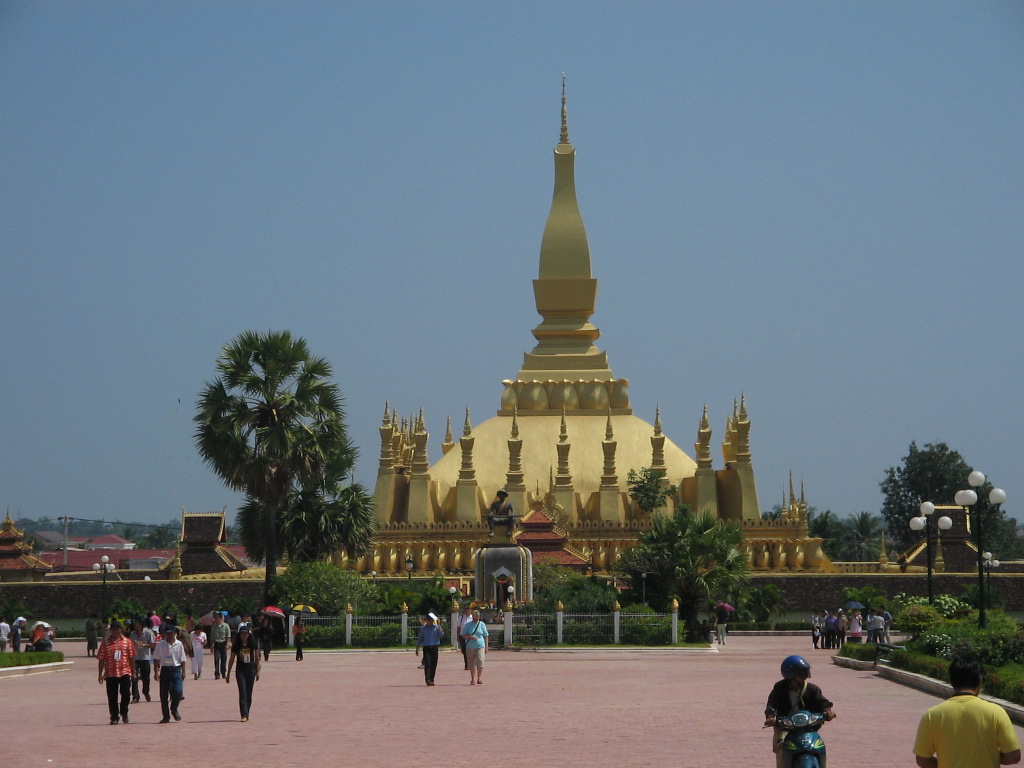
We also visited Laos’s most important temple, Wat Pathat Luang. The gold lotus glinting in the sunlight was hot, but it was fun to see a different design style than we usually find in Thailand. Two major tourists sites were enough for us for one day, though, so we spent the remainder of our time strolling the parkway along the river, eating baguettes, reading, and enjoying one last Beer Lao. It was a true vacation.

Friday, July 07, 2006

Kow Pansa


The chance to join in Thai festivals with our community is one of our favorite parts of being Peace Corps Volunteers in Thailand. Monday is "Kow Pansa," or the beginning of Buddhist Lent, so today we celebrated with the schools and villages. ("Kow" means "enter.")

Buddhist Lent lasts 3 months. The timing of it is related to moon cycles and the rainy season. Traditionally, monks walk through the villages every morning to collect food and other necessities. During rice planting time, farmers in olden times would get upset if monks trampled the fields. Pansa evolved into a time when monks are not supposed to leave the wat (temple). In addition, people are expected to abstain from harmful pleasures such as drinking alcohol, smoking, etc., and to visit the wat on certain days related to the moon. Until about 20 years ago, electricity did not extend to all parts of Thailand. My co-teacher explained that during Pansa, the people needed to bring candles to the monks in the wat so that they would be able to see at night.

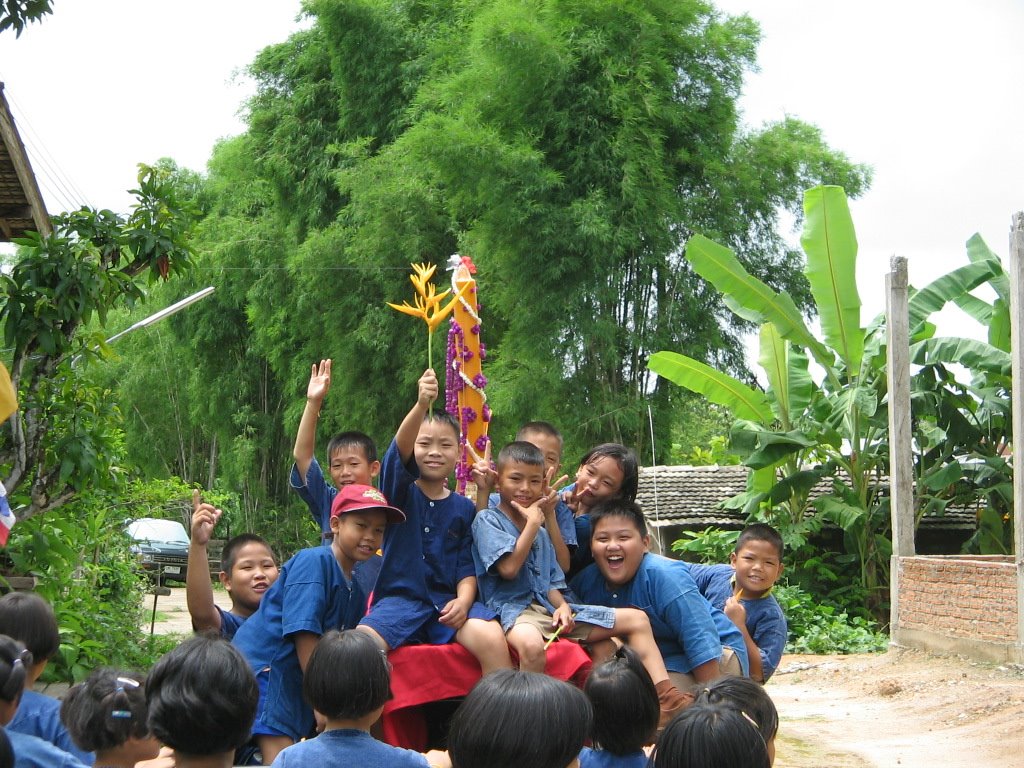
Candles therefore featured prominently in today’s ceremonies and festivities. At Robert’s Friday school, the students and teachers decorated two large orange candles which they carried through their two feeder villages collecting donations from the people. They then took the donations and the candles to the respective local wats, where they received blessings from the monks.

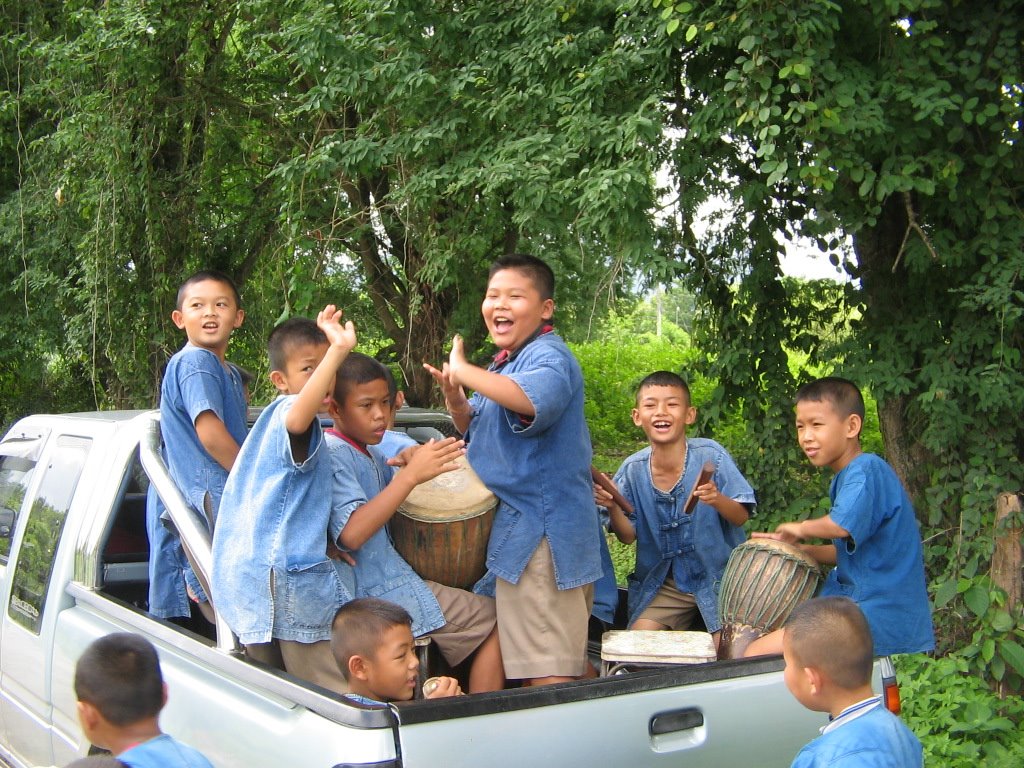
At my Friday school, the students and teachers converted the back of a pickup truck into a parade float featuring a large orange candle surrounded by flowers. We joined in the afternoon parade down the main street of town. All 9 floats in the parade had candles, and there were competitions for the most beautiful and creative designs. All the students then piled into the back of several teachers’ pickup trucks and went to two different wats to deliver offerings and receive blessings.

The photos show Robert’s students playing northern Thai music and proudly displaying their candle.

Tuesday, May 23, 2006

An Evening at the Wat


Two Fridays ago we went to our local wat in the evening to see the Wan Wisakhabucha ceremony. We were told it would start around 7pm, so we had a quick dinner and walked over around 7:15 – assuming some Thai lateness, of course. However, when we got there the temple was completely deserted except for the sound of a few monks chanting somewhere. We paced a bit trying to decide what to do, and finally assumed we had gotten it all wrong and started walking back home.

Before we had gone too far, though, a woman came out to ask us where we were going. After our reply she informed us that the ceremony would actually start at 8pm. "And don’t you have any flowers?" she asked with a puzzled look. No, we said, we were just going to watch this time.

We went back to the wat and this time met a few other early arrivers, all of whom had flowers in their hands. "Do you have a flower?" they asked us. No, we’re just watching... We chatted with one young couple visiting from out of town until a loud bell rang and everyone started moving inside the wihan (building).

We sat in a back corner hoping to be inconspicuous. As the room filled up and the monks started chanting, however, we were soon very well surrounded by teenagers, including some from our neighborhood. (To our surprise, this seemed to be a particularly teenager-attracting event.) Several people asked whether we had flowers. No, we said, we’re just watching.

About 20 minutes into the chanting, when my legs were really getting cramped from kneeling on the floor even though I had switched orientation several times, I felt a tap on my shoulder. I glanced behind me, and there was a young woman handing me a lotus flower. A young man was obtaining another for Robert, which I dutifully passed over. It seems the local teens couldn’t imagine the thought of us experiencing Wan Wisakhabucha without our own flowers. We relented, and I spent the remainder of the chanting admiring my nice bloom.

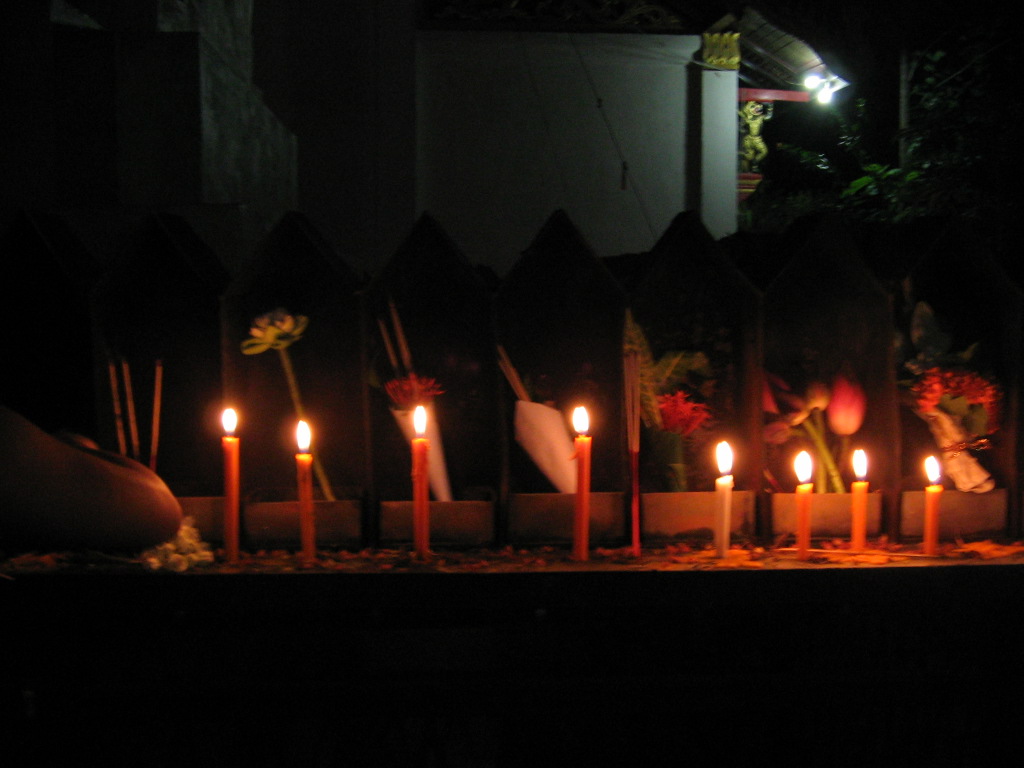
After the monks were finished, we all headed outside – about 150 people in all – and candles were lit. As everyone started walking around the wihan, Robert and I were each handed a candle as well, which we quickly lit before joining in the walk. Three times around in total, commemorating the birth, life, and death of the Buddha, and then we placed the candles and flowers in some little cubbies and went home. It was really a beautiful sight, and a testament to the determination of Thai people to include us in their special moments. No "just watching" allowed!

Saturday, April 15, 2006

Buat


Thai Buddhism has a tradition called the "buat." A "buat" is a monk ordination, and we were able to visit one last week. To be a real monk (as opposed to a child monk), you must be a male at least 20 years old. You have to memorize a lot of teachings in Pali – a language that comes from India. Some monks are "career monks" – they live full-time in a temple and do different activities such as teaching or providing community services. But many monks are just monks for a short time period (7-30 days) to bring honor to their families.

Last year, our landlords Por Or Sawat and Ajaan Warangkana explained to us that parents expect their sons to become monks for a time period, because the son will then be able to pull his parents into heaven (or whatever it’s called in Buddhism) after the reincarnation cycles are completed. Because our landlords have only daughters, we asked what they must do. They said that they have to go to at least 5 ordinations per year of other people’s sons.

This family lives on the main road around the block from our house. The mother is a teacher at one of Robert’s schools. Their son was ordained last week at our local temple. He was a monk for 7 days. We attended part of the ceremony, during which we ate some tasty northern food and watched him collect food and money for his monk bowl and then recite some things in Pali. I enjoyed it because (1) it was cool and calm inside the wat, and (2) it was fun to see all the old ladies in their fancy skirts.

(For a more detailed description of an ordination, you can go to the link "Wesley in Thailand" on the side of my blog page. Wesley is another volunteer. He attended the ordination of another volunteer named Michael, who is Buddhist and wanted to be a monk in Thailand for a while during his time here.)

Tuesday, February 21, 2006

Ornate Wats


Thailand has lots of great places to visit. To "bai tiow" means to go touring, and Thai people love to do it!

One thing that Thailand has no shortage of is "ornate wats." This photo shows Wat Pra Gaew in Bangkok -- the home of the Emerald Buddha, which traveled all around Thailand before landing here.

I've visited this place twice now -- once with my Dad, stepmom, and brothers in December, and once this past weekend with Robert's parents and sisters. Both times I have been completely taken with the beauty of the decoration and the intense care that was put into the design. Sitting in the main hall, below the Emerald Buddha, gazing at paintings and watching people of many nationalities meditate and observe, is an experience I could easily enjoy for hours.

If I could go straight from my front yard in northern Thailand to the grounds of Wat Pra Gaew without the necessary 8+ hour bus trip, I would do it regularly. Alas, I'll have to be content with taking all of our subsequent guests to visit and hoping that they are as easily enchanted as I am.