Wednesday, February 14, 2007

Burning


It's that time of year again... the air is filled with smoke all across northern Thailand. I go jogging along the river or through the rice fields, and random piles of burning material will send off plumes of smoke that fill my lungs and cause major coughing.
At night, we can look around at the mountains surrounding our town and see orange flames along the hillsides. During the day, if we're riding in a car or bus along the highway, occasional fires will be so close to the road that we'll feel their heat as we pass by.
Much of what is being burned is the leftovers of the rice harvest. Also, some set fire to underbrush in the woods. Sometimes people are making charcoal.
The mountains that are so green and sharp all through the rainy season and November and December are now barely visible, due to the combination of smoke and dust from lack of rain. It's a completely different environment!

Sunday, February 11, 2007

Personal Feature: Kun Por & Kun Maa


During our first ten weeks in Thailand – our Peace Corps training – we spent two months living with a host family. Robert and I got pretty lucky with our family – some volunteers had less positive experiences – and yesterday we went back for our last visit with them before the end of our service. It’s a bit of a hike to get to their house, so we hadn’t been for a year. Many things had changed for them, but entering their home we felt again like the 30- and 27-year-olds we were when we first arrived in Thailand. For my second personal feature, I will talk a bit about Kun Por (host father) and Kun Maa (host mother).

Kun Por, whose real name is Somnuk, was one of six children born in a Chinese-Thai family in Central Thailand. His father was a ditch-digger. Kun Maa – real name Sujitra – is also one of 6 children, but her family is 100% Thai. Her father was a teacher in the community where we did our training and was well-respected in the area. When Somnuk arrived in town about 30 years ago, they fell in love and were married. Somnuk quickly built up a reputation as a hard worker who could be trusted, and within ten years he had been elected "poo-yai bahn", or head man, of the village. It was a life term, so he still continues as poo-yai today. He is among the very small number of Thai men who do not drink alcohol, which likely contributes to his high status.

Somnuk and Sujitra have two children. Their son, Mongkonchai, earned a masters degree in computer technology in Australia, where he has been living for several years. He has a Thai fiancee who is also studying a masters in Australia, and they will return here to be married in about six months. Their daughter is Anothai, and we’ve always been a bit confused about her story. During the time that we lived in the house, she worked for Toyota in Bangkok. Now, however, she has married a local farmer, and they are living with her parents and expecting a baby in April. We think there’s a bit more to the story but have hesitated to ask.

When we moved in, the household included four others: Kun Boo, Somnuk’s elderly father who couldn’t speak much; Pi Porn, a housekeeper in her 50's; Nong Lek, Pi Porn’s teenage daugher; and Watlunyoopa, Pi Porn’s young granddaughter. Pi Porn and her family left partway through our training because a relative of hers had become ill and she went to be the caretaker. Kun Boo died a little over a year ago.

The house is far from empty, though. In addition to Anothai and her husband, Sujitra now cares for two additional family members. Her father – Kun Daa – had his legs amputated last year and moved into the house from his nearby village. Sujitra does all his cooking, bathing, and dressing. Also, Somnuk and Sujitra have adopted a young orphan from the village. Mot Dit’s father, as Sujitra explained to us, visited too many woman, contracted HIV, passed it to his wife, and died. Mot Dit’s mother died also, leaving the 12-year-old with no relatives. Adoption of strangers is not common in Thailand, and I think it speaks very highly of the generosity of our former host parents that they have taken Mot Dit into their home and are raising her and sending her to school.

Although training was rough, we were very happy in our host family’s home. The food was delicious and the conversation good. Kun Por and Kun Maa took their responsibilities for teaching us how to survive in Thailand very seriously, and were constantly concerned with our comfort and well-being. During the many times during my first year that I wanted to quit and go home, I would think of them and remember how hard they had worked to see that we had all we needed when we were in their home, and I knew I didn’t want to let them down by going home early. They are people who ask for nothing for themselves, and only try to make the lives of those they love – their parents, their children, and the others who live with them – happier and richer. I’ll always remember their goodness, and be grateful that my introduction to Thailand was largely through them.

Tuesday, February 06, 2007

Dry Season


Thailand has a 3-season climate. The hot season, with daily temperatures above 100F and nights rarely cooler than 85F, lasts from approximately March-April. Rainy season begins in June, in the north, and goes through September or October. Temperatures are still hot, but more bearable because of the cloud cover.


We're now in the dry season, or cool season as it's also known. It hasn't rained in our town since October. This year is unusually cold, and it's gotten down to 50F almost every night since mid-December. This is very cold if you don't have indoor heating!


The rice was harvested back in November in our area, and many of the fields are lying fallow until the next planting cycle, as shown in the brown-ish colored photo. Others are irrigated to grow other crops, including broccoli, potatoes, and tobacco. These two photos show the fields on either side of the road to my Monday-Thursday school. You can see how irrigation makes quite a difference!

Monday, February 05, 2007

Competition . . . Part II


Today we spent the day at the school-district-wide subject area competitions. They took place an hour north of town, at one of the high schools, so we had to leave at the unusually early hour of 6:45am in order to be there in time for the opening parade.

Despite my previously noted dislike for the Thai educational system’s focus on competition, I am nonetheless rather proud to announce that Donut, a 6th grader I’ve taught for two years at my Monday-Thursday school, won the English speaking competition for upper elementary school. For several months I was rather hoping he’d at least win the local competition (which he did, last week) but I hadn’t quite expected him to win overall.

The reason I wanted him to win is a bit difficult to explain. As I said, I don’t really believe there should be a competitionl. However, although I often feel like I don’t accomplish much as a Peace Corps volunteer in Thailand, I am particularly proud of the work I’ve done at this one school. For two years, Ajaan Warangkana and I have built a solid co-teaching foundation. We have a fairly consistent classroom routine (for Thailand) and have done a decent job of building new knowledge on top of skills the students have previously mastered (unusual, for Thailand). The kids actually like speaking English, in random but appropriate bursts, outside of class.

So, I felt like having Donut (his nickname) win the contest would be an external vindication that student-centered teaching pays off in the long run. It might not be the fastest or the most shiny – in terms of having lots for teachers to "show off" after a short period of time, as teachers in Thailand are wont to do – but it’s the most effective, and, I hope, permanent. Donut had a good speech, which he had practiced for several days as all the students do. According to the judges, though, what set him well ahead of the competition was his ability to understand and answer questions he was asked that he hadn’t had the opportunity to prepare for ahead of time. I like to think that this is because student-centered learning allowed him to learn to actually USE English, instead of just memorizing or repeating it.

So, even though I would have thought my work at this school was somewhat successful even if he hadn’t won, the fact that he did win will perhaps mean that some other teachers in the district might be interested in knowing how it was done. And for that they’ll have to go to my co-teacher, since I’m leaving soon. I compliment myself, a bit, for trying to bring new teaching techniques to the school. I compliment Donut, of course, for working hard and being brave enough to compete. But mostly I compliment Ajaan Warangkana, for being willing to try them for two years and adapting them with a sort of Thai-Warangkana flair. Hopefully, she’ll keep teaching with that flair, even after I leave. She was pretty excited after Donut won today, so I’m hopeful.

Robert would like me to note that even though none of his English students won medals, they did come up and ask "How are you?" when I saw them at the competition today. And they could answer when I asked in return. ("I am cold," because at 55 degrees, it was really freezing.)

[The photo is from several months ago. The boys are showing off a guava tree. Donut is second from left in the back row.]

Saturday, February 03, 2007

Charity, Service, and Giving


Yesterday we attended a couple of ceremonies thanking the American Chamber of Commerce for their donations to two local schools, including one at which I co-teach. The 2005 flood destroyed the school’s library, and the ACC, with some individual and business partners, gave 60,000 baht (about $1500) to help buy new books and furniture. The event gave Robert and I a number of topics to discuss over dinner.

One thing Robert observed, considering yesterday’s event and other opportunities we’ve had to see charitable organizations in action, is that charity seems to work best when it’s designed close to home. World Vision, which I described in an earlier blog, has an office located right in our town and staffed by local people who know exactly what the needs of the community are. As a result, it’s extremely effective at using its available resources to target real needs for the students.

The ACC donation was a joint effort between local school staff and ACC staff in Bangkok. Our principal, realizing a need for library improvement, requested a grant, and American Chamber of Commerce provided the funds. School teachers then used the money to order books, furniture, and supplies. I would like to say that this was also an example of effective targeting of needs, however, in my opinion (which is just, of course, my opinion), while a school library is essential, many of the books purchased with the money are actually not suitable for young children or middle schoolers. But that’s just a small quibble.

Our Peace Corps project is an interesting subject. After spending nearly two years in our town, in schools with students, I have a pretty good sense of what their needs are. I would prioritize education about sanitation, health, nutrition, and life skills (critical thinking, decision-making), especially those that are effective in HIV prevention. English teaching would be near the bottom of my list, after math, Thai, and geography. I have frequently attempted to move in a few different directions. But, the Thai Ministry of Education, located hundreds of miles away in the tall buildings of Bangkok, determines our project goals, and they prefer that we teach English. The teachers have to conform to official requirements. And so we do.

Then, of course, there are the heavily funded and not necessarily effective organizations such as UNICEF that seem to spend lots of money on conferences and fancy cars for select groups of people, with little benefit trickling down to local communities. I can’t say that I know a lot about this, as I haven’t witnessed it first-hand, but I do know that a fancy car for NGO staff doesn’t do my kids a whole lot of good.

What does all this mean? I suppose those of us who give to charity just need to try to make sure that our money is being spent as we intend it to be, to the best of our ability. Sometimes there isn’t much we can do – if local school teachers decide to purchase boring Thai history books without any pictures with their library funds, against the recommendations of their Peace Corps Volunteer, you have to let it be. But I do think that most of us like to think that our money is not being wasted.

Which brings me to my final point. As a line of students was coming forward to receive their free notebooks and pencils from a computer company, the Thai woman next to me – an employee of the Office of Basic Education Commission – turned to me and said, "I don’t understand why foreigners give money to Thai school children. Why don’t rich Thai people do the same thing?" The woman in front of her, a Thai employee of the ACC, turned around and agreed. I wonder it too. I have heard that this is typical of Asian societies: providing assistance or charity to one’s own family is acceptable, even expected, but aiding strangers is seen as downright strange. What is it about Americans – and other classes of foreigners – that makes many of us want to reach out to people we have never or will never meet, to share a bit of what we have? A recent study found that American charitable giving correlates not with political affiliation or liberal/conservative ideology, but with religious participation. Is there something about religion in America that encourages us to be charitable? And why isn’t the same true in Thailand? I have my own ideas... but I’ll save them for another time.

Thursday, February 01, 2007

Personal Feature: Ajaan Warangkana


As I have 55 days remaining as a Peace Corps Volunteer in Thailand, I’ve decided to highlight a few of the people who have been most important in my time here.

When asked what I will miss about Thailand when I leave, the easiest answer is my co-teacher, Ajaan Warangkana. I teach with her at my Monday-Thursday school, and she has been my constant support here.

Warangkana was born in a small village about twenty miles north of our town. The youngest of three children, she was the daughter of the village leader and his wife, a shopkeeper. Most children in her village did not complete school past third grade, but because her father was relatively important and well-connected, she and her siblings were sent to attend school in town. At age 19, she finished teacher college and began working in schools near her hometown. Shortly after, she met Sawat, another teacher. They married and had two daughters, living for several years in her home village without electricity or running water.

Twenty years ago, they built a house in our town. When their daughters were old enough, they were sent away to school in the city, returning home on weekends or during school breaks. Sawat became a principal and rose to prominence. He is one of three people in our province to have been "knighted" by the King. Now, one daughter is finishing college in Bangkok. The other is currently living in America and plans to study a masters degree in teaching.

During my first interactions with Ajaan Warangkana, I wasn’t sure what to make of her. She seemed intimidating – stern and formal. It was only after a few weeks of teaching together, and living just two houses apart (she and Sawat are our landlords), that I began to feel comfortable with her. In reality, she is quite different from my first impressions. She is giggly, opinionated, and easy to talk to.

In September of 2005, as I was explaining to her why, at a school district teacher training, it had bothered me that the audience started questioning Robert about what types of Thai women he preferred, we had our first real deep conversation. She told me that when we first met, she had been afraid to talk to me because I was so quiet and she was shy about her English skills. (Her English is actually very good.) I told her about my initial intimidation. We laughed about each being wrong about the other. Since then, we’ve had many a conversation discussing our different cultures, interpretations of gender roles and differences, families, and, of course, Thai education. We don’t always agree, but it has been wonderful to have someone to talk to within easy reach.

If I leave Thailand feeling like I’ve accomplished only one thing, it will be my friendship with Warangkana.

[If we look a bit hot and worn out in the photo, it’s because it was over 100 degrees that day. And look at the clothes we had to wear!]

Monday, January 29, 2007

Competition... Again?


Before I came to Thailand, I had no idea that there could be so much formal competition in one school year. In America, of course, we have spelling bees, geography bees, and numerous sports and games during various seasons. For the most part, however, these take place outside school hours – especially the practices – and teaching continues as usual.

Not so here. The school year runs from May to March, and includes a bewildering assortment of contests. December is when things really get going, though. At each school, students representing the different grade levels (pre-school, grades 1-3, and grades 4-6) are selected to represent their school in a multitude of subjects and activities. English, Thai, math, and science, of course. Art (clay sculpture, drawing, painting, fruit sculpture, etc), garden design, and poetry. Thai pop singing, English pop singing, Thai traditional dance, and pop dancing. And of course, sports (soccer, volleyball, betong, dakrow, and track), which require their own competition days.

Student spend day after day practicing at school. Classes are cancelled, of course, and at many schools this means that those students who aren’t competing in any subject spend their time running around the playground. Teachers don’t teach, because they are coaching the competitors or attending meetings to get information about contest details.

Finally, the local level academic and sports competitions take place. Last week, our town schools competed from Wednesday through Friday. This week, the village schools are competing today and tomorrow. It’s a fairly large operation. (These days did not include the sports.) Winners will go on next week to compete at the school district level. Winners from there will compete at the provincial level, and up on until reaching the national level.

On the one hand, perhaps there’s nothing wrong with encouraging some competition in education. Kids who are skilled can get some recognition and experience. Parents can cheer for their kids and their community. On the other hand, it seems ridiculous to me to essentially stop teaching as early as January. Also, some of the contest categories are, in my opinion, completely inappropriate for elementary school students. Namely, the "dancer" competition.

I think it’s great that a large number of students learn traditional Thai dancing. However, in recent years, kids are learning and competing in a new style of dance. A style that, if I had a small daughter, I wouldn’t want her to do in her own house, much less on a stage in a skimpy costume in front of half the neighborhood. Thai people call this style of dancing "dancer," which I guess is some adapted language from America, except that in America, no school child could dance like this at anything remotely resembling a school event.

So, last Friday, I suffered through a good six hours of watching young girls (ages 5-12) shake their hips seductively. Most of them don’t have hips yet, of course, but you wouldn’t have known that from the costumes. I’m not sure why I didn’t just walk out, but my school was participating, after all. At one point, during a particularly disturbing dance by a group of 6th graders, I asked my co-teacher, "When your daughter gets to be that age, will you want her to dance like this?" "Of course," she responded. "Thai people aren’t good at showing their emotions. This helps girls learn confidence." Since the music was blaring, I really had no good response.

[The photos here are actually from the 2006 town school sports competitions. Lest anyone think I’m overreacting, let me make it clear that these costumes are nothing compared to the "dancers."]

Sunday, January 28, 2007

Meditation


Both my schools are "Buddhist Way" schools. "Buddhist Way" is a current educational initiative in Thailand aimed at teaching students about moderation, thoughtful action, and diligence. It has a variety of interesting implementations.
At both schools, as well as at both of Robert's schools (which are not actually "Buddhist Way" schools), students participate in daily meditation. After lunch and noon hour recess, they gather in the hallways for several minutes of silent reflection, legs crossed and hands in the proper position.
Because Thai kids are pretty much like kids anywhere, though, many of them enjoy this opportunity to make faces at their friends and throw little bits and pieces of things at each other if the teachers aren't watching. I usually enjoy the opportunity to open Newsweek for a few minutes.

Friday, January 26, 2007

Wednesday Lunches


Sometime during our early weeks at our site, I was sitting at a desk at the school district office and a woman came up to me. She introduced herself as "Pi Noy" and asked me a list of rather complex English questions. Upon further conversation, and discovering that I was a vegetarian, she invited Robert and I to her home for a vegetarian lunch. I can't remember what it was, but it was absolutely delicious.
For nearly two years now, Pi Noy has from time to time made lunch for us on Wednesdays, our office day. She never makes the same food twice. We've had kao soi curry, spicy tofu "laab" salad, "rad na" (noodles with gravy) over omelettes, and lots of other fancy dishes. Shown in this photo is a recent meal of eggrolls with peanut sauce. Pork-filled for Robert, and tofu-filled for me. I ate way too many!

Monday, January 22, 2007

Noni & Mimi


On Friday night, I was chopping garlic for the kidney beans and two small creatures made their way towards our patio. Not wanting to scare them away, I quietly got some kids' books off our shelf, carried them outside, and set them on the bench. The books were instantly snatched, perused, loudly discussed, and played with.
Sunday evening while I was chopping garlic for the lentils, the same two small creatures approached. This time, when finished with the books, they came into the house and looked at our photos and cards on the walls. Robert got out a geography kit that we were given a while back, and they had great fun playing with the kid-friendly binoculars.
Both girls live two houses down from us, at the home of Kroo Deeah and his wife Pi Min. Mimi, the older girl (grade 2), is the daughter of Pi Min's sister, who I've never met. Noni, age 3 (though nearly as big as Mimi), is the daughter of Pi Min's daughter, who I've also never met. In other words, Mimi lives with her aunt & uncle, and Noni lives with her grandparents, and this is a total of 4 people living in the same house.
I was happy about the visits, because for nearly two years Noni has simply run away in fear anytime I've acknowledged her presence. We seem to have reached a turning point in our neighborly relations over the weekend, so that now she feels free to run in and out of our house at her pleasure. It was quite delightful to be making dinner with the sounds of two girls reading and playing.

Thursday, January 18, 2007

Chinese Celebration Meal

As I mentioned in yesterday’s blog, a Chinese meal was served for the Teachers’ Day lunch. Chinese meals of a certain style are often served at important social functions in Thailand – weddings, housewarming parties, etc. They are very different from what a typical Thai meal for a similar occasion might be.

Last year, I asked my co-teacher if she liked the food served at these meals. She told me that she doesn’t, and that most people in our area don’t. When I asked her why it was served, then, if people would prefer to eat Thai or northern Thai food, she replied that it had to do with status – the Chinese meal is a sign of wealth, so serving one gives the impression that you are well off. (This would explain the 100 baht per person price tag for yesterday’s lunch, which all the teachers were expected to pay. Peace Corps volunteers were served free.)

Anyway, here is a description of yesterday’s meal, which is fairly typical of what you would find at such an occasion:

The first course includes a plate of appetizers, mostly different types of meat. Yesterday, it included pork dumplings, processed pork, baked jerky-style pork, picked eggs, and some pineapple and pickled ginger in the center. Robert says that the jerky-style pork and the dumplings were "pretty good." I refrained from eating any of it, though I did try a pickled egg once about a year ago at the command of a teacher from Robert’s school. I thought it was pretty nasty.

Yesterday’s second course, not pictured, was called "fish stomach soup." However, my co-teacher explained that these days it no longer includes real fish stomach. Instead, it had chicken and pig skin. Robert thought it was "pretty good."

The third course included two dishes: fried rice with pork, and spicy shrimp and pig skin salad. The fried rice was called "American fried rice" because it had raisins added. (I told my co-teacher that we don’t put raisins in fried rice in America, and she laughed.) I should point out here that all of the courses are served on one large plate in the center of the table, and diners serve themselves into small bowls using chopsticks or spoons. Robert says that the spicy shrimp and pig skin salad was "tasty, with a nice mix of flavors and a crunchy texture," and the fried rice "did justice neither to fried rice nor to raisins."
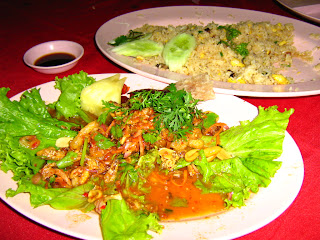
Next came a plate of stir-fried vegetables with shrimp and a flaming pot of tom yam soup. "Tom yam" is a spicy soup made with lemongrass and kaffir lime leaf. It is traditionally made with seafood but can be made with other meats, or mushrooms or tofu, as well. Yesterday’s tom yam included squid, fish meat, and processed fish balls. Robert isn’t a big tom yam fan, and thought that one bowl was enough. (I like it when it’s made vegetarian.)

A whole steamed fish, also on a flaming plate, came next, which Robert reports was "ok." And last came a plate of sliced fruit, including guava, papaya, and orange sections. This, finally, I did enjoy a small bit of. I really like guava.

So there is a description of what you might find at a Chinese celebration meal in Thailand. To our great relief, this one did not include Robert’s all-time least favorite food here: chicken feet!

Wednesday, January 17, 2007

Teachers' Day: A Time for Reflection and Revelry...


Today, January 16, was Teachers’ Day in Thailand. This yearly holiday includes merit-making and fun for educators all across the country. It was our second Teachers’ Day here, and no less interesting than the first.

The merit-making ceremony was scheduled to begin at 8:00, and since we were wearing fancy clothes and hauling two large bags of oranges, our landlord (a prominent local principal) picked us up a few minutes beforehand. We arrived at the school district office and laid out our wares next to the other teachers’ offerings. When the group of 51 monks arrived, they circled the tables, and each teacher carefully placed one of their pre-prepared food items into the alm’s bowl of each monk. Although as non-Buddhists we felt no need to make merit for our future reincarnations, Robert placed our oranges into the bowls while I took photographs, in order to show some participation.

When the monks were finished with their rounds and the white canvas bags were bulging with sticky rice, fruit, ramen noodles and canned sardines, we all moved into the large meeting hall for the next ceremony. To begin, the monks did some chanting and prayers for about an hour, and the crowd of teachers sang a solemn song enumerating moral virtues. This was followed by an awards ceremony. I am pleased to report that both of my co-teachers received awards, one for excellence in teaching social studies and the other for library reading program development, but I didn’t have anything to do with either.

Thais love to take photographs, and the advent of the digital camera has only increased their enthusiasm. Since there was about an hour-long gap between the conclusion of the awards ceremony and the serving of lunch, that time was of course filled with a hyper, crazy photo session. Every possible combination of teachers, principals, teachers and principals, teachers and Peace Corps volunteers, teachers and principals and Peace Corps volunteers, principals and Peace Corps volunteers, and on and on, was duly recorded on memory chips.

Finally, it was time for lunch, and a good thing because I was quite hungry. But oh, disappointment! It was a Chinese party meal of which I could eat nothing (description to follow tomorrow). Oh well. The whiskey was poured, the young hired women in increasingly revealing outfits began singing karaoke, and the atmosphere turned into one of loud revelry. We escaped with my co-teacher at 1pm and I came home to eat a cheese sandwich, but when Robert went to the market just before 5pm to buy our vegetables for dinner, he ran into a few inebriated teachers who were just leaving the festivities. They reported that the party was still rolling.

Sand Sea Resort Review


In the life of many a Peace Corps Volunteer, there comes that moment when parents come to visit, and they finally treat you to many of the luxuries you have not been able to afford on your living stipend in your country of service. Such it was for us at the Sand Sea Resort on Railay Beach West in Krabi, which we visited last August, courtesy of my mother.

Railay is only accessible by boat; for us, a longtail boat chartered by the resort. We were whisked away across the water, past brilliant green karst bluffs and into a light rainstorm. Adventure! Upon our arrival at Railay, we followed a cart full of our bags over a short path and into the Sand Sea gardens.

Bungalows line either side of a well-tended path meandering towards the pool, and a moment later, the beach. Although our bed was a bit hard, the sparkling clean shower and comfortable wooden porch chairs more than made up for it. Each morning we enjoyed a buffet breakfast overlooking the water.

For meals other than breakfast, however, I recommend eating elsewhere. Railay Bay Resort next door has better food and better service. Due to Muslim ownership, neither resort serves alcohol, but there are plenty of small beachside bars to fill the gap.

Days can be spent swimming, snorkeling (many guided trips are offered from shops around the resort, including the fantastic "sunset snorkel" ), rock climbing, wandering over to Phra Nang Beach, or just sitting by the pool. In the evenings, you might run into an impromptu game of beach volleyball at sunset, or perhaps walk the five minutes over to Railay Beach East for bar movies and a livelier crowd. There’s no rush to life at Railay – it’s all about enjoying the laid-back, mellow atmosphere. Pure vacation.

Sand Sea Resort has onsite laundry and a mini-mart, as well as relatively affordably internet access.

Tuesday, January 16, 2007

Funeral


Last night we went to a funeral for the son of a school principal in our town. Age 24, an engineering graduate, he committed suicide last week in Bangkok. We’ve been to many funerals in Thailand, but they’ve all been for old people, so this had some similarities and some differences. [Note: By "funeral," I am referring to what we would think of as a "wake" in America. In northern Thailand, up to seven nights of funeral are sponsored by different community groups and take place at the house. After the funeral nights are finished, there is a daytime cremation ceremony at the local crematorium. Robert has been to a cremation, but I have not.]

Last night’s funeral was sponsored by the school district, the police department, the hospital, and one of the outlying villages, so many teachers and principals were in attendance. The basic format was the same as the other funerals I have attended: everyone was dressed in black and white; a photo display of the deceased was prominently set; representatives of each group presented bouquets and money to the family in front of the casket; the monks arrived after 8pm and did long chantings and a sermon; the formal ceremony was followed by snacks (in this case, oranges, banana chips and Thai herbs juice); and there was little display of sadness or grief.

This was a much more somber event than the other funerals I have attended, though. Instead of chatting loudly during the sermon, most people seemed to be listening, or at least sitting quietly. There were few cell phones ringing, and only one extended phone conversation. I’m not usually able to hear much of the monk’s preaching because of all the distraction, but last night much of it was very clear, and I clarified main points with a Thai friend afterward.

The sermon seemed to focus specifically on suicide and on what we in America would call depression. Robert and I agreed, later, though, that we wish it could have had a different slant. I don’t see how blaming the young man for his sadness, or implying that he hadn’t done enough good deeds, is respectful of the family or of anyone else who might be similarly suffering. I think that part of the issue is that in Thailand, depression doesn’t "exist." It’s an unacceptable state. (We once heard a Thai person comment that she couldn’t understand why someone who had graduated from college and had a good job could be suffering from depression, because she clearly had enough food to eat.) It made us appreciate the wealth of resources that exist in America for people who have mental or emotional problems.

It was also hard to hear that in Thai Buddhism, a person who has committed suicide is permanently removed from the circle of death and rebirth, and will therefore never have an opportunity to reach Nirvana. Most other sins can be forgiven, it seems, even if you have to be reborn as a lowly animal for a while, but not suicide. Though not a believer in reincarnation myself, I feel a great deal of sympathy for a family who, in addition to grieving for the loss of their loved one, doesn’t even have the comfort of believing they might be moving on to a better place.

We know of three suicides within our small community of teachers, principals, and their families – two of which occurred since our arrival in this town, and one that was not too many years before. All were individuals in their 20s or 30s. It seems to me to be an high number for such a small group of people. Part of me wonders if the attitude towards depression in Thai society is one that results in a higher incidence of suicide, because people are not able to find help for what could be a treatable condition. To quote Robert, the experience last night left us with mixed feelings: sadness for the family who lost their son, some anger at the monk for the content of his sermon, and gratefulness to be part of a society – Americans – in which depression can be recognized and treated.

Sunday, January 14, 2007

Children's Day


Yesterday was National Children’s Day in Thailand. I think the original purpose was to focus on kids: their potential, their right to be treated well, their child-like qualities, etc. I attended celebrations at my school on Friday and at the local government office yesterday.

Many of the activities were pleasant to observe. Kids might volunteer to go up on stage and answer questions, such as, "How do you help out at your house?" or "What do you want to be when you grow up?" They always got prizes for being brave enough to give an answer. A group of my fifth and sixth grade boys did a traditional northern Thai dance at the government office on Saturday morning that I thought was very impressive. Not only were they good dancers for being so young, but they also showed that they had been working hard on it. (See photo.)

Other activities were less enjoyable. Many of the kids’ performances involved heavily made-up girls in mildly provocative outfits, lip synching to Thai pop music and shaking their hips far too suggestively. I don’t know why this is so popular in Thailand, and I don’t know why it is done at elementary school. (With some reluctance, I’ve put up a photo of one of these groups of girls. I don’t really like to promote it in any way, but I wanted to show an example. It’s from among the less suggestive outfits I’ve seen.)

On the whole, though, it was nice to see kids in Thailand getting a little more recognition and approval than they usually do. At school, teachers often treat kids as an afterthought or even a nuisance – school is really more about the status of the teachers than about the education of the students. (Some schools are worse about this than others.) But on Children’s Day, it seemed like for one day the kids got to be front and center. That was a refreshing change.

Thursday, January 11, 2007

Sponsorship


Before I say anything, let me emphasize that this is NOT a sales plug! My goal is just to inform.
Back in the USA, I often saw commercials on late-night television for charitable organizations of one sort or another, trying to convince viewers to sponsor a child in a third-world country. I never really bought into those things, because who knows where the money ends up?
But as it turns out, there is an office of the Christian organization World Vision here in our little northern Thai town, and they do a lot of good work. At my Monday-Thursday school (pictured), all of the students are sponsored by families through World Vision. At my Tuesday-Friday school, about two-thirds of the students are sponsored.
What does this mean for my kids? Every year, World Vision buys their notebooks, pencils, and other basic supplies. World Vision pays for their school uniforms. If you look closely at the boys' black and orange jackets, you'll see that they have a World Vision label -- the sponsored kids sometimes get additional items of clothing for certain types of weather. World Vision buys books and sometimes even furniture for the school library and other rooms. Last year, when my Tuesday-Friday school was extensively damaged by the flood, World Vision paid for many replacement items.
Additionally, World Vision will occasionally pay for a field trip for the students. Last year I went with 6th graders from six different local schools to a number of sites around our province, with all fees, transportation, and meals paid for by World Vision. They give scholarships to several students every year for study at high schools in our provincial capital. And, my co-teacher informed me today, they hold a World Vision football (soccer) competition every year.
I'm not trying to convince anyone to sponsor a kid through World Vision. However, I did want to point out that if anyone was considering doing so anyway, I can vouch that it really does work!

Tuesday, January 09, 2007

Just for Fun


For a little glimpse of what I do on a typical school day, here are some shots of flashcards and student work. The flashcards, as I'm sure is obvious, are "People Adjectives." The kids have a lot of fun with these.
The student work has photos that the kids selected from a folder of magazine cut-outs. After choosing a photo, they "interview" the person in the picture in English. Thus, if you were able to read some of the questions and answers, you might see that the skier's favorite sport is "skiing" and Queen Elizabeth II's favorite food is "chocolate."

Sunday, January 07, 2007

Blessings


Back in November, we helped do an English camp at our friend Sean’s site. During a break time, we were hanging out at the home of one of Sean’s counterparts. An old man in the house wanted to give us a blessing before we left.

He tied a string around the left wrist of each one of us while murmuring his wishes that we have good health, good travels, and good remaining time in Thailand. He was very sweet and sincere.
Typically, when you have a string ceremony like this in Thailand, you wear the string until it falls off. The one I currently have on my wrist is from our COS conference in December.

If you can’t tell from the photos, it was yellow shirt day at English camp.

Thursday, January 04, 2007

A Great Group of Kids


There are times when being a Peace Corps volunteer in Thailand starts to feel rough. Emotionally... It's a difficult culture to adapt to, the weather is challenging (whether hot or cold), and sometimes I don't feel like I'm accomplishing all that much at my "job."
But the 5th and 6th graders at my Monday-Thursday school never fail to bring my spirits up a bit. Perhaps they'll insert random English words we've studied into an otherwise Thai conversation in an amusing way. Perhaps they'll joke about the "kaab moo" (baked pig skin) that Robert offered them one day. Perhaps they'll make fun of my daily breakfast -- oatmeal -- which they find to be amusing both gastronomically and linguistically.
Or perhaps, like today, during a lesson on comparative adjectives, they'll repeatedly insist that OF COURSE I am more beautiful than Tata Young, the Thai singer. And they'll laugh when I tell them that's worth a few bonus points. But they said it even without the bonus points... so there!
The photo was taken on our field trip to the Mae Mo Power Plant in November. Ajaan Warangkana, my co-teacher, is posing in front of the yellow flowers with the kids.

Tuesday, January 02, 2007

Small Town Life


Sometimes traveling to different parts of Thailand gives us a new perspective on our little town. This past weekend we visited Pai, a hippie-mountain town in Mae Hong Son province, with a group of volunteers. More on that trip later, but for now I’d like to share a couple of rambly tidbits about our rural town.

A guidebook I once read noted that violent movies are popular in Thailand, and the farther away you get from big cities, the more violence you find on TV. This is an accurate description of where we live. Because there isn’t much to do here – no shopping, no movie theater, no major sporting events – entertainment tends to be limited to TV, cockfighting, and alcohol. Lots of alcohol. Frequent holidays and festivals are occasions for variety, and of course for more alcohol as well.

There are many good sides to being out of the big city. We know our neighbors well. It’s easy to get around by bicycle. The air is clear, aside from the smoke from burning fields. I would not have given up the opportunity to experience small town life.

We’re set in a valley surrounded by farmland and then mountains. For security reasons, I’m not allowed to name the area on this blog, but I’ve included a couple of photos from this evening’s bike ride. You might notice the cell phone towers, the smoke rising from harvested rice fields and the Casa Que Pasa t-shirt. Oh, we miss burritos.