Tuesday, October 31, 2006

Mekong Slow Boat -- Day 2


This is Chapter 4 of our Laos journey.

We awoke early in Pak Beng after a fine night’s sleep to find that the river was literally underneath our window. We hadn’t noticed it the previous night in the dark. Fog was thick over the water and we watched as boat traffic started moving. After packing up, we walked outside and bought baguette sandwiches from stands along the road to last us through the day. Such luxury!

The second day on the slow boat passed much like the first, except that the scenery was even wilder and the seats more comfortable; due to engine trouble, we had been switched to another boat, much to our happiness. We spent many hours conversing with Young & Ben, a couple about our age who had been traveling through Southeast Asia for several months.

I continued to reflect on the small villages we passed on our way – their smallness, their evident poverty, and their isolation. I also began noticing the relatively large numbers of school-aged children present in the villages. It appeared that these kids were not attending classes of any sort. If they were dressed at all, it usually was not in a school uniform, and most of the villages looked too small to support a school anyway. In Thailand, the primary schools are often not much to speak of, but they do exist and most, if not all, kids attend. Seeing this different situation in Laos made me curious about other ways in which the two countries might differ, despite their physical closeness.

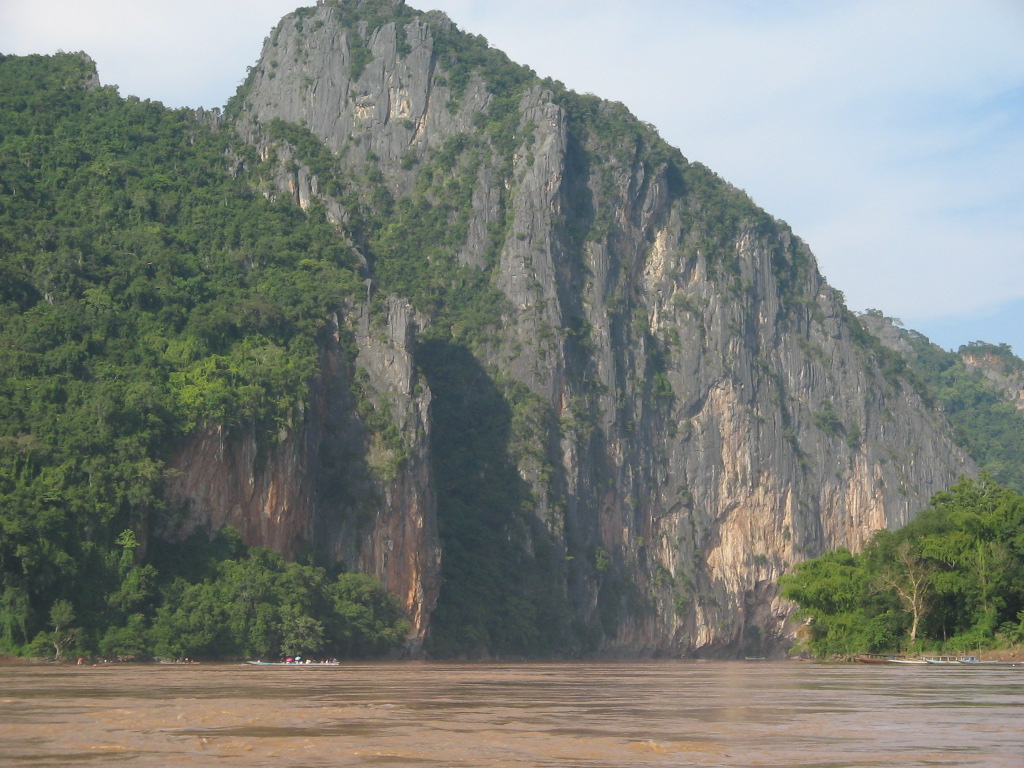
Shortly after 4pm, we turned a corner past some large cliffs and came to the town of Luang Prabang, the former capital of Laos. Although it had been a pleasant trip, we were glad to be off the boat at last and more than ready to settle in for a couple of days. We climbed into a tuk-tuk and headed off to our guest house.

Thursday, October 26, 2006

Mekong Slow Boat to Pak Beng


This is Chapter 3 of our Laos journey.

When Robert and I were planning our Laos vacation, we felt a bit guilty about sticking to "the beaten path." If you were to open the Lonely Planet Laos and read their suggested itinerary #1, you would find a nearly-exact description of our trip. Did this mean we would be missing out on the "real" Laos? Would we only see what had been specially tailored for tourists? Given our time and budget limits, though, it was the best choice for us. Besides, we rationalized, we’ve been living OFF the beaten path in Thailand for nearly two years now, so that must count for something. We were ready to be tourists for a change.

Nonetheless, we were taken aback as we watched our slow boat fill with North American and European backpackers. It got so full, in fact, that another boat had to be brought around, so that one could be filled too. Who were these people? Where did they get the time and money to sit on a boat in Laos for two days? (Were we not Peace Corps volunteers in Thailand, I’m quite sure we’d not have had the opportunity. There were, I should note, two other Peace Corps Thailand volunteers on the boat as well.) Had we come to Laos to see Laos, or to see Europe?

When you spend two days sitting on a small boat with the same group of people, though, you do get to know them some, and I will say that our fellow Mekong River travelers were a lively, yet friendly, bunch. They swapped travel plans and advice, looked at one another’s copies of the Lonely Planet, drank Beer Lao and saluted the fine scenery together. For our part, the daytime consumption of Beer Lao was out of our budget, but we did splurge on a package of Oreos when the boats pulled up to a tiny village and a family of vendors boarded with their baskets of goods. Yes, I ate Oreos on the Mekong River.

There were a few "real" Lao people on our boat, though, so occasionally we got the opportunity to dock at a village, usually a very small group of houses down close to the water, so they could get off. The houses themselves were a sight to see; made of rattan with a thatched roof, they were completely different from Thai houses. At each village, adults and children would hurry down to the water to look at the "farang" travelers and find out who was coming or going. There are no roads in this part of Laos, so the river traffic is their connection to the outside world.

Just as it was getting dark, we pulled into the town of Pak Beng for the night. We had been dreading Pak Beng, as I had read numerous blogs describing the bugs, rats, and drug pushers wandering its roads and guest houses. To our great surprise and delight, though, we immediately settled in at the Salika Guest House, which had screened windows, private bathrooms, and no rats anywhere, all for an affordable price. Amazed at our good fortune, we headed out to find food and ended up at Hasan Indian Restaurant, owned and operated by a nice young man from southern India. The food was good, and he spent a solid hour talking with us about what it was like being an Indian restaurant owner on the beaten path in Laos.

Feeling much pleased with ourselves for being such good travelers – surviving our first day on the wooden benches of the slow boat and the dark roads of Pak Beng – we retired to our room for a good night’s sleep.

Wednesday, October 25, 2006

Robert and Sid Ficious Toast Ian in Honor of his Birthday Month

Huay Xai


This is Chapter 2 of our Laos journey.

The small town of Huay Xai on the Mekong River was our introduction to Laos, and we were immediately enchanted. After buying our visas, we walked up the hill and through town to the Aramid Guest House (a fine place to stay). "This feels different from Thailand," said Robert. "This feels a lot like Thailand, but calmer," I replied. "Nobody is shouting at us."

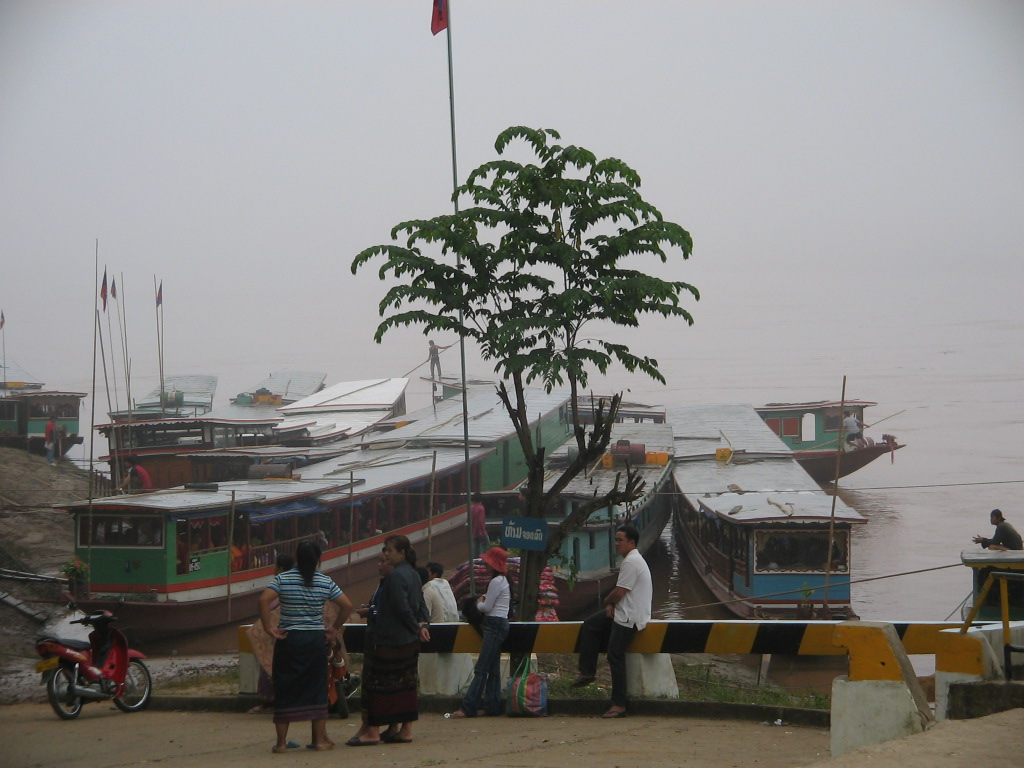
At the recommendation of the enthusiastic owner of the Aramid, we walked down to the slow boat landing for dinner overlooking the water. Seated at a table above the river, we watched as boats loaded and unloaded. A group of tourists arrived and trudged up the hill with their backpacks. Families watched the activities. Women bathed on the front of the boats, wearing sarongs – some families use the boats as both home and workplace. Joined by Sid Ficious, we took our first taste of Beer Lao and became instant fans. Robert ordered fish laab, I ordered stir-fried vegetables, and we shared both dishes with sticky rice. The sun slowly set on our first evening in Laos.

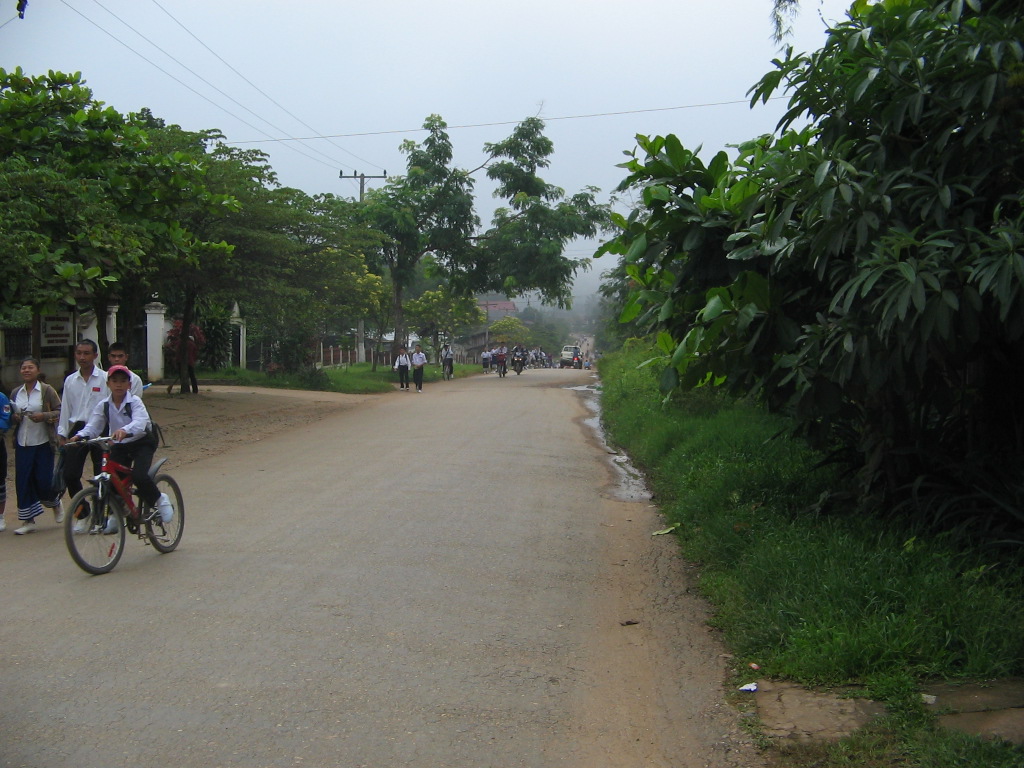
We had heard many rumors about the presence of overwhelming numbers of French baguettes in Laos, due to its colonial legacy, and we were eagerly anticipating them in the weeks leading up to our trip. In the morning at the Aramid, we were not disappointed: the wife of the owner made us fantastic "omelette sandwiches," the likes of which we’ve never had in Thailand. Well-fortified, we hoisted our backpacks once again and walked back to the slow boat landing, sharing the road with hundreds of students walking and riding bicycles to school.

Morning on the Mekong is foggy; we couldn’t see across to Thailand when we arrived, but as we waited nearly four hours for our boat to leave, it became visible. We were entertained by watching the continuing loading of the boats, including the transfer of hundreds of crates of Beer Lao between land and water. We also bought several more baguettes for snacking during the day. In the ticket office, Robert snapped a photo of some flags showing our location.

When a horde of other "farang" backpackers arrived from Thailand around noon, we settled ourselves onto the boat and got ready to depart Huay Xai.

Tuesday, October 24, 2006

To the Mekong


I’ve decided to write about our journey through Laos as a series of blog entries over the next ten days or so. There is so much to say, and so many photos to show. I’ll start first off, though, by saying that it was a fantastic trip – despite tiredness, upset stomachs, bus breakdowns (plural), and many hours long hours logged on various transport. I only wish we had had more time. I would gladly return, and recommend it to anyone who is considering making the trip.

Today I’ll give a brief summary of the first leg of our journey: from our house to Huay Xai, Laos. We left our house at the early hour of 8:45am and walked two blocks to a basketball court, where we boarded an ordinary, non-airconditioned bus that took us, over the course of many hours, all the way to Chiang Rai – the northernmost province in Thailand. The bus ride from our house north was a fantastic experience itself – we had never ridden in that direction before, and we got to see new places in our own district. Chiang Rai is beautiful – higher mountains, well-tended rice fields, cultivated hillsides. We spent one night in the city there and then took another scenic 3-hour bus ride to Chiang Khong the following day. Chiang Khong is one of the places where foreigners can cross the border – the Mekong River – from Thailand into Laos.

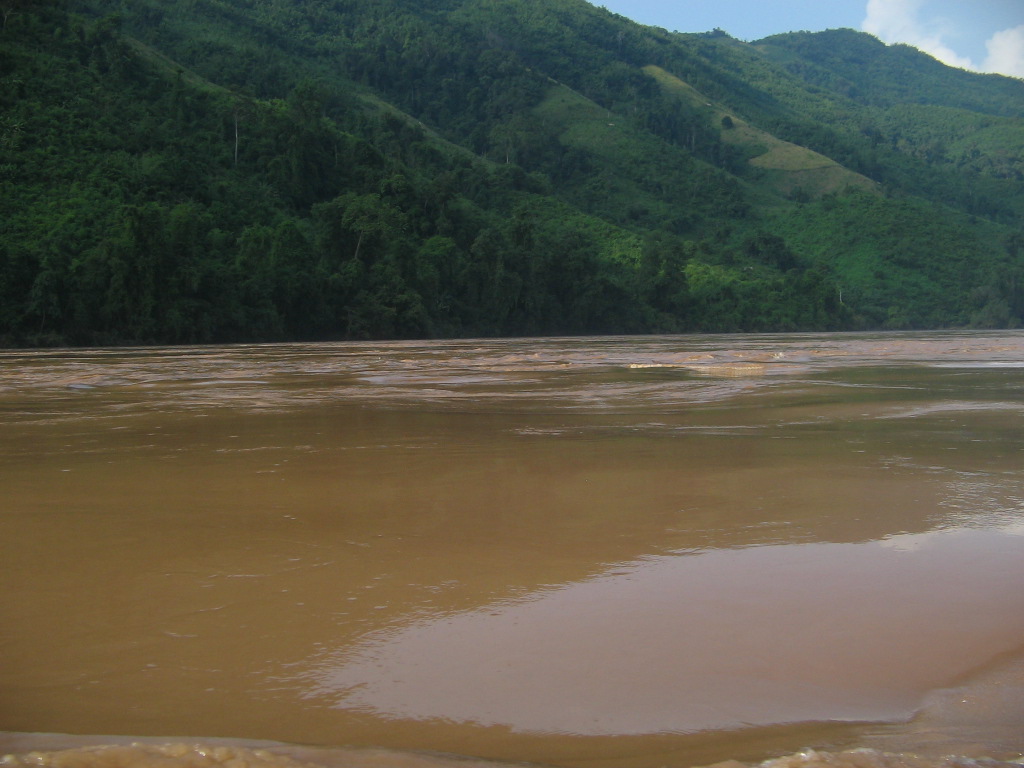
The Mekong impressed us at first sight. It was big, brown, and fast moving. We watched little boats fighting against the current as they made their way back and forth. Even the bigger boats seemed to have to work pretty hard. Laos, on the other side, looked green and lovely.

From Chiang Khong, we took a tiny river ferry across to Huay Xai, Laos. When I say tiny, I mean that it could only hold a few people, and we were just a couple of inches above the water! I spent the 10-minute journey shaking as I snapped a few photos and tried not to tip much to one side or the other.

We arrived in Huay Xai, paid what felt like an exorbitant fee for a visa (we’re Peace Corps volunteers, after all), and headed up the hill into town.

[The photos, mysteriously out of the order I tried to arrange, show the following: our bus to Chiang Mai, Robert standing on the Thai side of the river, a fish pal crossing on the little boat, and our arrival at Lao immigration.]

Tuesday, October 17, 2006

Hello from Laos

Robert and I are sitting in an internet cafe in Luang Prabang, Laos. I wanted to have a post on my blog from Laos, because I think it's cool!

We are big fans of Laos. I'll give more details about why, and some photos, next week when we return to Thailand. In the meantime, imagine us visiting historic temples and eating lots of baguettes.

Thursday, October 12, 2006

Kids and Instruments


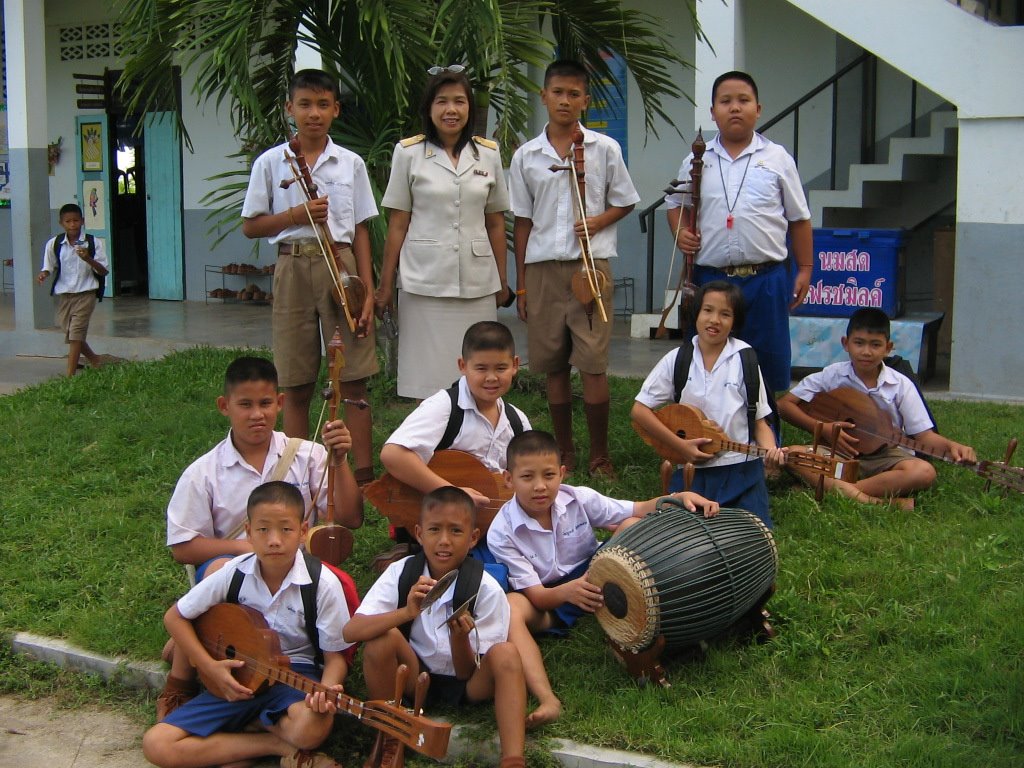
One thing many of the schools in our town are very good at, despite their other issues, is the teaching of traditional northern Thai music. Kids learn about the different instruments and how to play them, and they usually sound pretty good! It’s fun to hear.

This photo shows the music group at my Monday-Thursday school. There are 4th, 5th, and 6th graders. They are instructed by the principal and sometimes by high school students. My co-teacher, Ajaan Warangkana, is standing with them.

If you look closely at the photo you might notice the big blue milk cooler and the shoe rack, as well.

Wednesday, October 11, 2006

Boys and Milk


About ten years ago, someone in Thailand looked at students from Europe and America and observed that they are, on the whole, taller than Thai students. This someone also observed that in Europe and America, many kids drink milk every day. So the connection was made: milk = tall, maybe.

As a result, the Thai government now provides daily milk for all students in the country. Every day kids line up at the big cooler for their bag, or carton, and drink up. My students all say that they like to drink it, which is notable considering that Thai adults can’t drink milk without getting stomach aches. I guess the new policy has changed Thai digestion. However, they do all agree that soymilk is more delicious. (A non-milk-drinker myself, I agree with the soymilk lovers.)

Regarding floods, our house is still dry. We haven’t had much rain in the last couple of days – I think most of it is falling further south – but I make no predictions about what happens next!

Monday, October 09, 2006

I thought we were done with this!


Yesterday, in a fit of housekeeping that included washing windows and expelling dozens of spider webs from the ceiling (the spiders weren’t too happy), I decided to finally start unpacking the garbage bags we’ve had sitting around the house, filled with our stuff, for three months now. We hadn’t had much rain lately, and the river seemed quite normal. In the late afternoon, I happily curled up in the newly restored guest bedroom with a book, feeling like my flood troubles were over.

But I forgot that in Thailand, expectations and assumptions are generally worthless. So this morning when the phone rang shortly after 8:00am with a co-teacher warning us that the water was coming, I wondered why I had dared to be so optimistic. In fact, there is flooding in 43 of the 76 provinces of Thailand right now, so the only real surprise is that we actually are not yet underwater. Reports are that there is a bizarre convergence of heavy rains with high tides, so Thailand is being deluded from multiple directions, and will be so for another three days.

We spent today – our first official day off together this school break – doing myriad errands, chatting with other neighbors about flood worries, and checking the level of the river near our house every hour or so. (It did not actually reach our house today, though it came within a block or so.) It has gone down nearly two meters since it’s high level of the morning (shown in the photos), but who knows what tonight will bring? We plan to stay at our house to guard our things, unless there are any dramatic changes...

Parents, don’t worry, we have kind neighbors with 2-story houses.

Tuesday, October 03, 2006

Kids on Bikes

Transportation in Thailand has fascinated me from the first day of our arrival here in January 2005. Before dinner at the training center that evening, Robert and I stood by the side of the highway and watched the parade of vehicles flying by – pickup trucks, motorcycles, songtaews, and strange three-wheeled contraptions we had never seen before.

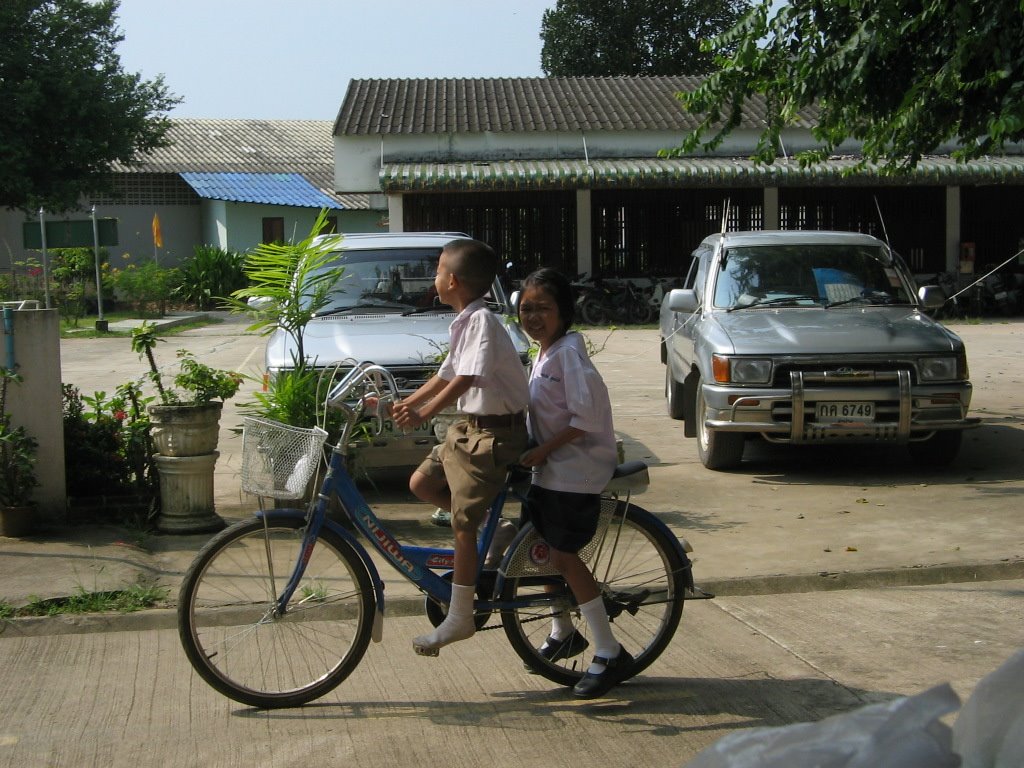
Kids get to school by means no less interesting. Some arrive on songtaews or the backs of their parents motorcycles. A few ride buses more like ours in America. Some walk. And many, especially elementary school students, arrive with their siblings or friends on bicycles, just like in the photo. It’s a skill they learn from a remarkably young age. I think I did this as a child, when we had "banana seats," before helmets were widespread in America, but I’ve long since forgotten how and I think it always was a little scary anyway. But Thai kids hop on and off all the time, no problem!

Our weather is just a tiny bit cooler this week, at night. Low 70's. It makes a big difference when it’s time to go to sleep! Days are still plenty hot, though.

Monday, October 02, 2006

Satah Banah


Yesterday morning my Tuesday-Friday school had a "satah banah" ceremony. It was the anniversary of the school’s founding. I had been invited to attend, and since it was a Sunday morning I dressed casually only to show up and find out that most everyone else was quite well dressed. Oops!

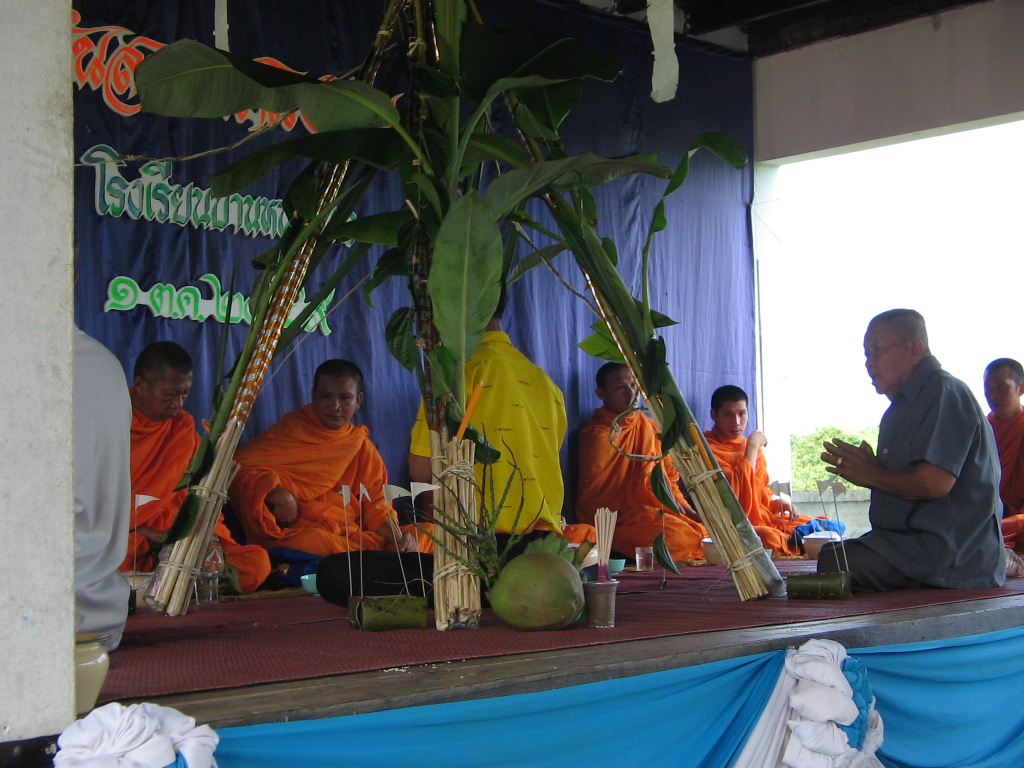
The ceremony was much like others I have seen. There was a lot of chanting, lots of food was given for the monks to take back to the temple, and special string was tied around everything. One new thing I hadn’t seen before was a bonfire-shaped stand of banana tree branches, under which the principal sat for the duration of the chanting. My co-teacher said that this was to wish him a long life.

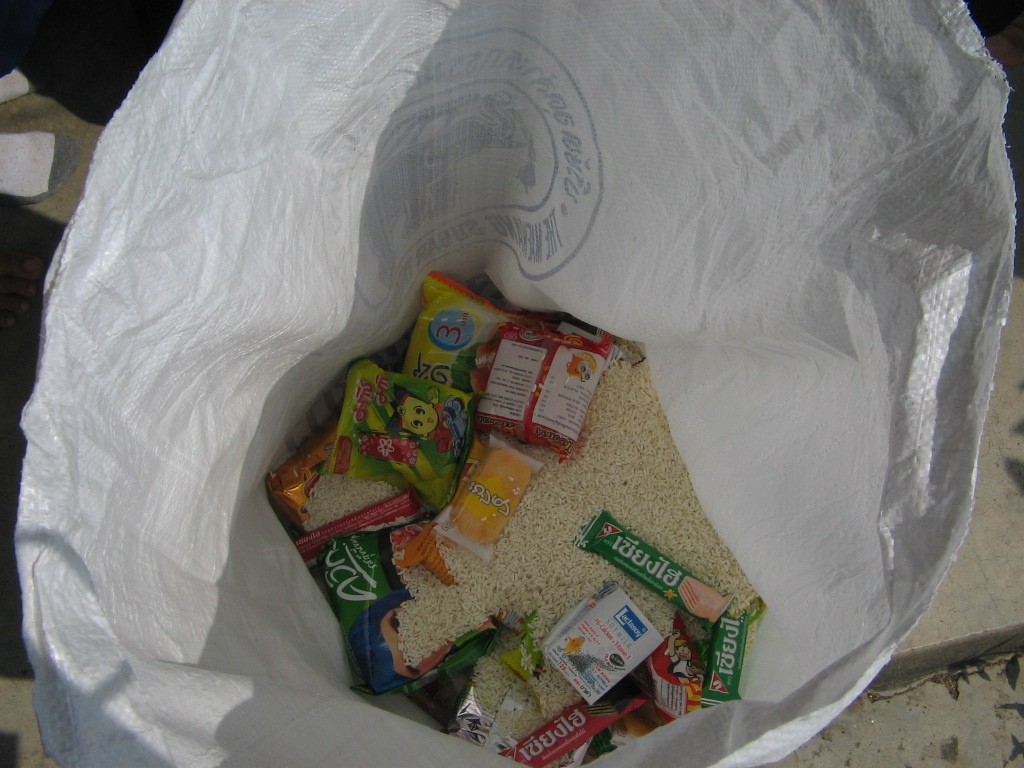
The photos show the head monk chanting next to a picture of the King; the principal sitting under the banana leaves; people putting food into the black monk bowls; a selection of food for the monks (sticky rice grains and packaged treats); and the head monk sprinkling the audience with holy water and blessings.

Thursday, September 28, 2006

One Year Ago


In honor of the one-year anniversary of our big flood, I am posting a photo of our house as it was seen that day from our neighbors’ upstairs window, where we had temporarily evacuated. Yikes! And, there’s also a photo from several months later, for comparison.

Weather has improved dramatically lately – the river has been down at normal levels for five days now. We heard reports today of a typhoon over the Philippines that might travel this far, but I have my doubts. In the meantime, things are looking good.

There was much grumbling over the past few days over the new uniform requirement. No one likes having to do so much laundry!

Wednesday, September 27, 2006

Unexpected Gathering


Last Friday evening, a remarkable coincidence occurred at our house. For the first time ever, we were asked by some Thai neighbors to translate a legal document from German. And also for the first time ever, we happened to have a native German speaker on the premises.

Late afternoon, while Robert was riding his bicycle home from school and stopping to pick up dinner on the way, I heard a car pull up outside and a friendly, "Hello?" at the gate. I hurried to the door and met Lena, the German exchange student living a bit north of town for the year. A week earlier, Robert had met her host mother, Mor Chatra ("Dr. Chatra"), the local dentist who runs the primary school toothbrushing programs. Mor Chatra had assured Robert she would bring Lena over soon.

The three of us sat on the porch chatting, and when Robert arrived he joined us as well. At about 5:30pm, Mor Chatra and Lena started to go to their car, as in walked our neighbor from across the street with an elderly couple. "Robert," she asked, "could you help us read this document?" Robert took one look and ran outside. "Lena, could we trouble you for some German help?" he called.

Lena was happy to help, and thus began a lengthy, stressful discussion about the nature of the documents. The elderly couple’s daughter had married a man in Switzerland, and then died, and the documents were the only information her parents had received. The 16-year-old Lena did her best to understand the German legalese (not being a lawyer, this tested even her native German skills) and soon determined that we were looking at a will. She would then translate into either English or Thai, at which point Robert or I would try to clarify the Thai for the older people. The whole process was made more difficult by the fact that they were hoping to get different information from the documents than what was actually there, and they couldn’t understand why their desired information wasn’t available.

Immediately after the neighbors left, Mor Chatra’s daughter and nephew arrived at the house and a fantastic downpour started. Since no one could leave in the rain (Thais hate getting wet in rain), Robert brought out banana chips and we spent more time chatting on the porch. It was an unexpected end to an unusual week in Thailand.

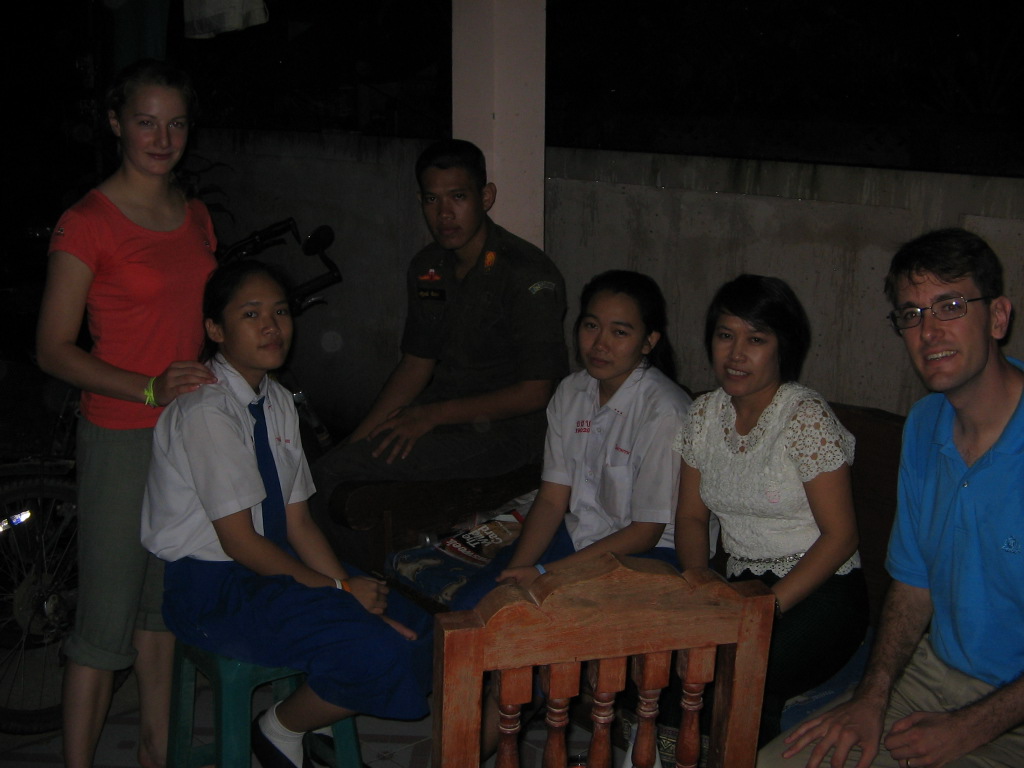
[The photo shows the above mentioned houseguests, as well as Milk, our neighbor across the street who attends school with Mor Chatra’s daughter.]

Tuesday, September 26, 2006

And Just Like That ---


Thai people love uniforms like no one I’ve ever seen. Status is important here, and clothing is a way of showing where you fit into the hierarchy. Farmers wear oversized long-sleeved plaid flannel shirts and thick head coverings. Nurses wear white outfits with little white hats. Students of all ages – from Anuban 1 (pre-school) to university – wear different uniforms depending on the theme of the school day. And teachers, yes, even teachers have uniforms in Thailand. Teachers are "ka ratchagan" – civil servants – and they must dress to show it.

During our first year in Thailand, the teachers’ outfits were more or less on a regular schedule, possibly depending on the particular school or the region of the country. For example, at my Monday-Thursday school, teachers dressed as follows: Monday – "ka ratchagan" uniforms (khaki, very official with rank bars and medals); Tuesday – sports clothes (school colors shirt and long black exercise pants); Wednesday – Scouts; Thursday – school uniform (dark blue suit with the school seal embroidered); and Friday – northern Thai.

This school year, because of the 60th anniversary of the King, there were some changes. In May, the order came down from above that all "ka ratchagan" were to wear yellow shirts on Mondays. Yellow polos with the King’s seal replaced the light brown uniforms. In June, Tuesdays were added to the yellow shirt schedule. Casual yellow shirts replaced the sports clothes. Suddenly, female teachers were wearing pants two days a week, and they enjoyed it. Some even started substituting black pants for their navy blue skirts on Thursdays!

Yesterday, however, a new order came from above. The difference is that, this week, "above" means the leaders of the coup. The new order requires that all "ka ratchagan" throughout the country wear the khaki "ka ratchagan" uniforms EVERY DAY OF THE WEEK. Starting tomorrow. No more yellow shirts on Mondays, no more northern Thai on Fridays, and no more pants for the women. All "ka ratchagan," all the time.

Reaction at our schools has ranged from irritation to resignation. Those teachers who only own one or two "ka ratchagan" uniforms – a majority – are trying to figure out how they will find the time to wash and dry them every day of the week. The stated reason for the new policy is because it will help soldiers to distinguish between real "ka ratchagan" and imposters, but it’s hard to tell if the teachers are buying this or not. In any case, it’s a fascinating example of what life can be like in a country where following the orders of your superiors – even when they are army generals who have overthrown the elected government and annulled the Constitution – is the only acceptable response.

[The photo, taken 18 months ago at my practice school during training, shows a teacher wearing the "ka ratchagan" uniform.]

Sunday, September 24, 2006

City Escape


On the spur of the moment after yet another downpour on Friday night, we decided to use this weekend to make a temporary escape from the blood-pressure-raising flood watch. Merissa, a volunteer who lives in a nearby province, and Bryn, another volunteer who lives in our provincial capital just an hour away, invited us to spend Saturday night with them at Bryn’s house. Hey, we thought, it’s been months since we spent time with other volunteers, we need a bit of social life! So we re-secured our possessions into the black garbage bags, re-packed those items that had been slowly spilling out over recent weeks, and re-hung the tea bags, spices, and toiletries on the window nails. Finally, mid-day Saturday we locked the gate and headed out of town.

Our nights on the town in the capital usually include dinner at a rambly wooden riverside restaurant that makes great pizza, and last night was no different. What was unusual, though, was that the tables where we usually sit were covered in muddy water. The lower level of the restaurant was flooded! We sat on the upper level and watched as servers walked across planks down below, between the kitchen and the staircase. A trip to the restroom at the end of the meal meant that I, too, got to walk the plank. (My beverage consumption over dinner did not make this feat any easier.) Only in Thailand would a restaurant continue business as usual while partially submerged in floodwater!

After dinner, Bryn led us further upriver to a night market that Robert and I had never seen. We met up with several of her Thai friends, one of whom sells handicrafts in the street outside her house. They were kind enough to serve us beer and popcorn while we chatted and watched the shoppers wander by.

And then... about a hundred feet away, we heard the thumping beat of Thai hip-hop music. Carrying our beer glasses, we moved towards the sound and discovered a group of teenage boys spinning and grooving on a mat. Breakdancing! They were really very talented – lots of fancy, flexible moves. We watched for at least 20 minutes before finally moving away.

At some point I looked around at the crowd, the market stalls, the lively chatting, and realized that back in our sleepy river valley town, our neighbors were all inside for the night. The only sounds would be crickets, roosters, and occasional mumbles of television or drunken men conversing. What a difference a city can make. We’re glad to live where we do, but it sure was nice to have a Saturday escape.

[The photo, taken over a year ago, shows Bryn on the left and Merissa on the right. These days, Bryn has long hair and Merissa’s is short.]

Thursday, September 21, 2006

No Bus for Us

A flood? A coup? A flood? A coup? A flood?

It’s hard to decide what to be more excited/concerned/nervous about – the daily rise and fall of our river or the military takeover of the government. Even just within today, my attention has bounced back and forth between the two situations numerous times. I’d say it’s exhausting, except that thanks to the coup we’ve been granted what feels like a free and unexpected weekend.

The "Standfast" for Peace Corps Volunteers in Thailand was lifted this morning, so we can leave our sites again, but we are not allowed to travel to Bangkok or Chiang Mai. We had originally been scheduled to go on a trip this weekend – starting one hour ago – with teachers from one of Robert’s schools. The primary destination? Bangkok. The hotel on the 2nd night? Currently flanked with tanks, as it’s in the heart of the government center.

The Peace Corps was, to put it mildly, a little shocked when Robert called today to tell them that the trip was still on, and to ask whether we should be packing our bags to join them or not. "They’re still going?" asked our Program Director incredulously. "But the place is full of soldiers!" said our Safety and Security Officer. "So we don’t have to go then?" Robert asked hopefully.

We were nervous about the trip anyway, since it involved two overnight bus rides during what has felt like the worst of the rainy season, and we were even less interested in going once the capital was taken over by the army. So I was relieved when Robert called me at school to confirm that indeed, no, the Peace Corps was not going to bend the rules for this one.

Many people did run home from school or work during the day to take care of their flooding houses, but that’s the OTHER river, on the OTHER side of town, not our river. So now we’re snug in our still-dry house, not on an overnight bus, and OUR river is back down to four steps below the road.

Wednesday, September 20, 2006

The Rain Still Falls (But More Lightly Now)

Since media is being censored, I’ll be cautious about giving too many descriptive details here, but I wanted to share a bit about what our first day of living under martial law was like.

For the most part, the average visitor would not have noticed any big differences in our town before and after the coup. Life seemed to be proceeding as normal, despite the post office, banks, and government buildings being closed. In fact, you might not even known that the school district office was closed. When we arrived late morning, it was full of people. A big meeting for area teachers that had been previously scheduled was still going on, and other employees who hadn’t wanted to sit at home on the surprise day off were milling about. On the whole, I might just say that things were quieter than usual yesterday. We didn’t even have our nightly serenade of Thai pop music blasting from the house next door.

A fellow Peace Corps Volunteer wrote a blog about the easily changing allegiances of Thais during the World Cup in June. Describing the atmosphere of watching a game with a bunch of Thai friends, he noted that they took the side of whoever was winning! Robert and I wondered if, at least publicly, that was also happening with respect to this coup. We live in the rural north, where support of the ousted prime minister has been traditionally high. But yesterday you wouldn’t have known that anyone here ever liked him. At one point, in a conversation with some employees at the school district office, Robert referred to what happened Tuesday night as a "coup." (To be fair, he used the Thai word for a regular coup, as opposed to a bloodless coup, which has a different word, we learned later.) The three women present looked shocked, and hurried to correct him that it had not, absolutely not, been a coup, it had been POLITICAL REFORM.

Right... Political reform. With tanks.

Tuesday, September 19, 2006

Yes, a Coup

We're just starting to learn a little now, but here's what I can tell you. The military has taken over the government here, and Bangkok has a lot of tanks and soldiers. It's "bloodless", so that's good. That's about all I know.

We did also hear that people in Bangkok were taking their photos next to the tanks, so that sounds like Thailand can't have changed too much overnight!

We first heard of it at about 11:30pm last night, when text message arrived simultaneously on both our cell phones. Peace Corps Thailand is currently under a "standfast", meaning that volunteers are not allowed to leave their sites or travel. We don't know how long this will be the case.

Perhaps the more pressing concern for us today is the level of the river. We had another night of torrential rain... Wish us luck.

Monday, September 18, 2006

Field Trip


During my first school year in Thailand, I used to get annoyed when unexpected field trips popped into the schedule. I thought it took too much time away from English teaching. But in my second year, I’ve adjusted my expectations and understandings of Thai schools, mellowed out a bit, and come to see field trips as enjoyable. So Sunday afternoon, when I got the message that we’d be visiting a Thai cloth factory yesterday, I was excited.

We left school at 9:30 – students walking in line, teachers in assorted motorized vehicles – and went up the hill to the house of a former county commissioner. He owns a cloth weaving operation with about 8 looms. He gave a talk to the kids and then showed them how the cotton is made into thread, and the thread into cloth. I was impressed by how difficult and intricate of a job it appears to be! He also talked about how the dyes for the thread are made from different local ingredients – leaves, fruits, etc. Now I know, when I buy cotton products in Thailand, how authentic they really are!

After the cloth factory, the teachers got back into vehicles and the kids walked down to the village wat (temple) for some prayers, meditation, and a speech by a monk on why you should obey your parents. Although my back got stiff from sitting in proper position for so long, it was still pleasant to sit and think and look at the paintings on the walls.

After lunch back at school, the 3rd-6th grades climbed into the backs of 3 pickups and we headed off to another nearby wat that they had never visited because it’s in a different village. There, we also did the requisite sitting and meditating, but the monk’s speech was hard to decipher because he spoke Pali (the official language of Buddhism, from India) instead of Thai. The kids were interested in the decorations and the history of the wat, though, so they still had a good time.

Although it was an enjoyable day, it was made slightly more difficult by temperatures near 100. Then a big storm came through last night, and the river is high once again. We’ll be extra cautious over the next few days now... It’s always something here.

Friday, September 15, 2006

Mine or Yours?


As I was washing laundry after school on Tuesday, I witnessed an unusual event that has since caused some internal reflection.

When I first heard the moaning, I thought it was the cat that has been hunting lizards in our yard lately. I quickly realized, though, that one of the women who lives across the road from us was making the unusual noise, rocking and moaning in front of her house. The moaning turned to howling, and occasional wild laughter, and a group of watching neighbors began to grow around the house. When a strange man pulled up on a motorcycle and began giving the woman a drink that made her vomit multiple times, I was sure that what I was seeing was a case of "pii kow," or possession by a ghost.

On my own, I would not have come to such a conclusion. I might have assumed that the woman was having a seizure or some other psychiatric experience. But because Robert saw this same woman have a similar episode last January, and had been filled in by another neighbor as to its presumed cause, I was pre-informed.

When Robert saw the "pii kow," it was cured by a monk who came and chanted over our neighbor. The strange man who performed the cure that I saw is called, I was told by my co-teacher yesterday, a "ghost doctor." Both times, the "cure" seemed to have the desired effects: the woman returned to her normal self.

My reflection over the days since the incident has concerned the questions: Whose explanation is correct? And, to what extent does it matter anyway? Some years ago I read The Spirit Catches You and You Fall Down, by Anne Fadiman, describing the true story of a Hmong girl with epilepsy whose parents and doctors could not accept one another’s assessments and treatments of her condition. The parents’ belief was that her illness was of a spiritual nature, while the doctors approached it scientifically. I wonder whether this week’s incident demonstrated a similar conflict between traditional and modern medicine. Whose interpretation is accurate? Was she possessed by a ghost, or is there a mis-wiring in her brain somewhere?

My co-teacher, who I discussed it with yesterday, told me that most educated Thai’s no longer believe in possession by ghosts (though they may still believe in ghosts in general). They accept the scientific explanation. It’s the rural areas where these beliefs still hold. I, myself, coming from the background I do, tend to believe more in the scientific explanations as well. However, in both incidents that Robert and I witnessed, the cure was not scientific but spiritual. I suppose it’s a question that cannot be answered easily, if at all.

The photo shows the area where it all took place.