Tuesday, July 04, 2006

Pineapple Glut


You know you’re living in a tropical country when...

As you exit the windy road through the mountains and ride along the west side of our valley, you can look out the window of your vehicle at hills covered in pineapples. Actually, you can just see the sprouty tops, because the fruit grows underground. These hills are very pretty, but even though I came to Thailand anxious to eat lots and lots of fresh pineapple, I’ve had more than my fill lately.

Apparently, pineapple growing was so profitable in our province for a while that many people started growing it who hadn’t done so before. As can be expected, the supply has outgrown the demand. About a month ago there were protests in our provincial capital by farmers claiming that the government owed them money for having grown all this pineapple. I don’t know all the details, but I do know that the governor, anxious to stop the protests, agreed to buy the pineapple from the farmers at the price of 80 satang per kilogram.

Now, 80 satang per kilogram is pretty much nothing at all. There are approximately 40 baht to the dollar, and 100 satang to 1 baht. So, 80 satang comes out to be about 2 cents. 2 cents, for 2.2 pounds of fresh pineapple. But even at that rate, and even with the primary schools taking advantage of the low price and buying it like crazy, they still can’t sell all the pineapples so they’re being thrown into big holes. (This is the story I am told.)

Last Friday at our English camp, lunch included stir-fried pineapple for the main course, with fresh pineapple for dessert. I felt a little high on sugar by the end of the meal! The teachers were surprised that I wanted to take a picture of pineapple. They were even more surprised when I explained that it’s a very expensive fruit in the United States.

(Other food items in the photo include red curry, rice and rice noodles, and fish sauce with chilies.)

Saturday, July 01, 2006

Trip to the Doctor


Peace Corps medical philosophy is that Volunteers are largely responsible for our own health care. Our first week in-country, we were given two medical books apiece and large medical kits. We try to handle most small problems on our own, with occasional phone calls to our Medical Officer, Dr. Rit, in Bangkok.

When something comes up that we can't do on our own, however, such as when we came down with bronchitis and sinusitis last summer or when I had tooth problems in January, Peace Corps will arrange appointments for us with appropriate doctors. Sometimes this means a trip to Bangkok, which for us is 12 hours of travel, each way, and a choice between missing school or riding an overnight train, or maybe both. Not feeling tempted by either of those choices, I requested to have my appointment this week in Chiang Mai -- an easier 4-hour trip. I also requested a Saturday appointment so as not to miss any school.

So, my short description of what's involved for this Peace Corps Volunteer to make a trip to the doctor:

The second day of English camp ended at 4pm Friday, and by 4:05 we were out on the highway waiting for the bus. It picked us up 20 minutes later, and we rode in relative -- though non-air-conditioned -- comfort along the windy mountain roads for over an hour until reaching our provincial capital. As it was Friday evening, as we expected, the buses to Chiang Mai were mostly full, but we were able to get standing room on a 2nd-class air-conditioned bus that left the station at 6pm. We stood our way across the next set of mountains, not entirely comfortable, until reaching a mid-point city just after 7. A number of people got off there and we were able to claim two seats for the remainder of the ride -- a huge relief!

We arrived in Chiang Mai shortly before 8pm, found a songtaew to our guest house, and checked in. I took a quick shower while Robert called an Indian restaurant to check their hours. By 10 pm, stuffed with cheap Indian food (see preceeding blog entry), we were back at the guest house preparing for bed.

We checked out at 9:30 the next morning and went off to find breakfast. For a little luxury I wanted good coffee, so we went to the Libernard Cafe for banana pancakes and cinnamon cappucino (orange juice for Robert). After breakfast, Robert went for a walk through the old city while I met with the doctor.

After being pronounced healthy, I met up with Robert in the hospital lobby at 11:30. We jumped in another songtaew, went back to the bus station, and found seats on a 12:00 bus back to our province. Not having to stand, I was able to read my book this time around!

We arrived back in our capital just before 2:00, so it was time for a little lunch. Big C is not far away, so we wandered in for some quick food and a few purchases before getting to our local bus line stop in time for the 4:00 departure. We were back at our house by 5:30pm, giving the entire trip to the doctor a total time of 25 1/2 hours.

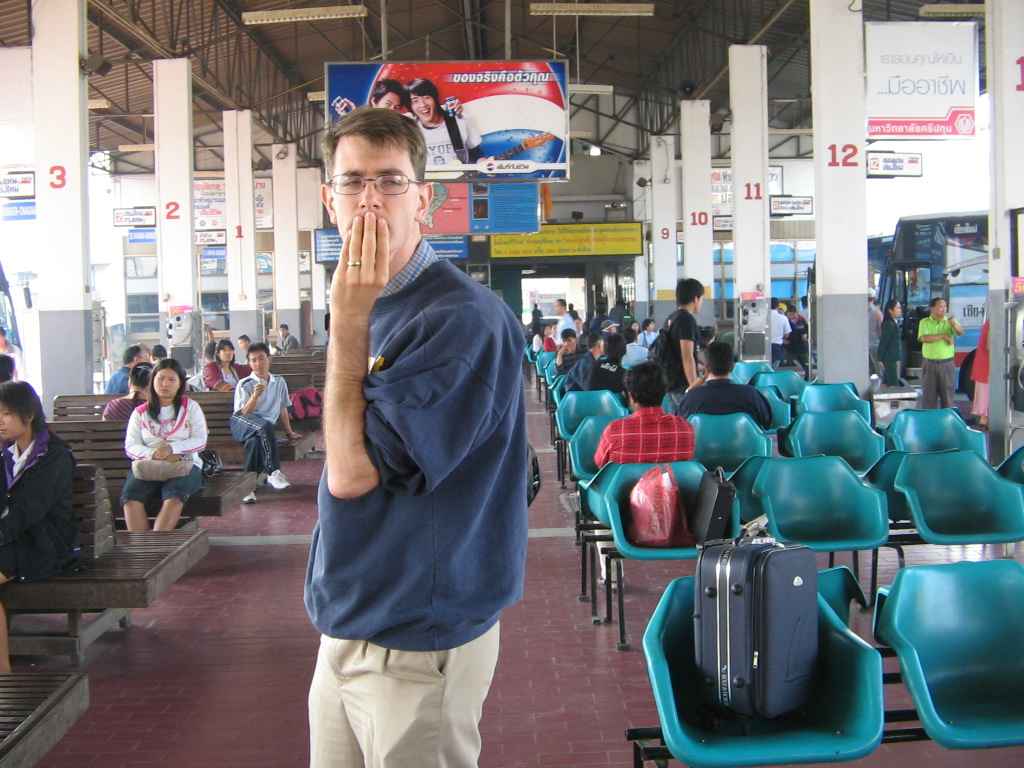
The photo shows Robert at the bus station in our provincial capital. It was taken in January, hence the sweatshirt.

Indian Restaurant Vegetarian Food

We have learned to interpret the recommendations of the Lonely Planet guidebook series with some skepticism. Their descriptions of lodging and food, though never entirely off the mark, will often have some error or omission that we'll wish we had known about sooner. Their listing of "Indian Restaurant Vegetarian Food" in Chiang Mai, however, was right on.

We arrived in Chiang Mai after dark on Friday evening. Hungry for some cheap but moderately healthy food, we called over to the restaurant to make sure they were open. "Oh, yes, come on in," they said. "What time do you close?" we asked. "Oh, whatever time is good for you," the woman replied.

We walked the short distance from our guest house to the restaurant. Located on a busy but quiet lane with many shops catering to the backpacker tourist crowd, Indian Restaurant Vegetarian Food looks like a small cafeteria with about 6 or 7 tables. Bollywood music videos were playing on the television, and the white walls were decorated with an assortment of Thai and Indian posters. Only one table was already occupied when we arrived, but by the time we left an hour later they were all full. A stout gentlemen with grey-black hair brought us our menu. "Are you hungry?" he asked. "Yes, we're very hungry!" we replied. I ordered some samosas to start.

The all-vegetarian menu contained all the standard curries, with a few additional options. We decided to each order a "thali" -- a selection of curries with rice and flatbread. When the stout gentleman arrived with our samosas, he was ready to take our order. "So you'll be having a thali and a dosa?" he asked. "No," we said, "we each want a thali." "Ok, a thali and a dosa, big for you to share," he continued. We looked at each other. "No, we don't want dosa. Just two thalis," we tried again.

"Oh, two thalis!" he answered. "Ok. So you will have some lentils, some paneer, and some capsicum curries?"
"Well, can we choose our own curries?" we asked hesitantly.
"Choose, ok."
"I would like lentils, chickpeas..." Robert started.
"No chickpeas. How about capsicum?" said the gentleman.
"Err... how about these potatoes and peas?" tried Robert. "And some potatoes and tomatoes?"
"Ok, and one more," said the man. "You want capsicum?"
"How about potatoes and paneer?" Robert asked.
"Potatoes potatoes potatoes!" exclaimed the gentleman. "All you are eating is potatoes!"
"I like potatoes," Robert replied.

"Ok," the gentleman turned to me, "and you will have four different curries that I will choose for you?"
"Well, I would like dahl too," I started.
"Ok, dahl too," he replied, "and capsicum?"
Capsicum (bell pepper) curry didn't sound very appealing to me, no matter how much he was pushing it. "Can I have yellow pumpkin?" I asked.
"Ok, he said." "And capsicum?"
"And how about spinach and paneer?" I continued.
"Ok, and then capsicum?"
I gave up. "Ok, I'll try the capsicum." I said. We ordered two mango lassis and dove into our samosas as soon as he was gone. They were outstanding, though better on their own than with the accompanying sauce.

While waiting for the arrival of our thalis, we watched the woman in the kitchen, presumably the wife of the gentleman who took our order, juggle the various pots and pans on the stove. It seemed to be very much a family operation.

When the food came, we were not disappointed. The dahl was fantastic. Although there were a few changes from what we remembered ordering (we both ended up with capsicum), everything was delicious. The individual flavors in each curry stood out well, especially the yellow pumpkin. The flatbread was good, and the rice was an aromatic variety I haven't seen in Thailand. The mango lassies were refreshing and not too sweet.

At the end of the meal, our total bill -- including samosas, 4 scoops of curry apiece, rice, flatbread, water, and mango lassis -- came to just 290 baht, or about $7.50. We were impressed. Completely stuffed, we walked back to our guesthouse and vowed to return to the gentleman's Indian restaurant as often as possible. If he pushes the capsicum, we may take him up on it again.

To get to Indian Restaurant Vegetarian Food, enter Soi 9 off Moon Muang Road (along the moat). A short walk down the soi, the Local pub will be on your right. Turn left to walk away from it and you'll see the big white free-standing sign listing cheap Indian vegetarian foods.

Thursday, June 29, 2006

Spitting Llamas?


"How about a giraffe? What sound does a giraffe make?"
"I don’t think a giraffe makes a sound."
"A penguin? That can’t make a very fun sound. How about a beaver?"
"A beaver probably makes a sound like this: (gnaw and cluck with front teeth sticking out)."
"Yeah! That’s good for a beaver. They’ll like that. What else?"
"Does a llama make a sound?"
"That llama on Sesame Street used to make a squealing sound, but it wasn’t very pleasant."
"How about if it sort of snorts and spits? A llama might do that. But then the kids might all start spitting instead of singing..."
"Maybe if we do the llama last, then the song will be almost over anyway, so they won’t have a lot of time to spit."
(Pause)
"Can you believe this is our dinner table conversation?"
"Yeah, why did I bother learning the Library of Congress catalog system, writing a thesis on Quebec’s Quiet Revolution, and studying Foucault’s theories of post-modernism in history?"

If you had been a gecko on the wall around 6:30pm in our pink house, as I was clearing the dishes and Robert was finishing off his pad si iew (stir-fried noodles with soy sauce), you would have heard an extended version of the above conversation. It took place at the end of the first of two days of the English camp we are running for 6th graders at 5 schools in our town. There are 129 students, divided into 8 groups, with each group represented by an animal that lives primarily outside southeast Asia.*

The camp is actually a science and English camp, with 8 different stations. Our four English stations include Animals Around the World, Landforms, Weather, and Conservation. To liven up the Weather station a little, we selected vocabulary words like "typhoon" and "blizzard" instead of "rain" and "snow".

Overall, the first day went well. The teachers enjoyed their stations, and the kids said they were having fun. We’re trying to liven a few activities up for tomorrow, though, and the snippet of conversation above is part of our attempt to map out "Old MacDonald Had a Zoo" for the morning’s opening song.

One highlight of my day, unrelated to spitting llamas, was discovering a bizarre Thai dessert that I actually liked. Usually I don’t like traditional Thai desserts, because they either a) are gelatinous in texture and come in colors like fluorescent pink and green, or b) have a meat filling, like pork or shrimp. There is a particular dessert, though, that is only partially gelatinous and comes in a nice shade of light brown that I don’t mind too much. Today I picked up a piece during the morning coffee break, but when I opened it I discovered that it had a new ingredient that made me nervous.

"Ajaan Wirinton," I said to the teacher working at the Conservation Station with me, "does this have any meat in it?" "No," she replied in a reassuring voice, "you can eat that!" Ajaan Dara came over and verified. "Thai desserts are usually just sugar and coconut milk, no meat!" they agreed. "That one just has some onions! It’s still vegetarian!"

"Right..." I thought, "just some onions. Exactly what I expect to find in my dessert!" But I took a bite, and what do you know, it was really good. So there you have it: sugar, coconut milk, and crispy fried onions: a surprisingly tasty treat.

*The animals, in addition to giraffes, penguins, beavers, and llamas, include kangaroos, woodpeckers, hippos, and camels.
And yes, Robert really did make the commend about Foucault’s theories, etc.

Sunday, June 25, 2006

Neighbors


Growing up in the Merriam Park and Macalester-Groveland neighborhoods of St. Paul, I was used to wide streets, front and back lawns, grassy boulevards, and plenty of space between houses. It was rare to hear neighbors talking inside their house, listening to their music, or cooking their food.

Life in our small town has been a good crash course in high-density housing – at least the kind you might encounter in a hot climate where most doors and windows are open most of the time. Few secrets could be held in our town, because you can hear much of what is happening in the neighbors’ homes. We know when they are making dinner, watching TV, taking a bath, yelling, or playing. Fortunately for us, I think, the language barrier works in our favor – I don’t have to worry about people understanding the conversations I have with Robert, and I can tune out much of what is happening outside in a way that I might not be able to if it was in English.

Despite the noise and relative lack of privacy, however, I have grown used to living in such a close space. It’s nice to know that if you had a problem, it would be easy to find someone to help out. Many of the sounds have grown comforting in their own way: garlic sizzling in the wok, wooden window shutters closing, chairs being dragged back under the awning for the night. As I type I can hear water running as the dishes are washed next door.

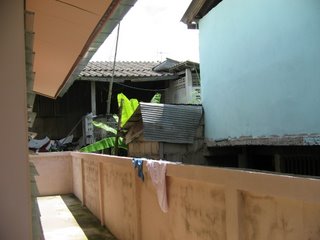
In the photo, our house is the pink one, the blue is next door, and the brown is behind.

Thursday, June 22, 2006

Neighborhood Clean-Up


Twenty minutes before I left the house this morning, my co-teacher Warangkana called to tell me that today was neighborhood cleanup day in one of the villages that feeds our school. Good thing we didn’t have important lesson plans! I rode my bicycle over and met up with the students – grades 3 and 6 – across the river, where they were filling bags of trash.

A major goal of the neighborhood cleanup, which takes place in all villages in our area at the start of every rainy season, is to prevent an outbreak of dengue fever. Dengue is spread by daytime-biting mosquitoes who like to lay eggs in standing water. The students, together with the teachers and a group of local health volunteers, distribute little packets of "mosquito sand" * to the people in the village and help put the mosquito sand in the various buckets of water that stand around the houses. I think they also try to discourage people from keeping buckets of standing water in the first place.

I was excited to get to be part of this activity for several reasons. One, I always like to go deeper into the neighborhoods where my students live and see what things are like. I got to see several of their houses today as well, which I’ll describe more in a later blog. Two, I think it’s pretty cool that the school teams up with the hospital to do community outreach in the village. That’s a great example of working together. And three, I really don’t want to get dengue fever. It’s not one of "those" diseases "over there" – you can really get it here! Three volunteers have gotten it since we arrived in Thailand, and all of them described it afterwards as pretty awful. So despite the fact that I was sweltering in the heat and had sweat dripping down my back all morning, I was having a good time.

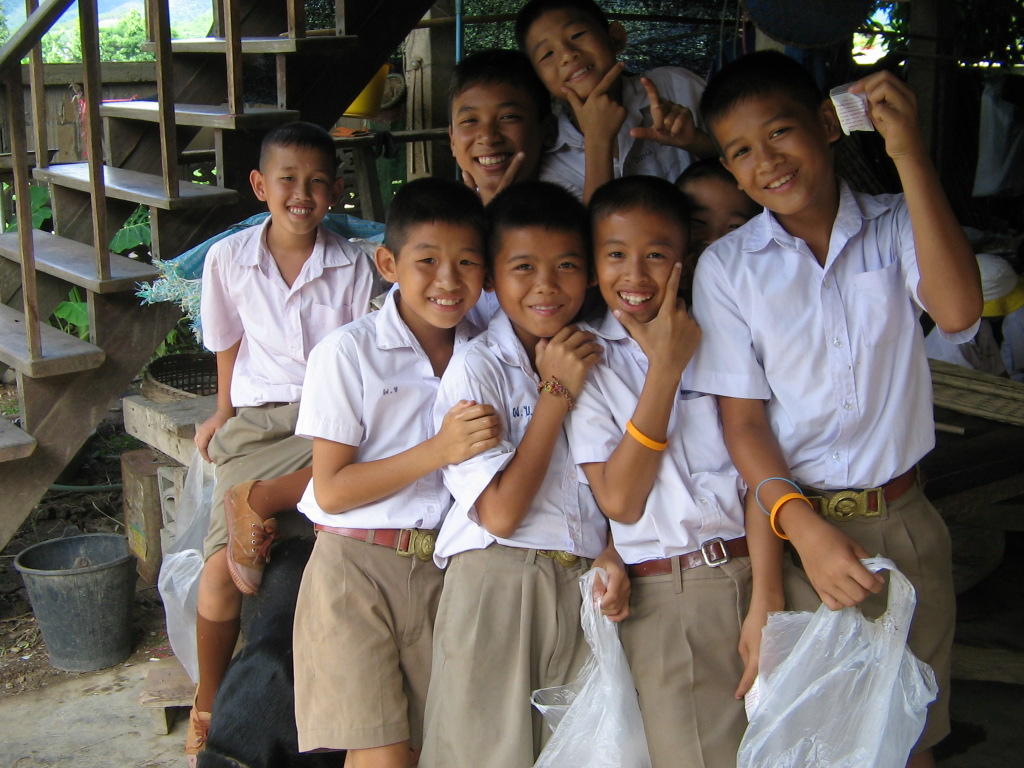
* "Mosquito sand" is not an official term. It’s what the 6th grade came up with in English class to describe what they had been doing. I assume the substance is some sort of pesticide. My co-teacher said that it would make us sick if we ate it, but it doesn’t kill mosquitoes – it just stops them from laying eggs in the water. The only words in English on the back of the packet are a brand name "ABATE," and the ingredients tetramethyl and thiodiphenylene bis (phosphorothioate). Not being much of a scientist, I can’t explain those, but maybe someone else can? The close-up photo of the boys shows one of them, Giangsak, holding up a packet.

Wednesday, June 21, 2006

Nam Prik Het


Most of the time, I don’t make Thai food when we’re in our house. I know I should be practicing for when we return to the USA and I want to make it myself, but it’s just not as delicious when made by me as it is when made by people in our town! But last week the teachers at my school helped me learn to make one of my favorite dishes, and since then I’ve made it at home three times.

"Nam Prik" translates literally as "chili water," and there are dozens of varieties of it in northern Thailand. Nam Prik Num is a basic chili dip made primarily with green chilies and garlic, and sometimes fish sauce or fermented fish sauce. Nam Prik Ong, Robert’s favorite, has the addition of tomatoes and pork. But my favorite is Nam Prik Het, made with forest mushrooms that spring up from the ground when the rains are heavy.

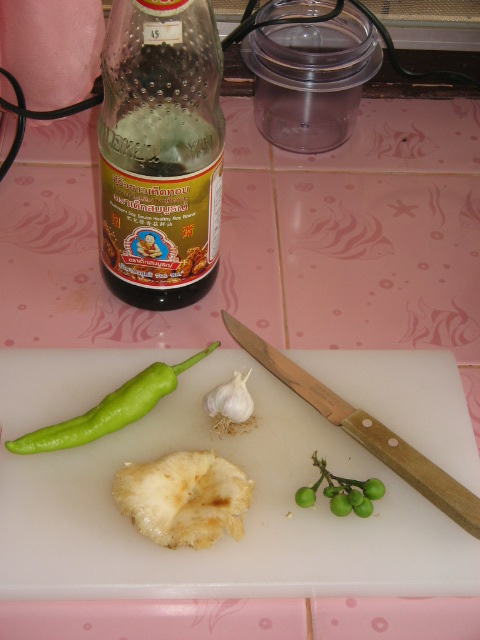
The ingredients in Nam Prik Het include: the forest mushrooms mentioned above (I don’t know the name of the variety in English, but I’m sure that other large soft mushrooms could be substituted); fresh green chilies; a bunch of garlic cloves; some small round green things that grow on a stem (I have no idea what they’re called, either, sorry!); and a little soy sauce.

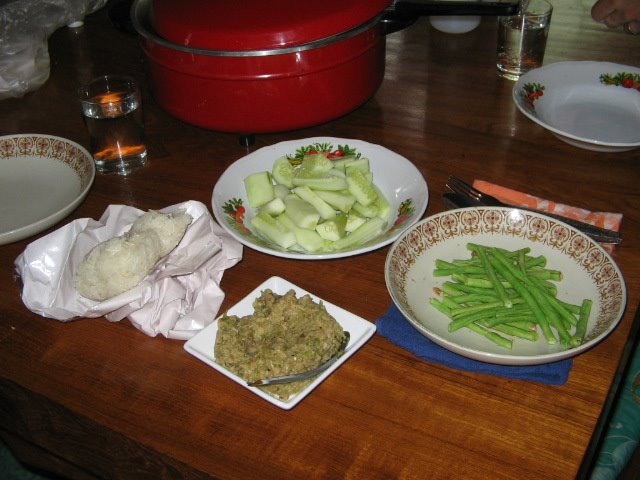
First, you roast the chilies until they are soft and a bit blackened. I do this in the wok. Next, you grill or roast the mushrooms until most, but not all, of their water is gone. Then, take the chilies, garlic, and little green things and smash them up in a mortar (if you’re traditional) or a blender attachment (if you’re me). Add in those warm mushrooms and some soy sauce, keep smashing a bit more, and you have a tasty dip. We like to eat it with sliced cucumbers, green beans, boiled eggplant (not pictured), and sticky rice.

Tuesday, June 20, 2006

"Seven"


When one applies to and is accepted to the Peace Corps, one often has an image of the "developing" country as being almost entirely without modern conveniences and services. Certainly, many Peace Corps countries are this way, such as Mali in West Africa where my sister spent two years living in a mud hut with no running water, electricity, or telephone service.

Most of Thailand does not fit that description, however, as I realized the first time I stepped into a 7-11 way back during our training in early 2005. Not only was it air-conditioned, it had ice cream, candy bars, yogurt, wheat bread, Corn Flakes cereal, and Lays potato chips!

In Bangkok and other large Thai cities, there might be a 7-11 – called "Seven" by the Thais – nearly every other block. It is quite an institution. We’ll often duck in on our way to or from the Peace Corps office to grab some bottled water, a cell phone card, or some deodarant. Our town does not have one, however, which is probably a good thing. We have to travel 50 kilometers on windy mountain roads before seeing the bright red and green. I’m happier to support our local shops anyway, even if they don’t have M & M’s. A Peace Corps Volunteer does not need to have everything!

Friday, June 16, 2006

Khantoke


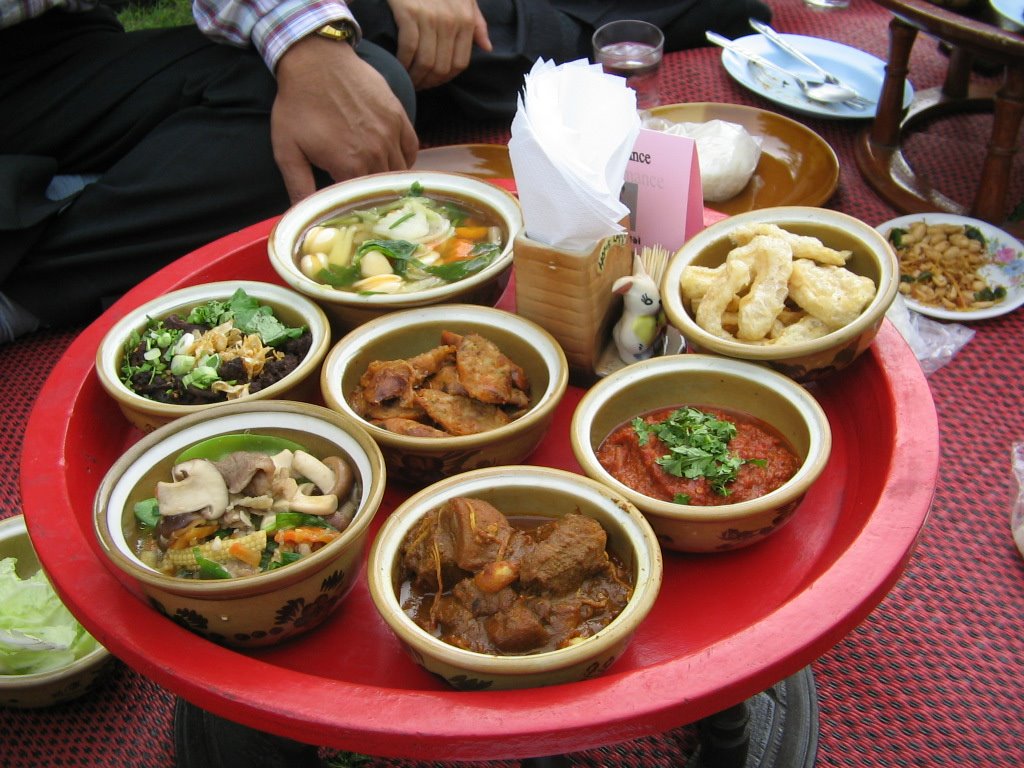
Last night we were invited to attend a Khantoke dinner at Jae Hom Wittaya, the local high school. A khantoke is a small round table filled with many dishes, usually including a vegetable stir-fry, a Burmese-style curry, a northern minced meat spicy salad, fried pig skins, spicy sausage, and various other assorted items. Because it is a traditional northern Thai-style dinner, all food is eaten with sticky rice.

This dinner was given in honor of a group of foreign exchange students who arrived in Thailand 2 months ago and are living in various provinces all around the country. They came to our province to attend a camp at a national park. We got to chat with a few of them, including one from Minnesota!

The entertainment at the khantoke was performed by Thai students at the high school. They did a number of traditional dances including classical style, swordfighting, fire-throwing, and drumming. It was very pleasant to sit on ground and watch while snacking on peanuts roasted with ginger and kaffir lime leaves. Mmm.

Thursday, June 15, 2006

The Rambutan


Thailand has many interesting fruits. During my last 10 months here, I will try to highlight some of them as they come into season.

Shown in this picture is the lovely rambutan. Robert once described it as a red fruit with green hair! I usually use the prongs of my fork to slice it open around the middle (though most people use their thumbnails), until out pops a white, football-shaped sweet fruit with a big seed in the middle. It can be a bit difficult to eat sometimes – I’ve had more than one fly out of my fingers and onto the floor – but it’s quite tasty, and rather festive, too.

(The other fruits are oranges, which are green in Thailand, and some other sweet-sour thing that grows in the forest that I didn’t like very much.)

Wednesday, June 14, 2006

Sick!

One of my friends wrote me a letter several months ago asking what I miss from home when I'm sick over here in Thailand. This week I can answer that question very easily!

Last week, Robert and I spent three days helping at our school district's English camp for gifted high school students, which took place at a nearby national park. As English camps go, it was a pretty good one, but as usual we didn't get enough sleep and came down with illnesses immediately following.

The first thing I miss is COOL AIR. When you are sick -- headache, fever, sore throat -- there are few things more unpleasant than lying in bed sweating even while the fan is blowing on you. It keeps you from getting that sleep you need to recover! It also keeps you from wanting to drink the hot tea that might be so helpful for your throat.

The second thing I miss is HEALTHY CONVENIENCE FOOD. At home, when sick, I could easily open a can of soup and heat it up on the stove. Here, I can choose between more intensive cooking (the healthier choice) and local take-out (the faster choice). But again, when you're hit by fever, neither of those choices is particularly appealing.

The third thing I miss is TV, or movies anyway. Yes, we can watch movies on our DVD -- and we did, a bit, on Saturday and Monday -- but setting up the computer and speakers and all the cords is more labor intensive than just walking into the living room and pushing a few buttons like I might have at home. We don't have a real TV here -- and we don't want one -- but once in a while it might be a nice break.

The last thing I miss is PERSONAL SPACE. Back in training, our Peace Corps doctor said to us, "Thai people are very into being sick." This is true. As soon as our neighbors-co-teachers-supervisors-anyone else knows that we're sick, they'll start pelting us with questions: Have you been to the doctor? Did you take medicine? Are you drinking warm water? If the answer to any of those is "no," it will produce an additional flood of questions: Why haven't you been to the doctor? Should I call the hospital for you? Do you need a shot? Why haven't you taken _XXX_ medicine yet?

The questions are all very well and good, and they show a genuine interest on the part of our Thai neighbors in their desire to attend to our health, but sometimes I want to say that what I really need is a night in a quiet, rooster- and karaoke-free, cold building with no one to ask me any questions!

Saturday, June 10, 2006

60 Years of the King


This year Thailand is celebrating the 60th aniversary of the King. King Bhumibhol ascended the throne in 1946 and is the longest reigning monarch in the world. In fact, a Peace Corps Volunteer did some research last week and determined that the only monarch who ever reigned longer was Ramses II of Egypt (66 years). So it’s an impressive statistic here in Thailand.

More amazing than the length of his reign, though, is his record of development projects in the country. Not one to sit on a throne and give commands, this King has spent decades traveling to distant rural villages, promoting education and public health, and sponsoring all sorts of programs designed to help the Thai’s – and hill tribes living in Thailand – to help themselves. The people love him, and with good reason.

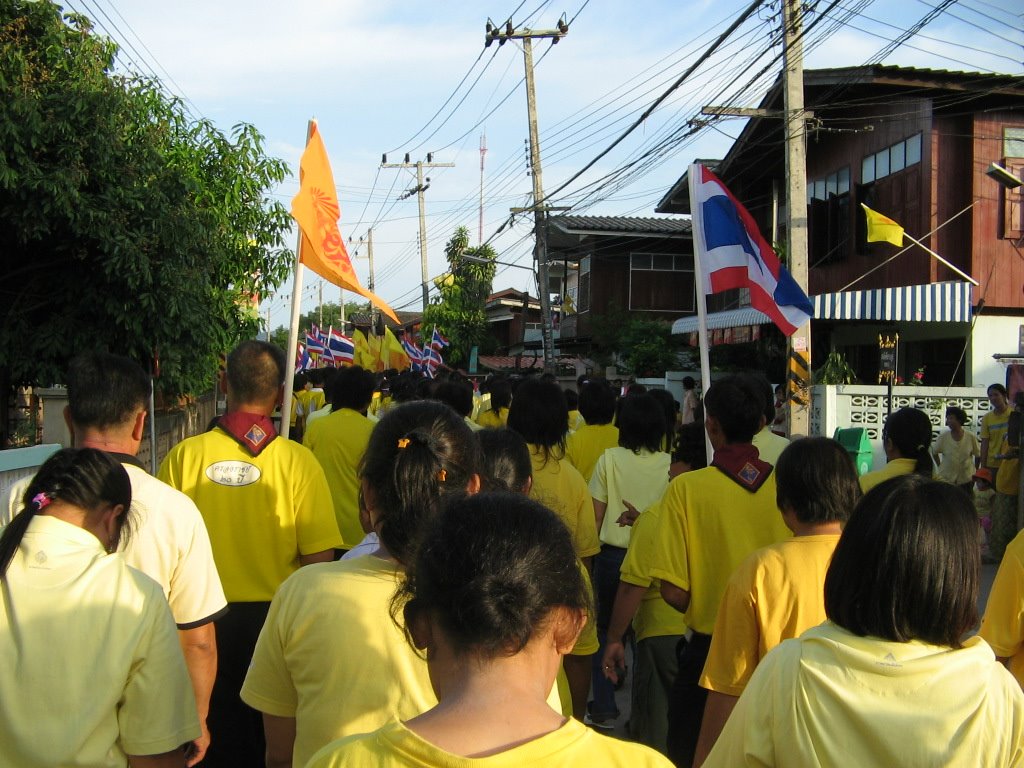
Friday was declared a national holiday so that everyone would have an opportunity to join in the celebration. (In typical Thai fashion, the declaration was made on Tuesday night, so those of us off at English camp didn’t get to enjoy our holiday until it was nearly over.) We made it back from camp mid-afternoon, so we had time for a quick shower before re-donning our yellow shirts and orange "Long Live the King" bracelets. (Yellow is the King’s color. Thailand has been experiencing a yellow shirt shortage in recent weeks.)

Our town’s parade started at the basketball court near our house and moved up the main road to the town government building. There, we were able to look at some displays showing the King’s life and accomplishments, purchase local products and snacks, and participate in the candle ceremony after sundown. We were both moved during the singing of the King’s anthem. It’s a beautiful song, and being able to honor him in that way with a crowd of adoring Thai’s was a singularly unique experience.

Tuesday, June 06, 2006

Grace

In many ways, four years of teaching in a Catholic school prepared me well for teaching in Thailand’s public schools. The schools, being Buddhist, incorporate religion throughout the day (at least nominally). Morning prayers are said after the national anthem, a picture of the Buddha hangs in the classroom, and all school ceremonies include giving offerings to the Buddha statue.

An educational movement called "Buddhist Way School" is moving through Thailand now. The idea behind it is that if the daily life in a school is centered and designed around a Buddhist philosophy – one that teaches the students moderation and mental discipline – students will have better behavior and academics will improve. In theory, and if implemented well, it seems like a good idea. The schools in our town are just beginning to follow the "Buddhist Way" plans.

One of the features of the Buddhist Way school is an extended communal prayer before the lunchtime meal. At both of my schools, the students enter the cafeteria, sit down with their trays of food, and then wait to be given a signal. At the signal, they all lift their hands into the "wai" position and say the grace. At one school, it is led line-by-line by the head of the student body, with all other students repeating. At the other, they all speak the entire grace together.

In the photo you might notice: tablecloths on the tables, portraits of the King, Queen, and a monk hanging over the doorways, the teachers’ lunch table through the doorway on the left, all boys have the same haircut and all girls have the same haircut.

Saturday, June 03, 2006

Toothbrushing


Back in April I posted a blog about the cavities I’ve developed here in Thailand. At our mid-service conference in April, where all of us January 2005 arrivals had our doctor and dentist check-ups, it turned out that I was not the only one to experience this disturbing phenomenon. (One volunteer had SIX cavities, which certainly beat my four. Robert, amazingly, had none.) The general theories for why this is include the higher sugar levels in the Thai diet and the lack of flouride in our drinking water.

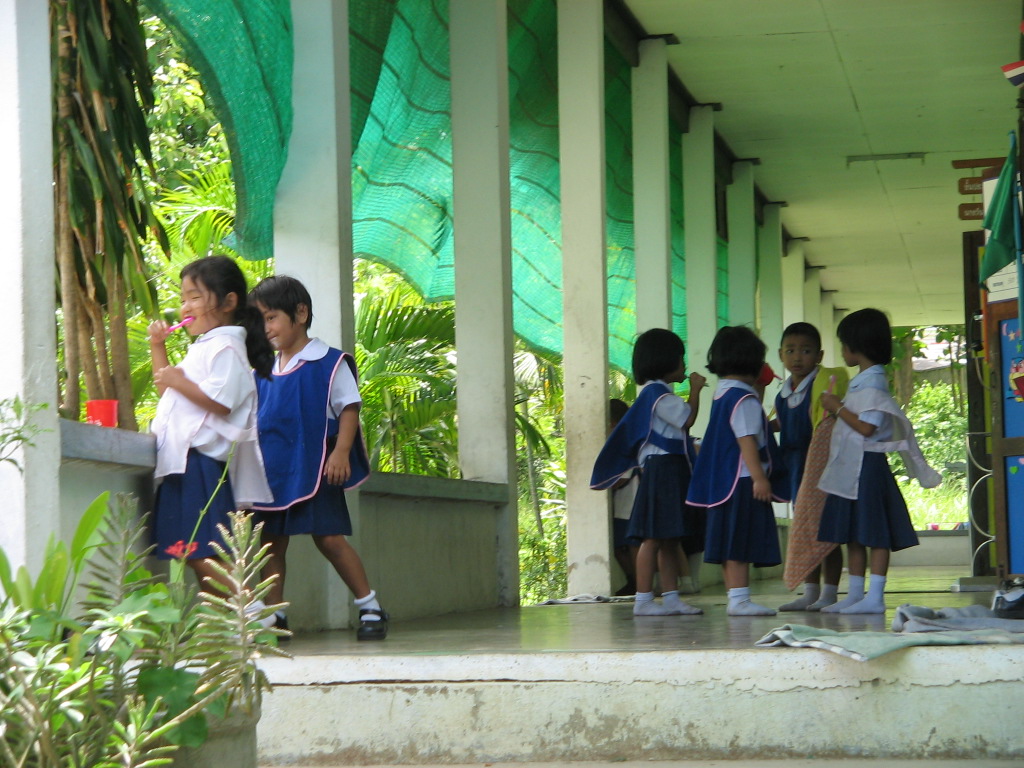
In any case, it seems as though dental health is something that the Thai school system takes somewhat seriously these days. All across Thailand, after lunch is finished, kids troop down to the toothbrushing stations (or canals, or water troughs, or whatever feature is available at their schools) and brush. At many schools – including the four at which Robert and I teach – this is all coordinated by a selection of songs designed just for this purpose: the "call to the toothbrush" song, the "how to brush your teeth" song, and the "now it’s time to return to class" song. The "how-to" song includes such great lines as "now, the upper-left! now, the lower-right!"

While I give high marks to the toothbrushing program, it’s clear to me that there are other steps that could be taken to ensure the students’ dental health. For one, the schools do not need to have canteens selling sweet treats during the lunch hour. Similarly, the local ice cream man does not need to be given permission to sell ice cream to the kids on the playground even before the end of the school day. It’s said that American kids eat way too much junk food – and that’s certainly true – but I will say that after plenty of experience watching kids eat junk in both countries, Thai kids are definitely come out ahead in the sugar race.

Yesterday, the dentist came to one of my schools and my co-teacher and I watched him check all the 6th graders mouths in the hallway outside the classroom. Only 4 out of 18 had cavities this time, so I guess that’s not too bad. When he returns I may get to watch him fill them in the meeting hall, like I did last year!

Thursday, June 01, 2006

Wan Wai Kroo


Today was the hottest day we’ve had so far this year. It was also Wan Wai Kroo – the day of honoring teachers. So we all got to be really, really hot in our nicest clothes.

At my school, the ceremonies began shortly after 9am and included several parts. First, the teachers, principal, custodian, and two student body leaders gave offerings to the school spirit house. Next, the same group along with the student council paid respects to the school Buddha statue, King Rama V statue, and King Rama VI statue. We then joined the rest of the students in the meeting hall. They did some chanting, and then two representatives from each class brought a flower arrangement to the teachers.

Following those "honor" ceremonies, the principal gave a speech about being good students and good community members. Then all the students receiving scholarship money from the community fund to help pay for books and supplies lined up to get their envelopes. After some picture taking, the event was concluded and we returned to swelter in the classroms for the remainder of the day!

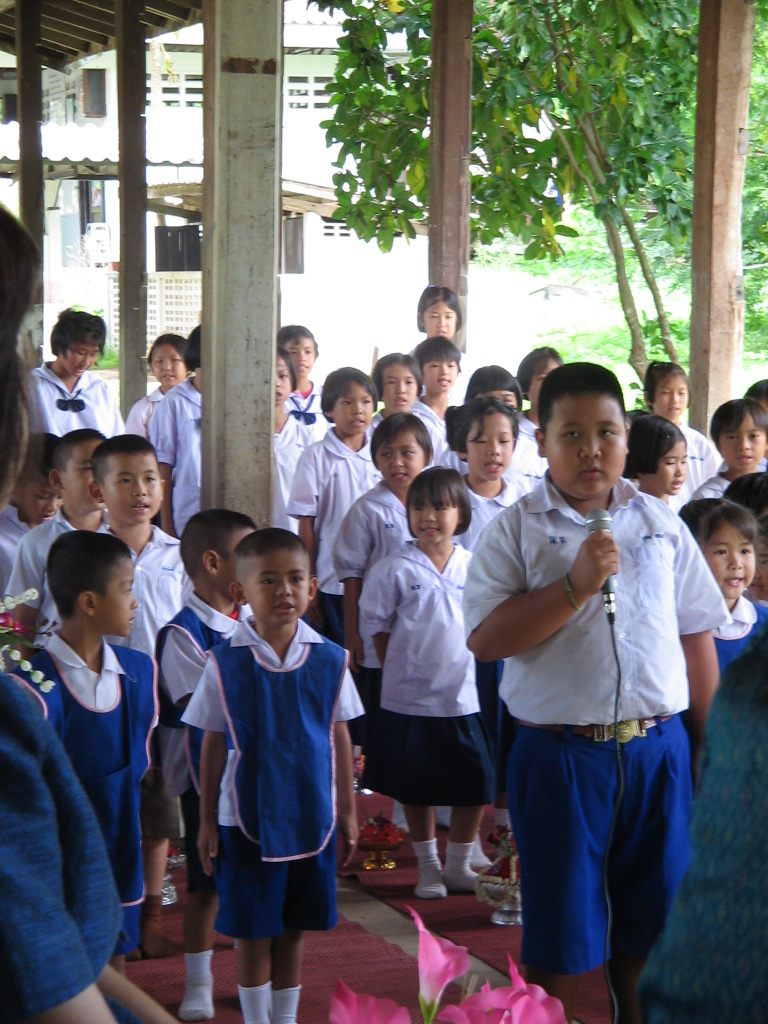
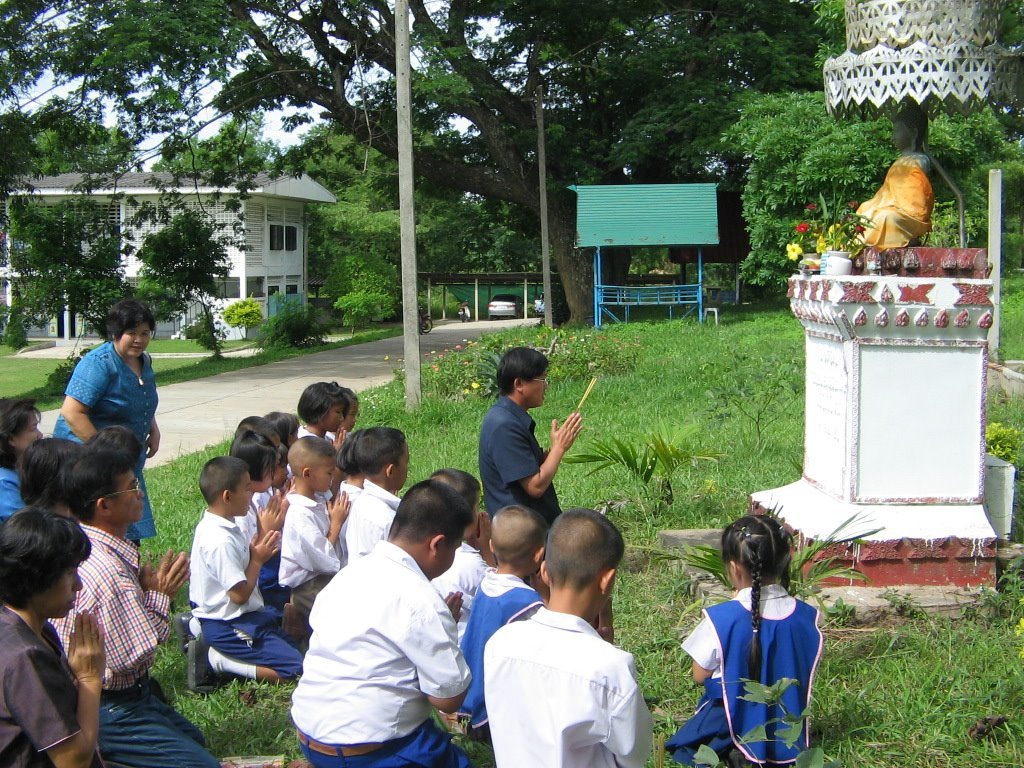
Things to notice in the photos: the current year in Thailand, the teachers’ fantastic silk suits (except for mine, which is cotton), the microphone, the lack of shoes at certain spots, the incense sticks, the pig’s head and beer.

Sunday, May 28, 2006

Update

The floods did not come to our town. However, the four provinces that were hit were hit much harder than we were last year. Massive mudslides and that sort of thing. Three volunteers were flooded out of their houses, but are otherwise safe.

Our town gave a big sigh of relief when the rain stopped on Friday. Things had been pretty tense here for a few days. Now we're just back to roasting hot. Always something!

Tuesday, May 23, 2006

Here We Go Again...

It's happening. The endless days of rain thanks to typhoons around Southeast Asia are having their effects on northern Thailand.

Yesterday evening our next door neighbor told us that several northern provinces have already flooded in the last couple of days, including ours, though still over a hundred kilometers from our house. With that information, we gathered our passports and a few other emergency supplies into backpacks that are now sitting ready in case of a quick escape. At midnight when the rain came heavily again I couldn't sleep, and stood out on the patio watching it until Robert got me to come back in.

Today it's the first topic on everyone's mind. Our supervisor at Peace Corps called at 7:30am to check in. She reported that another volunteer has been flooded already, two provinces south of us. As soon as we arrived at the school district office we were asked, "Did you pick up your things yet?" (Meaning, did you prepare your house?) We'll be doing a lot of that tonight, I think. My goal is to preserve as much of our material goods as possible this time around! Not that material goods are all-important, of course, but it would be much better if we didn't lose them all the same.

I do like rain. But I don't think I will ever feel quite the same about it again.

An Evening at the Wat


Two Fridays ago we went to our local wat in the evening to see the Wan Wisakhabucha ceremony. We were told it would start around 7pm, so we had a quick dinner and walked over around 7:15 – assuming some Thai lateness, of course. However, when we got there the temple was completely deserted except for the sound of a few monks chanting somewhere. We paced a bit trying to decide what to do, and finally assumed we had gotten it all wrong and started walking back home.

Before we had gone too far, though, a woman came out to ask us where we were going. After our reply she informed us that the ceremony would actually start at 8pm. "And don’t you have any flowers?" she asked with a puzzled look. No, we said, we were just going to watch this time.

We went back to the wat and this time met a few other early arrivers, all of whom had flowers in their hands. "Do you have a flower?" they asked us. No, we’re just watching... We chatted with one young couple visiting from out of town until a loud bell rang and everyone started moving inside the wihan (building).

We sat in a back corner hoping to be inconspicuous. As the room filled up and the monks started chanting, however, we were soon very well surrounded by teenagers, including some from our neighborhood. (To our surprise, this seemed to be a particularly teenager-attracting event.) Several people asked whether we had flowers. No, we said, we’re just watching.

About 20 minutes into the chanting, when my legs were really getting cramped from kneeling on the floor even though I had switched orientation several times, I felt a tap on my shoulder. I glanced behind me, and there was a young woman handing me a lotus flower. A young man was obtaining another for Robert, which I dutifully passed over. It seems the local teens couldn’t imagine the thought of us experiencing Wan Wisakhabucha without our own flowers. We relented, and I spent the remainder of the chanting admiring my nice bloom.

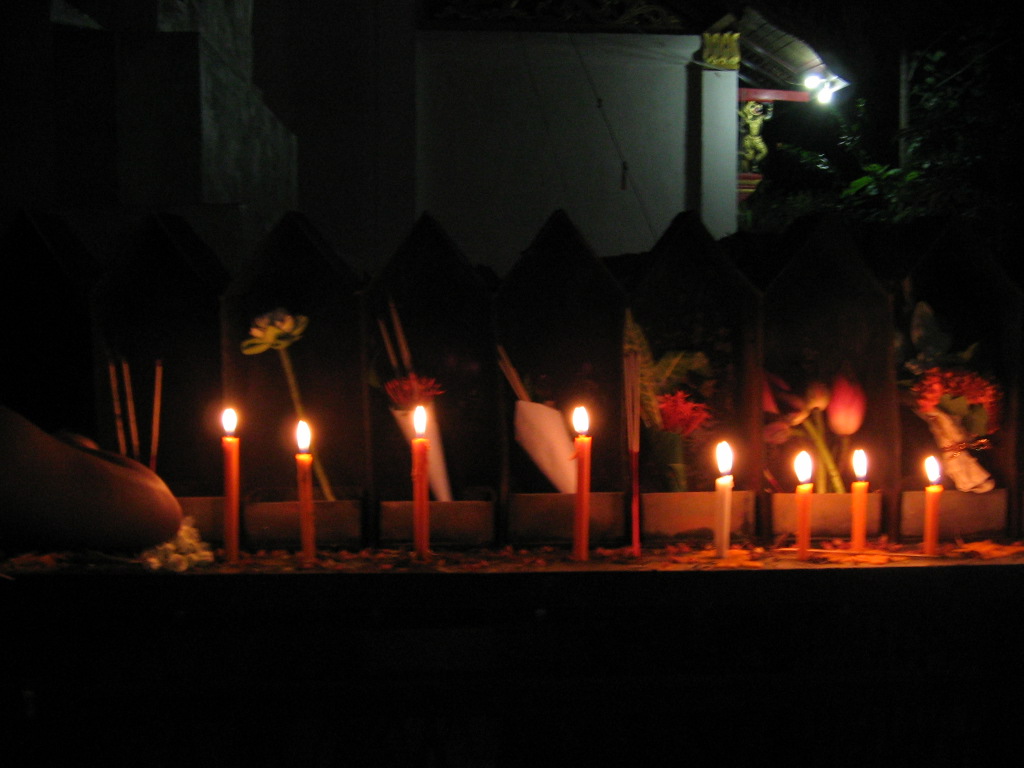
After the monks were finished, we all headed outside – about 150 people in all – and candles were lit. As everyone started walking around the wihan, Robert and I were each handed a candle as well, which we quickly lit before joining in the walk. Three times around in total, commemorating the birth, life, and death of the Buddha, and then we placed the candles and flowers in some little cubbies and went home. It was really a beautiful sight, and a testament to the determination of Thai people to include us in their special moments. No "just watching" allowed!

Monday, May 22, 2006

Big C


On Saturday we visited Big C. It’s kind of like Target, but on a super-sensory, Thai-style level. We go there about once a month to stock up on supplies not available in our town, like raisins, cheddar cheese, Energizer digital batteries, and internet cards.

A typical day trip to Big C, including preceeding and follow-up events, looks something like this:
Sleep in, go for a jog, eat breakfast and shower. Walk to the town bus/songtaew stop. Wait for a vehicle to depart. Ride over many hills and around many curves until arrival in the city. (Usually, Robert looks out the window while Kate reads a book.)
Upon arrival at Big C, to settle the stomach, head for the cash machine and then the lunch counter. Eat a quick and cheap Thai lunch. Attack the aisles, trying to avoid the massive display piles, the young women advertising various products with loud stereos and megaphones, and the crowd of teenagers clustered around the skin-whitening deodarant selections.
After forking over a large portion of PCV monthly stipend (peanut butter is expensive here!), head down the escalator for a recovery stop at the DQ, where mini-blizzards are available in all the usual flavors for less than a dollar. Walk with ice cream out to the parking lot, where a songtaew will be waiting for a full complement of other commuters. Ride that songtaew to the songtaew stop for our town, board it with all the bags of groceries, and ride for another 80 minutes or so to the gate of our house.
Upon arrival at home, lie on the bed for at least 20 minutes to get over car-sickness or songtaew exhaust poisoning before starting to make dinner. Enjoy a relaxing evening that includes at least one food purchase from the day!

Thursday, May 18, 2006

Drunk Bugs


"Floods never come to our town!" "It won’t rain at the English camp!" "The drunk bugs aren’t coming this year!"

All of the above are examples of extremely misguided predictions that I’ve heard in Thailand during the last 12 months. Each one turned out to be quite the opposite: the flood DID come to our town, it DID rain at the English camp, and...

It only took an hour this evening between the time that I observed, before leaving on my bicycle for aerobics at the town hall, that the drunk bugs seemed to have not returned to our house this rainy season, and the time that I returned, well-exercised and sweaty, to find the little fluttery wings all over the walls, floors, furniture, and bathroom floor.

We first met these bugs last May, during one of the first rainstorms of the year, when, as we sat outside enjoying the sudden cool breeze, we saw that all of our neighbors were shutting their doors and windows. "How silly," we thought, "for them not to take advantage of the change in the air." In fact, we were the deluded ones, not realizing that with our doors wide open, the house was rapidly filling with strange moth-like creatures that fly dizzily, crash into walls, and flail about on the floor losing their wings all over. Each morning we swept them out the door, and each evening we watched as gecko lizards ate their fill.

We call them the "drunk bugs" because when we were first told their name, "maleng mao," we thought that "mao" (falling tone) was the same as "mao" (flat tone). The first refers to the bugs, the second is the adjective for drunk. They certainly seemed drunk to us, anyway, what with flying into walls and then falling to the floor, so it was an honest mistake.

As I write this blog, we are just hoping that when we turn out the lights for the evening, they will crawl back outside underneath the cracks in the doors... otherwise I do fear for Robert’s sanity!

(The photo also shows a friendly frog.)