
Wednesday, October 25, 2006


Huay Xai



This is Chapter 2 of our Laos journey.
The small town of Huay Xai on the Mekong River was our introduction to Laos, and we were immediately enchanted. After buying our visas, we walked up the hill and through town to the Aramid Guest House (a fine place to stay). "This feels different from Thailand," said Robert. "This feels a lot like Thailand, but calmer," I replied. "Nobody is shouting at us."
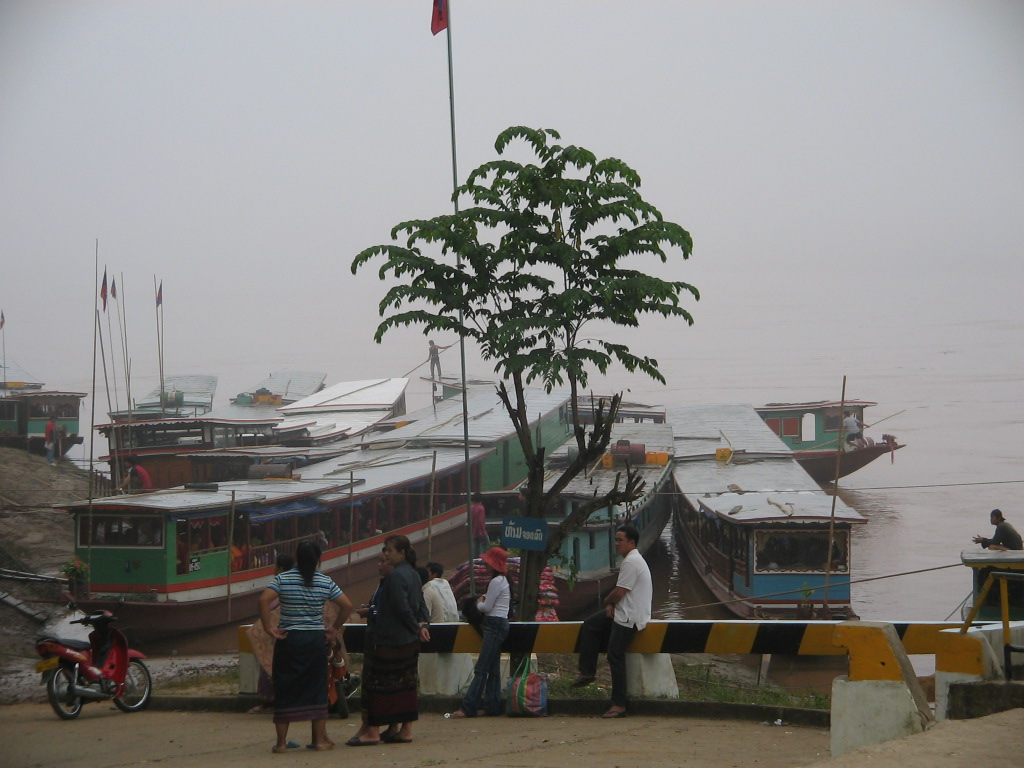
At the recommendation of the enthusiastic owner of the Aramid, we walked down to the slow boat landing for dinner overlooking the water. Seated at a table above the river, we watched as boats loaded and unloaded. A group of tourists arrived and trudged up the hill with their backpacks. Families watched the activities. Women bathed on the front of the boats, wearing sarongs – some families use the boats as both home and workplace. Joined by Sid Ficious, we took our first taste of Beer Lao and became instant fans. Robert ordered fish laab, I ordered stir-fried vegetables, and we shared both dishes with sticky rice. The sun slowly set on our first evening in Laos.
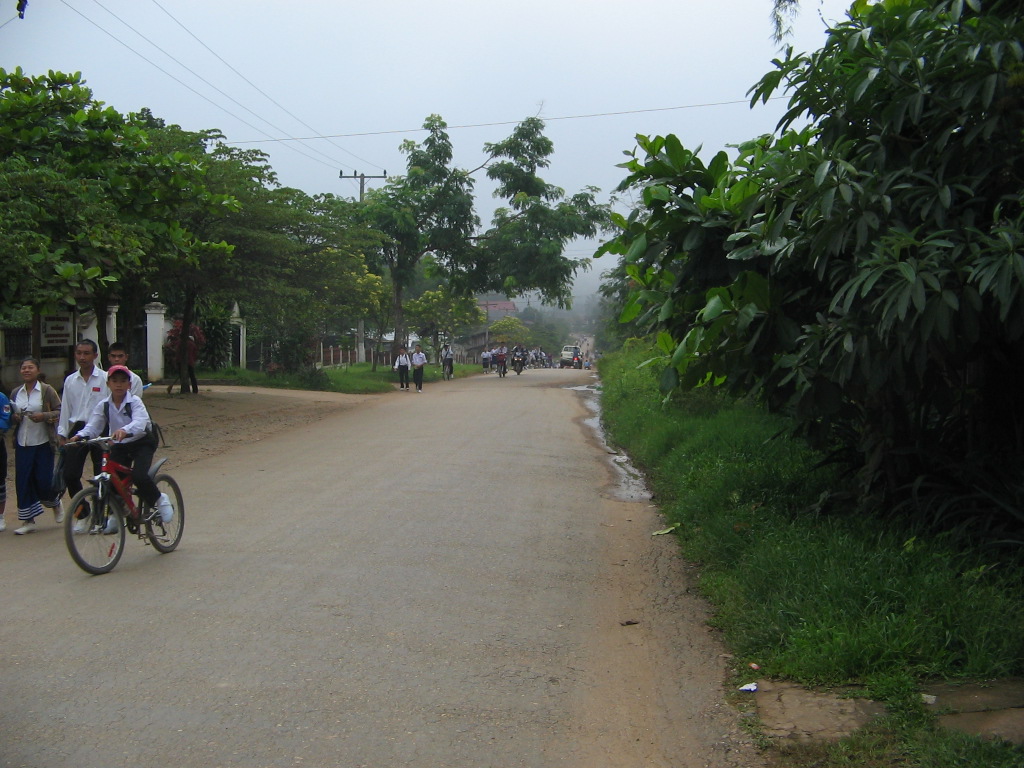
We had heard many rumors about the presence of overwhelming numbers of French baguettes in Laos, due to its colonial legacy, and we were eagerly anticipating them in the weeks leading up to our trip. In the morning at the Aramid, we were not disappointed: the wife of the owner made us fantastic "omelette sandwiches," the likes of which we’ve never had in Thailand. Well-fortified, we hoisted our backpacks once again and walked back to the slow boat landing, sharing the road with hundreds of students walking and riding bicycles to school.
Morning on the Mekong is foggy; we couldn’t see across to Thailand when we arrived, but as we waited nearly four hours for our boat to leave, it became visible. We were entertained by watching the continuing loading of the boats, including the transfer of hundreds of crates of Beer Lao between land and water. We also bought several more baguettes for snacking during the day. In the ticket office, Robert snapped a photo of some flags showing our location.
When a horde of other "farang" backpackers arrived from Thailand around noon, we settled ourselves onto the boat and got ready to depart Huay Xai.
Tuesday, October 24, 2006
To the Mekong


I’ve decided to write about our journey through Laos as a series of blog entries over the next ten days or so. There is so much to say, and so many photos to show. I’ll start first off, though, by saying that it was a fantastic trip – despite tiredness, upset stomachs, bus breakdowns (plural), and many hours long hours logged on various transport. I only wish we had had more time. I would gladly return, and recommend it to anyone who is considering making the trip.
Today I’ll give a brief summary of the first leg of our journey: from our house to Huay Xai, Laos. We left our house at the early hour of 8:45am and walked two blocks to a basketball court, where we boarded an ordinary, non-airconditioned bus that took us, over the course of many hours, all the way to Chiang Rai – the northernmost province in Thailand. The bus ride from our house north was a fantastic experience itself – we had never ridden in that direction before, and we got to see new places in our own district. Chiang Rai is beautiful – higher mountains, well-tended rice fields, cultivated hillsides. We spent one night in the city there and then took another scenic 3-hour bus ride to Chiang Khong the following day. Chiang Khong is one of the places where foreigners can cross the border – the Mekong River – from Thailand into Laos.
The Mekong impressed us at first sight. It was big, brown, and fast moving. We watched little boats fighting against the current as they made their way back and forth. Even the bigger boats seemed to have to work pretty hard. Laos, on the other side, looked green and lovely.
From Chiang Khong, we took a tiny river ferry across to Huay Xai, Laos. When I say tiny, I mean that it could only hold a few people, and we were just a couple of inches above the water! I spent the 10-minute journey shaking as I snapped a few photos and tried not to tip much to one side or the other.
We arrived in Huay Xai, paid what felt like an exorbitant fee for a visa (we’re Peace Corps volunteers, after all), and headed up the hill into town.
[The photos, mysteriously out of the order I tried to arrange, show the following: our bus to Chiang Mai, Robert standing on the Thai side of the river, a fish pal crossing on the little boat, and our arrival at Lao immigration.]
Tuesday, October 17, 2006
Hello from Laos
Robert and I are sitting in an internet cafe in Luang Prabang, Laos. I wanted to have a post on my blog from Laos, because I think it's cool!
We are big fans of Laos. I'll give more details about why, and some photos, next week when we return to Thailand. In the meantime, imagine us visiting historic temples and eating lots of baguettes.
We are big fans of Laos. I'll give more details about why, and some photos, next week when we return to Thailand. In the meantime, imagine us visiting historic temples and eating lots of baguettes.
Thursday, October 12, 2006
Kids and Instruments
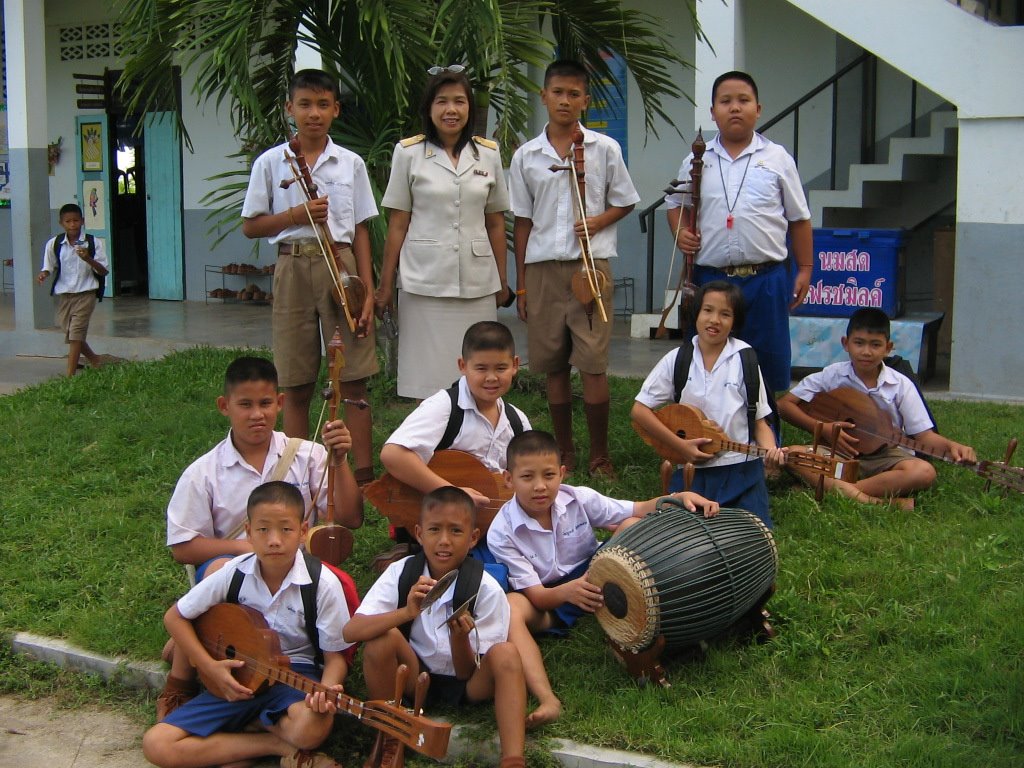
One thing many of the schools in our town are very good at, despite their other issues, is the teaching of traditional northern Thai music. Kids learn about the different instruments and how to play them, and they usually sound pretty good! It’s fun to hear.
This photo shows the music group at my Monday-Thursday school. There are 4th, 5th, and 6th graders. They are instructed by the principal and sometimes by high school students. My co-teacher, Ajaan Warangkana, is standing with them.
If you look closely at the photo you might notice the big blue milk cooler and the shoe rack, as well.
Wednesday, October 11, 2006
Boys and Milk

About ten years ago, someone in Thailand looked at students from Europe and America and observed that they are, on the whole, taller than Thai students. This someone also observed that in Europe and America, many kids drink milk every day. So the connection was made: milk = tall, maybe.
As a result, the Thai government now provides daily milk for all students in the country. Every day kids line up at the big cooler for their bag, or carton, and drink up. My students all say that they like to drink it, which is notable considering that Thai adults can’t drink milk without getting stomach aches. I guess the new policy has changed Thai digestion. However, they do all agree that soymilk is more delicious. (A non-milk-drinker myself, I agree with the soymilk lovers.)
Regarding floods, our house is still dry. We haven’t had much rain in the last couple of days – I think most of it is falling further south – but I make no predictions about what happens next!
Monday, October 09, 2006
I thought we were done with this!


Yesterday, in a fit of housekeeping that included washing windows and expelling dozens of spider webs from the ceiling (the spiders weren’t too happy), I decided to finally start unpacking the garbage bags we’ve had sitting around the house, filled with our stuff, for three months now. We hadn’t had much rain lately, and the river seemed quite normal. In the late afternoon, I happily curled up in the newly restored guest bedroom with a book, feeling like my flood troubles were over.
But I forgot that in Thailand, expectations and assumptions are generally worthless. So this morning when the phone rang shortly after 8:00am with a co-teacher warning us that the water was coming, I wondered why I had dared to be so optimistic. In fact, there is flooding in 43 of the 76 provinces of Thailand right now, so the only real surprise is that we actually are not yet underwater. Reports are that there is a bizarre convergence of heavy rains with high tides, so Thailand is being deluded from multiple directions, and will be so for another three days.
We spent today – our first official day off together this school break – doing myriad errands, chatting with other neighbors about flood worries, and checking the level of the river near our house every hour or so. (It did not actually reach our house today, though it came within a block or so.) It has gone down nearly two meters since it’s high level of the morning (shown in the photos), but who knows what tonight will bring? We plan to stay at our house to guard our things, unless there are any dramatic changes...
Parents, don’t worry, we have kind neighbors with 2-story houses.
Tuesday, October 03, 2006
Kids on Bikes
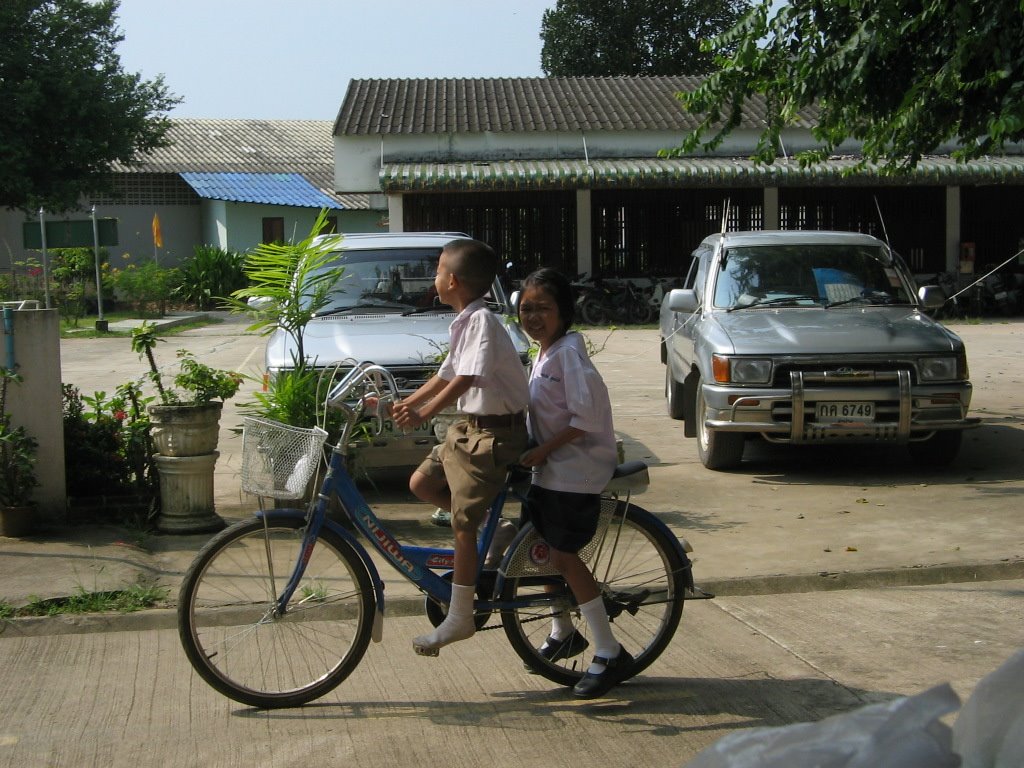 Transportation in Thailand has fascinated me from the first day of our arrival here in January 2005. Before dinner at the training center that evening, Robert and I stood by the side of the highway and watched the parade of vehicles flying by – pickup trucks, motorcycles, songtaews, and strange three-wheeled contraptions we had never seen before.
Kids get to school by means no less interesting. Some arrive on songtaews or the backs of their parents motorcycles. A few ride buses more like ours in America. Some walk. And many, especially elementary school students, arrive with their siblings or friends on bicycles, just like in the photo. It’s a skill they learn from a remarkably young age. I think I did this as a child, when we had "banana seats," before helmets were widespread in America, but I’ve long since forgotten how and I think it always was a little scary anyway. But Thai kids hop on and off all the time, no problem!
Our weather is just a tiny bit cooler this week, at night. Low 70's. It makes a big difference when it’s time to go to sleep! Days are still plenty hot, though.
Monday, October 02, 2006
Satah Banah


Yesterday morning my Tuesday-Friday school had a "satah banah" ceremony. It was the anniversary of the school’s founding. I had been invited to attend, and since it was a Sunday morning I dressed casually only to show up and find out that most everyone else was quite well dressed. Oops!
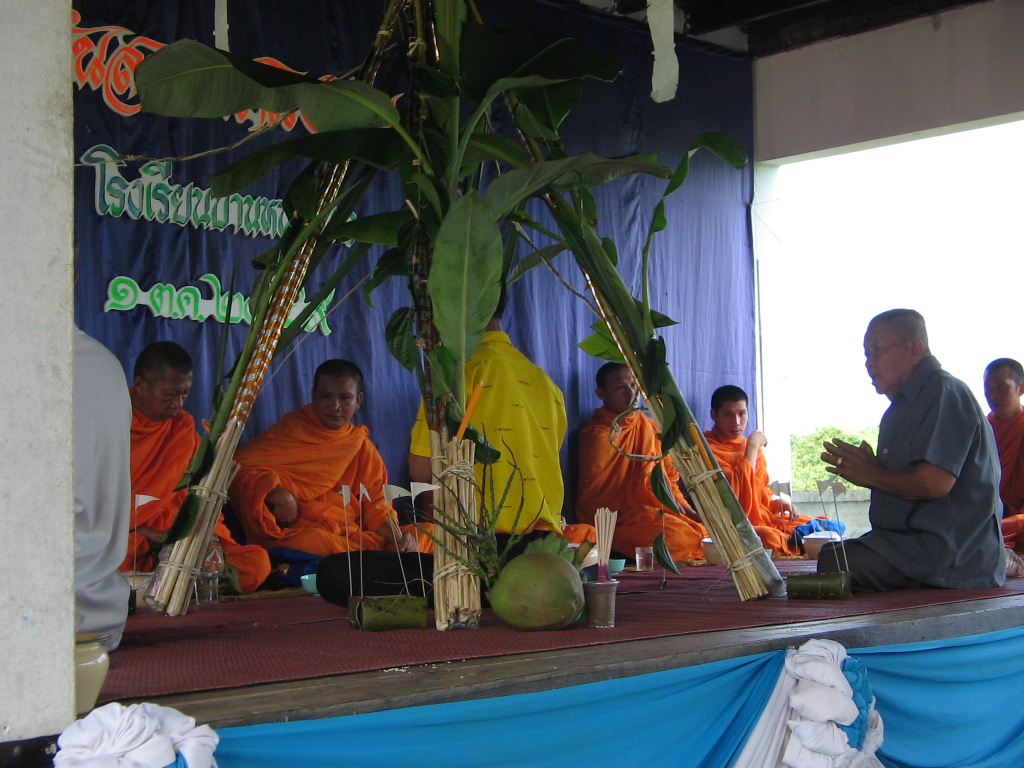
The ceremony was much like others I have seen. There was a lot of chanting, lots of food was given for the monks to take back to the temple, and special string was tied around everything. One new thing I hadn’t seen before was a bonfire-shaped stand of banana tree branches, under which the principal sat for the duration of the chanting. My co-teacher said that this was to wish him a long life.
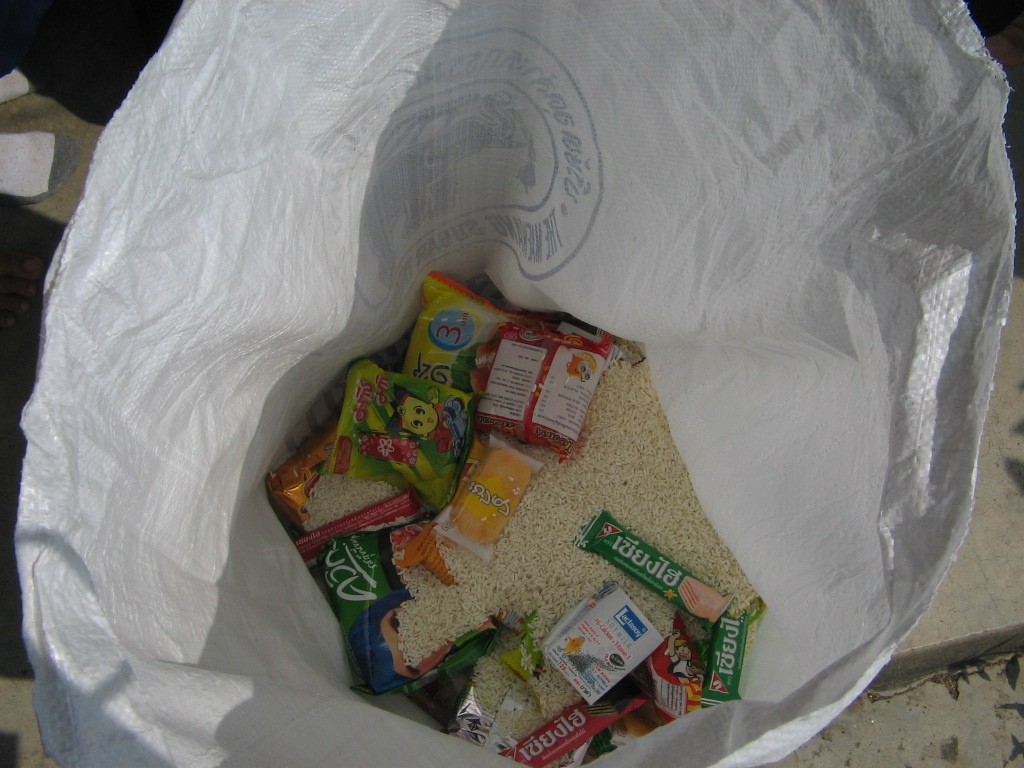
The photos show the head monk chanting next to a picture of the King; the principal sitting under the banana leaves; people putting food into the black monk bowls; a selection of food for the monks (sticky rice grains and packaged treats); and the head monk sprinkling the audience with holy water and blessings.

Thursday, September 28, 2006
One Year Ago


In honor of the one-year anniversary of our big flood, I am posting a photo of our house as it was seen that day from our neighbors’ upstairs window, where we had temporarily evacuated. Yikes! And, there’s also a photo from several months later, for comparison.
Weather has improved dramatically lately – the river has been down at normal levels for five days now. We heard reports today of a typhoon over the Philippines that might travel this far, but I have my doubts. In the meantime, things are looking good.
There was much grumbling over the past few days over the new uniform requirement. No one likes having to do so much laundry!
Wednesday, September 27, 2006
Unexpected Gathering
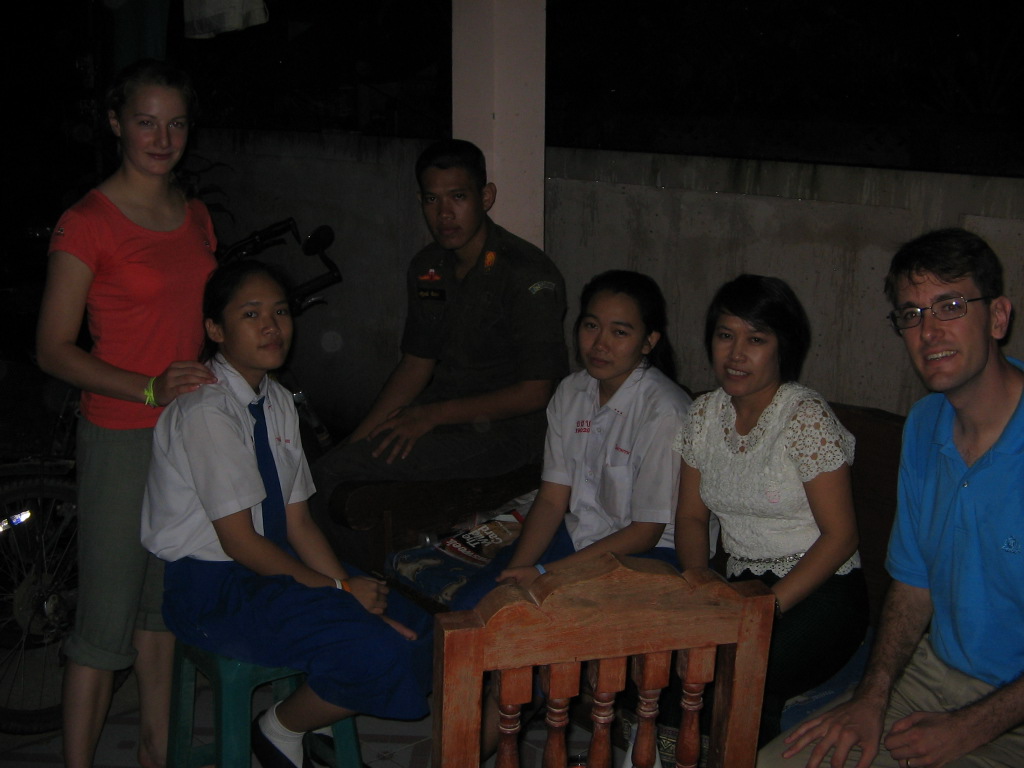
Last Friday evening, a remarkable coincidence occurred at our house. For the first time ever, we were asked by some Thai neighbors to translate a legal document from German. And also for the first time ever, we happened to have a native German speaker on the premises.
Late afternoon, while Robert was riding his bicycle home from school and stopping to pick up dinner on the way, I heard a car pull up outside and a friendly, "Hello?" at the gate. I hurried to the door and met Lena, the German exchange student living a bit north of town for the year. A week earlier, Robert had met her host mother, Mor Chatra ("Dr. Chatra"), the local dentist who runs the primary school toothbrushing programs. Mor Chatra had assured Robert she would bring Lena over soon.
The three of us sat on the porch chatting, and when Robert arrived he joined us as well. At about 5:30pm, Mor Chatra and Lena started to go to their car, as in walked our neighbor from across the street with an elderly couple. "Robert," she asked, "could you help us read this document?" Robert took one look and ran outside. "Lena, could we trouble you for some German help?" he called.
Lena was happy to help, and thus began a lengthy, stressful discussion about the nature of the documents. The elderly couple’s daughter had married a man in Switzerland, and then died, and the documents were the only information her parents had received. The 16-year-old Lena did her best to understand the German legalese (not being a lawyer, this tested even her native German skills) and soon determined that we were looking at a will. She would then translate into either English or Thai, at which point Robert or I would try to clarify the Thai for the older people. The whole process was made more difficult by the fact that they were hoping to get different information from the documents than what was actually there, and they couldn’t understand why their desired information wasn’t available.
Immediately after the neighbors left, Mor Chatra’s daughter and nephew arrived at the house and a fantastic downpour started. Since no one could leave in the rain (Thais hate getting wet in rain), Robert brought out banana chips and we spent more time chatting on the porch. It was an unexpected end to an unusual week in Thailand.
[The photo shows the above mentioned houseguests, as well as Milk, our neighbor across the street who attends school with Mor Chatra’s daughter.]
Tuesday, September 26, 2006
And Just Like That ---

Thai people love uniforms like no one I’ve ever seen. Status is important here, and clothing is a way of showing where you fit into the hierarchy. Farmers wear oversized long-sleeved plaid flannel shirts and thick head coverings. Nurses wear white outfits with little white hats. Students of all ages – from Anuban 1 (pre-school) to university – wear different uniforms depending on the theme of the school day. And teachers, yes, even teachers have uniforms in Thailand. Teachers are "ka ratchagan" – civil servants – and they must dress to show it.
During our first year in Thailand, the teachers’ outfits were more or less on a regular schedule, possibly depending on the particular school or the region of the country. For example, at my Monday-Thursday school, teachers dressed as follows: Monday – "ka ratchagan" uniforms (khaki, very official with rank bars and medals); Tuesday – sports clothes (school colors shirt and long black exercise pants); Wednesday – Scouts; Thursday – school uniform (dark blue suit with the school seal embroidered); and Friday – northern Thai.
This school year, because of the 60th anniversary of the King, there were some changes. In May, the order came down from above that all "ka ratchagan" were to wear yellow shirts on Mondays. Yellow polos with the King’s seal replaced the light brown uniforms. In June, Tuesdays were added to the yellow shirt schedule. Casual yellow shirts replaced the sports clothes. Suddenly, female teachers were wearing pants two days a week, and they enjoyed it. Some even started substituting black pants for their navy blue skirts on Thursdays!
Yesterday, however, a new order came from above. The difference is that, this week, "above" means the leaders of the coup. The new order requires that all "ka ratchagan" throughout the country wear the khaki "ka ratchagan" uniforms EVERY DAY OF THE WEEK. Starting tomorrow. No more yellow shirts on Mondays, no more northern Thai on Fridays, and no more pants for the women. All "ka ratchagan," all the time.
Reaction at our schools has ranged from irritation to resignation. Those teachers who only own one or two "ka ratchagan" uniforms – a majority – are trying to figure out how they will find the time to wash and dry them every day of the week. The stated reason for the new policy is because it will help soldiers to distinguish between real "ka ratchagan" and imposters, but it’s hard to tell if the teachers are buying this or not. In any case, it’s a fascinating example of what life can be like in a country where following the orders of your superiors – even when they are army generals who have overthrown the elected government and annulled the Constitution – is the only acceptable response.
[The photo, taken 18 months ago at my practice school during training, shows a teacher wearing the "ka ratchagan" uniform.]
Sunday, September 24, 2006
City Escape

On the spur of the moment after yet another downpour on Friday night, we decided to use this weekend to make a temporary escape from the blood-pressure-raising flood watch. Merissa, a volunteer who lives in a nearby province, and Bryn, another volunteer who lives in our provincial capital just an hour away, invited us to spend Saturday night with them at Bryn’s house. Hey, we thought, it’s been months since we spent time with other volunteers, we need a bit of social life! So we re-secured our possessions into the black garbage bags, re-packed those items that had been slowly spilling out over recent weeks, and re-hung the tea bags, spices, and toiletries on the window nails. Finally, mid-day Saturday we locked the gate and headed out of town.
Our nights on the town in the capital usually include dinner at a rambly wooden riverside restaurant that makes great pizza, and last night was no different. What was unusual, though, was that the tables where we usually sit were covered in muddy water. The lower level of the restaurant was flooded! We sat on the upper level and watched as servers walked across planks down below, between the kitchen and the staircase. A trip to the restroom at the end of the meal meant that I, too, got to walk the plank. (My beverage consumption over dinner did not make this feat any easier.) Only in Thailand would a restaurant continue business as usual while partially submerged in floodwater!
After dinner, Bryn led us further upriver to a night market that Robert and I had never seen. We met up with several of her Thai friends, one of whom sells handicrafts in the street outside her house. They were kind enough to serve us beer and popcorn while we chatted and watched the shoppers wander by.
And then... about a hundred feet away, we heard the thumping beat of Thai hip-hop music. Carrying our beer glasses, we moved towards the sound and discovered a group of teenage boys spinning and grooving on a mat. Breakdancing! They were really very talented – lots of fancy, flexible moves. We watched for at least 20 minutes before finally moving away.
At some point I looked around at the crowd, the market stalls, the lively chatting, and realized that back in our sleepy river valley town, our neighbors were all inside for the night. The only sounds would be crickets, roosters, and occasional mumbles of television or drunken men conversing. What a difference a city can make. We’re glad to live where we do, but it sure was nice to have a Saturday escape.
[The photo, taken over a year ago, shows Bryn on the left and Merissa on the right. These days, Bryn has long hair and Merissa’s is short.]
Thursday, September 21, 2006
No Bus for Us
A flood? A coup? A flood? A coup? A flood?
It’s hard to decide what to be more excited/concerned/nervous about – the daily rise and fall of our river or the military takeover of the government. Even just within today, my attention has bounced back and forth between the two situations numerous times. I’d say it’s exhausting, except that thanks to the coup we’ve been granted what feels like a free and unexpected weekend.
The "Standfast" for Peace Corps Volunteers in Thailand was lifted this morning, so we can leave our sites again, but we are not allowed to travel to Bangkok or Chiang Mai. We had originally been scheduled to go on a trip this weekend – starting one hour ago – with teachers from one of Robert’s schools. The primary destination? Bangkok. The hotel on the 2nd night? Currently flanked with tanks, as it’s in the heart of the government center.
The Peace Corps was, to put it mildly, a little shocked when Robert called today to tell them that the trip was still on, and to ask whether we should be packing our bags to join them or not. "They’re still going?" asked our Program Director incredulously. "But the place is full of soldiers!" said our Safety and Security Officer. "So we don’t have to go then?" Robert asked hopefully.
We were nervous about the trip anyway, since it involved two overnight bus rides during what has felt like the worst of the rainy season, and we were even less interested in going once the capital was taken over by the army. So I was relieved when Robert called me at school to confirm that indeed, no, the Peace Corps was not going to bend the rules for this one.
Many people did run home from school or work during the day to take care of their flooding houses, but that’s the OTHER river, on the OTHER side of town, not our river. So now we’re snug in our still-dry house, not on an overnight bus, and OUR river is back down to four steps below the road.
It’s hard to decide what to be more excited/concerned/nervous about – the daily rise and fall of our river or the military takeover of the government. Even just within today, my attention has bounced back and forth between the two situations numerous times. I’d say it’s exhausting, except that thanks to the coup we’ve been granted what feels like a free and unexpected weekend.
The "Standfast" for Peace Corps Volunteers in Thailand was lifted this morning, so we can leave our sites again, but we are not allowed to travel to Bangkok or Chiang Mai. We had originally been scheduled to go on a trip this weekend – starting one hour ago – with teachers from one of Robert’s schools. The primary destination? Bangkok. The hotel on the 2nd night? Currently flanked with tanks, as it’s in the heart of the government center.
The Peace Corps was, to put it mildly, a little shocked when Robert called today to tell them that the trip was still on, and to ask whether we should be packing our bags to join them or not. "They’re still going?" asked our Program Director incredulously. "But the place is full of soldiers!" said our Safety and Security Officer. "So we don’t have to go then?" Robert asked hopefully.
We were nervous about the trip anyway, since it involved two overnight bus rides during what has felt like the worst of the rainy season, and we were even less interested in going once the capital was taken over by the army. So I was relieved when Robert called me at school to confirm that indeed, no, the Peace Corps was not going to bend the rules for this one.
Many people did run home from school or work during the day to take care of their flooding houses, but that’s the OTHER river, on the OTHER side of town, not our river. So now we’re snug in our still-dry house, not on an overnight bus, and OUR river is back down to four steps below the road.
Wednesday, September 20, 2006
The Rain Still Falls (But More Lightly Now)
Since media is being censored, I’ll be cautious about giving too many descriptive details here, but I wanted to share a bit about what our first day of living under martial law was like.
For the most part, the average visitor would not have noticed any big differences in our town before and after the coup. Life seemed to be proceeding as normal, despite the post office, banks, and government buildings being closed. In fact, you might not even known that the school district office was closed. When we arrived late morning, it was full of people. A big meeting for area teachers that had been previously scheduled was still going on, and other employees who hadn’t wanted to sit at home on the surprise day off were milling about. On the whole, I might just say that things were quieter than usual yesterday. We didn’t even have our nightly serenade of Thai pop music blasting from the house next door.
A fellow Peace Corps Volunteer wrote a blog about the easily changing allegiances of Thais during the World Cup in June. Describing the atmosphere of watching a game with a bunch of Thai friends, he noted that they took the side of whoever was winning! Robert and I wondered if, at least publicly, that was also happening with respect to this coup. We live in the rural north, where support of the ousted prime minister has been traditionally high. But yesterday you wouldn’t have known that anyone here ever liked him. At one point, in a conversation with some employees at the school district office, Robert referred to what happened Tuesday night as a "coup." (To be fair, he used the Thai word for a regular coup, as opposed to a bloodless coup, which has a different word, we learned later.) The three women present looked shocked, and hurried to correct him that it had not, absolutely not, been a coup, it had been POLITICAL REFORM.
Right... Political reform. With tanks.
For the most part, the average visitor would not have noticed any big differences in our town before and after the coup. Life seemed to be proceeding as normal, despite the post office, banks, and government buildings being closed. In fact, you might not even known that the school district office was closed. When we arrived late morning, it was full of people. A big meeting for area teachers that had been previously scheduled was still going on, and other employees who hadn’t wanted to sit at home on the surprise day off were milling about. On the whole, I might just say that things were quieter than usual yesterday. We didn’t even have our nightly serenade of Thai pop music blasting from the house next door.
A fellow Peace Corps Volunteer wrote a blog about the easily changing allegiances of Thais during the World Cup in June. Describing the atmosphere of watching a game with a bunch of Thai friends, he noted that they took the side of whoever was winning! Robert and I wondered if, at least publicly, that was also happening with respect to this coup. We live in the rural north, where support of the ousted prime minister has been traditionally high. But yesterday you wouldn’t have known that anyone here ever liked him. At one point, in a conversation with some employees at the school district office, Robert referred to what happened Tuesday night as a "coup." (To be fair, he used the Thai word for a regular coup, as opposed to a bloodless coup, which has a different word, we learned later.) The three women present looked shocked, and hurried to correct him that it had not, absolutely not, been a coup, it had been POLITICAL REFORM.
Right... Political reform. With tanks.
Tuesday, September 19, 2006
Yes, a Coup
We're just starting to learn a little now, but here's what I can tell you. The military has taken over the government here, and Bangkok has a lot of tanks and soldiers. It's "bloodless", so that's good. That's about all I know.
We did also hear that people in Bangkok were taking their photos next to the tanks, so that sounds like Thailand can't have changed too much overnight!
We first heard of it at about 11:30pm last night, when text message arrived simultaneously on both our cell phones. Peace Corps Thailand is currently under a "standfast", meaning that volunteers are not allowed to leave their sites or travel. We don't know how long this will be the case.
Perhaps the more pressing concern for us today is the level of the river. We had another night of torrential rain... Wish us luck.
We did also hear that people in Bangkok were taking their photos next to the tanks, so that sounds like Thailand can't have changed too much overnight!
We first heard of it at about 11:30pm last night, when text message arrived simultaneously on both our cell phones. Peace Corps Thailand is currently under a "standfast", meaning that volunteers are not allowed to leave their sites or travel. We don't know how long this will be the case.
Perhaps the more pressing concern for us today is the level of the river. We had another night of torrential rain... Wish us luck.
Monday, September 18, 2006
Field Trip


During my first school year in Thailand, I used to get annoyed when unexpected field trips popped into the schedule. I thought it took too much time away from English teaching. But in my second year, I’ve adjusted my expectations and understandings of Thai schools, mellowed out a bit, and come to see field trips as enjoyable. So Sunday afternoon, when I got the message that we’d be visiting a Thai cloth factory yesterday, I was excited.
We left school at 9:30 – students walking in line, teachers in assorted motorized vehicles – and went up the hill to the house of a former county commissioner. He owns a cloth weaving operation with about 8 looms. He gave a talk to the kids and then showed them how the cotton is made into thread, and the thread into cloth. I was impressed by how difficult and intricate of a job it appears to be! He also talked about how the dyes for the thread are made from different local ingredients – leaves, fruits, etc. Now I know, when I buy cotton products in Thailand, how authentic they really are!
After the cloth factory, the teachers got back into vehicles and the kids walked down to the village wat (temple) for some prayers, meditation, and a speech by a monk on why you should obey your parents. Although my back got stiff from sitting in proper position for so long, it was still pleasant to sit and think and look at the paintings on the walls.
After lunch back at school, the 3rd-6th grades climbed into the backs of 3 pickups and we headed off to another nearby wat that they had never visited because it’s in a different village. There, we also did the requisite sitting and meditating, but the monk’s speech was hard to decipher because he spoke Pali (the official language of Buddhism, from India) instead of Thai. The kids were interested in the decorations and the history of the wat, though, so they still had a good time.
Although it was an enjoyable day, it was made slightly more difficult by temperatures near 100. Then a big storm came through last night, and the river is high once again. We’ll be extra cautious over the next few days now... It’s always something here.
Friday, September 15, 2006
Mine or Yours?

As I was washing laundry after school on Tuesday, I witnessed an unusual event that has since caused some internal reflection.
When I first heard the moaning, I thought it was the cat that has been hunting lizards in our yard lately. I quickly realized, though, that one of the women who lives across the road from us was making the unusual noise, rocking and moaning in front of her house. The moaning turned to howling, and occasional wild laughter, and a group of watching neighbors began to grow around the house. When a strange man pulled up on a motorcycle and began giving the woman a drink that made her vomit multiple times, I was sure that what I was seeing was a case of "pii kow," or possession by a ghost.
On my own, I would not have come to such a conclusion. I might have assumed that the woman was having a seizure or some other psychiatric experience. But because Robert saw this same woman have a similar episode last January, and had been filled in by another neighbor as to its presumed cause, I was pre-informed.
When Robert saw the "pii kow," it was cured by a monk who came and chanted over our neighbor. The strange man who performed the cure that I saw is called, I was told by my co-teacher yesterday, a "ghost doctor." Both times, the "cure" seemed to have the desired effects: the woman returned to her normal self.
My reflection over the days since the incident has concerned the questions: Whose explanation is correct? And, to what extent does it matter anyway? Some years ago I read The Spirit Catches You and You Fall Down, by Anne Fadiman, describing the true story of a Hmong girl with epilepsy whose parents and doctors could not accept one another’s assessments and treatments of her condition. The parents’ belief was that her illness was of a spiritual nature, while the doctors approached it scientifically. I wonder whether this week’s incident demonstrated a similar conflict between traditional and modern medicine. Whose interpretation is accurate? Was she possessed by a ghost, or is there a mis-wiring in her brain somewhere?
My co-teacher, who I discussed it with yesterday, told me that most educated Thai’s no longer believe in possession by ghosts (though they may still believe in ghosts in general). They accept the scientific explanation. It’s the rural areas where these beliefs still hold. I, myself, coming from the background I do, tend to believe more in the scientific explanations as well. However, in both incidents that Robert and I witnessed, the cure was not scientific but spiritual. I suppose it’s a question that cannot be answered easily, if at all.
The photo shows the area where it all took place.
Sunday, September 10, 2006
Typical Tuesday

Last week’s "Typical Monday" was, interestingly enough, followed by what I might consider a "Typical Tuesday." I teach at 2 different schools. One, my Monday-Thursday school, is pretty well-run and the teachers, in my opinion, care a lot about the students. The other, my Tuesday-Friday school, is somewhat of a dysfunctional mess for many reasons I won’t go into just now. In any case, this past week illustrated some of the differences between the two schools.
On my "Typical Monday," as described, I taught several classes and helped with English club. By contrast, on my "Typical Tuesday," there was no teaching. All day. None.
When I arrived at school just after 8:30 (no morning run, but still oatmeal for breakfast), my co-teacher, Waewnapa, was a bit stressed. "Oh," she said, "a group is coming to look at the library today so I have to make many boards." In addition to being the 6th grade teacher and the English teacher for all grades, Waewnapa is also the librarian, and the principal has made a big push to develop the library over the past year or so since our flood. This past week, several school libraries in the district were being evaluated in some sort of contest to see who had the best one. Our principal really wanted to win.
So, our morning was spent making "boards," an activity in which I have minimal skill, not being artistically inclined or motivated. Boards are display pieces, kind of like what American elementary school students might use as in their science projects. They generally have lots of photos, descriptive text, and decorations. When I arrived on Tuesday, most of the work had already been done, so my role consisted of helping to select which paper flower went on which board, and what color (pink or white?) should be the paper used for listing the names of library donors. It made for a slow morning.
In the afternoon, the evaluators arrived, and I helped by standing nearby, smiling and occasionally agreeing that I could speak Thai. The principal also excitedly pointed out that I had helped with some of the decorations. The evaluators seemed mildly impressed by this information. I also assisted by taking photographs of the evaluators doing important things, like standing and reading the boards or sitting at tables in the library.
When I finally left school shortly before 4:00pm, I could think of little that I had truly accomplished during the day. Oh well. We had a fine evening, anyway, complete with yellow curry and aerobics class at the town hall.
[Note: The photo of Waewnapa making a board was actually taken last February, during another board-making flurry, hence her warm clothing! This week’s board-making took place during a severe hot spell.]
Monday, September 04, 2006
Typical Monday

As I was jogging along the rice fields this morning, getting some exercise to start off my week, I decided that I ought to write a blog about what a "typical" school day for me might be like. Of course, in reality there is no such thing as a "typical" day in Thailand, because nothing is predictable or consistent here, but today came pretty close. So here it is!
At 6:50am the alarm went off – a bit later than usual for a Monday, because we haven’t been sleeping enough lately and wanted to try to add a few more minutes. Robert got into the shower; I headed out for my run to a nearby temple on top of a small hill. Traffic was busy – lots of high school students on motorcycles, parents dropping kids off at school, women on their way to the market. I also encountered the usual wandering dogs (we know each other by now) and barefoot monks in orange robes out collecting their daily food from the townspeople.
After stretching, ironing, sending Robert off to school, showering, eating oatmeal, and checking email, I headed out on my bicycle just before 9:30am. It was incredibly hot – over 90 already – and very sunny, so I was sweaty by the time I arrived at school. My co-teacher, Warangkana, turned on her desk fan for me and I sat trying to cool off for several minutes.
Shortly before 10, two guys from Isaan (northeastern Thailand) showed up selling beautiful cloth to be made into "suits". Waranakana and the 5th grade teacher went a little crazy buying some, and I ended up buying some myself. We’ll see how my suit turns out!
From 10 until noon, we taught the 5th grade English class ("sweet," "sour," "salty," "spicy," and menu-making). (Photo) They were relatively well-behaved today despite the heat! We walked the kids across the athletic field to lunch and I visited with them in English about today’s meal. "What do you have for lunch today?" "Noodles!" "Watermelon!" "Pig blood!" My vegetarian lunch was stir-fried sprouts.
Just before 1pm, the kids brushed their teeth and had meditation. Then we taught the 6th grade for an hour. The first two-thirds of class were a continuation of "family" words from last week (grandparents, aunts, uncles, cousins, etc.) and the last third was my presentation of how to make oatmeal. Yes, we made oatmeal. They had been begging to see it ever since the day we learned "breakfast," "lunch," and "dinner," when I stated that I eat oatmeal for breakfast every day. To my surprise, many of them liked it and came back for seconds.
Normally at 2pm we would head off to teach the 4th grade, but today they were busy, so I got to observe 6th grade music class instead. They watched a video about how to practice the different movements in classical Thai dance, and we all tried to follow along. My wrists and shoulders were sore after the first 20 minutes, so after that I just sat back and watched.
In English Club – the one hour per week we spend with the 1st, 2nd, and 3rd grades combined – we practiced numbers 11-20 with a song and game. Then the day was over, at last, and I was more than ready to head home for my shower.
After putting on cooler clothes I went out on my bicycle once more to pick up some sticky rice and papaya salad to have along with dinner. Back at the house again, I did a load of laundry by hand, cleaned the ants out of the kitchen sink and dish drain, and prepared dinner. Robert arrived home just after 6pm, and we shared the details of our respective school days while eating at our teak table. For the remainder of the evening, we’ll be doing more ironing, email, and getting ready for tomorrow.
So there it is: a more or less "typical" Monday for this Peace Corps Thailand volunteer!
Saturday, September 02, 2006
Sunshine
It hasn’t rained for 26 hours, and the sun has been shining most of the day, so our river has gone about halfway back to its normal levels. I am now expecting a calmer weekend. Hooray!
Of course, while sunshine is welcome today if it keeps the floods away, it still does make it awfully hot. It’s currently 93°F in the shade. Ah, well.
Of course, while sunshine is welcome today if it keeps the floods away, it still does make it awfully hot. It’s currently 93°F in the shade. Ah, well.
Friday, September 01, 2006
Expertise We'd Rather Not Have Had


After last year’s flash flood, I lamented many of our lost items – letters from friends, photographs, teaching materials, books, and clothing – and plotted how I might try to attempt to save them if the occasion happened again. Before we left for the USA a few weeks ago, we put most of our irreplaceable items into large plastic garbage bags, hoisted the bags on top of beds and tables, and hung smaller bags from curtain hooks. When we returned to our town, we unpacked a few of the bags in an attempt to have a more normal-looking household.
Yesterday, everything went back into the bags, and we ourselves went off to spend the night on higher ground in hopes of sleep and safety. As of this writing on Friday afternoon, our house is still dry, but I expect a very interesting weekend! Here is how the last 44 hours have passed:
Wednesday, 5:10pm: I board a songtaew in the city after sending my mother and stepfather to the airport at the end of their visit. I notice dark clouds in the sky, but it’s not raining. By 5:30pm, though, the rain has started to fall.
Wednesday, 6:10pm: Still raining. I check the level of our river as the songtaew enters town. It isn’t too high – still about 8 or 9 steps below the road. (There are intermittent staircases along our side of the river bank – used by fisherman, washerwoman, and young swimmers when they want to enter the water.) Over dinner, Robert and I decide that if the water rises to within 2 steps of the road, we will move to higher ground.
Wednesday night: Rain continues to fall all night, though Robert says he heard it stop once or twice.
Thursday 9:20am: It’s still raining as I ride my bicycle to school. Crossing the bridge, I notice that the river has risen dramatically over the night. It’s now only 3 steps below the road at the point nearest our house, and it is moving very fast. After I arrive at school, I call Robert, who is still at the house, and tell him to pack up the computer and passports in a safe place.
Thursday day: It continues raining throughout the day, sometimes harder, sometimes just drizzling. My co-teacher, Ajaan Warangkana, says that in the event of a flood we can stay with her in a second-story room. I check in with Peace Corps, who says we can stay in a hotel in the city if needed.
Thursday, 3:15pm: As the teachers are gathering for a meeting, one gets a call on her cell phone reporting flooding in the district north of ours, upstream. A few minutes later, Robert calls to say that his school is closing early and sending all of the students home.
Thursday, 3:30pm: Parents begin showing up at school, asking to take their kids home because the town loudspeakers are warning of floods. When 30+ children hear the word "flood," they begin hollering and running around. The teachers dismiss them. I ride my bicycle home along with the students. On my way back over the bridge, I see that the water has risen just a few inches since morning, but is still moving quickly.
Thursday, late afternoon: Robert and I pack our backpacks and the house. I take the computer across the street to a neighbor’s second-story room. Robert listens to frequent announcements from our nearest loudspeaker, reporting more villages upstream that are being flooded. I check the river once and see that it has risen above the second step. Despite our earlier plan, we are reluctant to leave our house.
Thursday, 5:30pm: Robert and I go to look at the level of the river. It has risen above the first step and after a few more inches will be spilling over the brick pathway. (See photos!) Houses across the river, on lower ground, are beginning to get water. As Robert and I go to buy noodles for dinner, we discuss our options. Finally, we decide that leaving the house overnight would be more responsible. We compromise by planning to take care of our showers, toothbrushing, etc, before leaving, so that all we need to do at our safehouse is sleep!
Thursday evening: We eat dinner, finish packing, and get ready for bed. Plans are made for us to sleep at the house of Ajaan Lamduan, a teacher at one of Robert’s schools who lives less than a kilometer away but on significantly higher ground. She lives alone and has lots of space.
Thursday, 8:00pm: We say goodbye to our neighbors, put on our backpacks, and walk to Ajaan Lamduan’s house. We set up in her daughter’s room (she’s away at school). By 10:00 we’ve gone to sleep.
Friday, 2:00am: After a trip to the bathroom, I lie in bed listening to distant roosters and wondering about the state of the river. Suddenly the loudspeakers on the street are blaring. I poke Robert awake. The only words I catch are "water is here," "help each other," "safe already," and the name of our village. We aren’t sure what this means. About 15 minutes later, we hear the speakers again, but the ones nearest us aren’t turned on this time, so we can’t make out anything. Finally, after another half hour, a much more clear announcement comes. "Village 9, pick up your things. Move your refrigerators. Help each other. The water is flowing. If it reaches the road it will enter Village 9." It repeats a few times and then is quiet again. We lie awake until nearly 4:00am, wondering if the water has crossed the road and entered our neighborhood.
Friday, 6:00am: We wake up and get dressed. Ajaan Lamduan has brought us some desserts for breakfast, and she tells us that the water did not reach the road. 45 minutes later we head back to our house. It is indeed dry and the neighborhood has not yet been flooded. We get dressed and go to school.
Friday, 8:30am: On my way to school, I look at the river again. It has spilled over the banks and is covering the red brick pathway and the road alongside it. I can’t tell how high it reached in the night, or whether it is rising or falling.
Friday day: Although the morning was turning sunny and optimistic, rain has been falling on and off and now the sky is definitely cloudy. My teaching for the day is finished and I’ve retrieved the computer for the time being. I think there’s no way of knowing now if the water will rise again or not – it will depend on tonight’s weather! In any case, we’re ready to leave the house in a hurry again if need be. Ajaan Lamduan will welcome us at her house for as many nights as necessary. And that’s where we’re at!
PS: If you try to call us on our cell phones and can’t get through, try adding an "8" before the rest of the number. (after the country code) It might be a new policy thing going into effect today, but it’s not clear yet.
Wednesday, August 30, 2006
Signs 2

One of our frustrations with life as Peace Corps Volunteers in Thailand has been observing the spending choices made by school directors at our local schools. When the kids need teachers, desks, fans, and interesting library books, money is instead spent on teacher field trips, digital cameras, and signs. Almost every school we see has a large, fancy sign out front, usually black with gold lettering, attempting to symbolize that this, indeed, is a wonderful school.
It’s not just the schools in Thailand that go in for big fancy signs, though. Many of the local villages have their own signs, and some, like the one in the photo, are very big and ornate! When we were out biking a year ago we came across this sign, signifying the entrance to Bahn Sa Pae Village about 8 kilometers south of our house. You can see that it is no ordinary sign. The village itself, of course, is quite ordinary.
Thursday, August 24, 2006
Mushroom Sticks
We visited America – Minnesota and Washington – for two wonderful weeks earlier this month. It was great to reconnect with family, friends, and familiar landscape. The trip made me excited to return home next April, but also made me feel that "home" – my life in the USA – is not as far from Thailand as I thought it was.
One question we were asked several times while visiting home was, "Is the food you eat every day just like the food in a Thai restaurant?" The answer is, "Yes and no." Thai restaurants in America primarily serve central Thai food (from the central region of the country). Living in the north of Thailand as we do, a lot of our food is "northern Thai" food. So the logical next question is, "How is northern Thai food different from central Thai food?"
After some reflection, I think I’ve come up with the right answer. In central Thailand, with its miles upon miles of well-irrigated, flat fields, cuisine is based on agricultural foods: farmed vegetables, domesticated animals, etc. Northern Thai food, by contrast, is made from vegetables, leaves, grasses, and animals that grow on their own or are gathered from the forests and mountains: water spinach, mushrooms, bugs and frogs. Although it is now possible in our town to get food from all over the country, 20 years ago that wasn’t the case and most people ate what they could find in their own backyards.
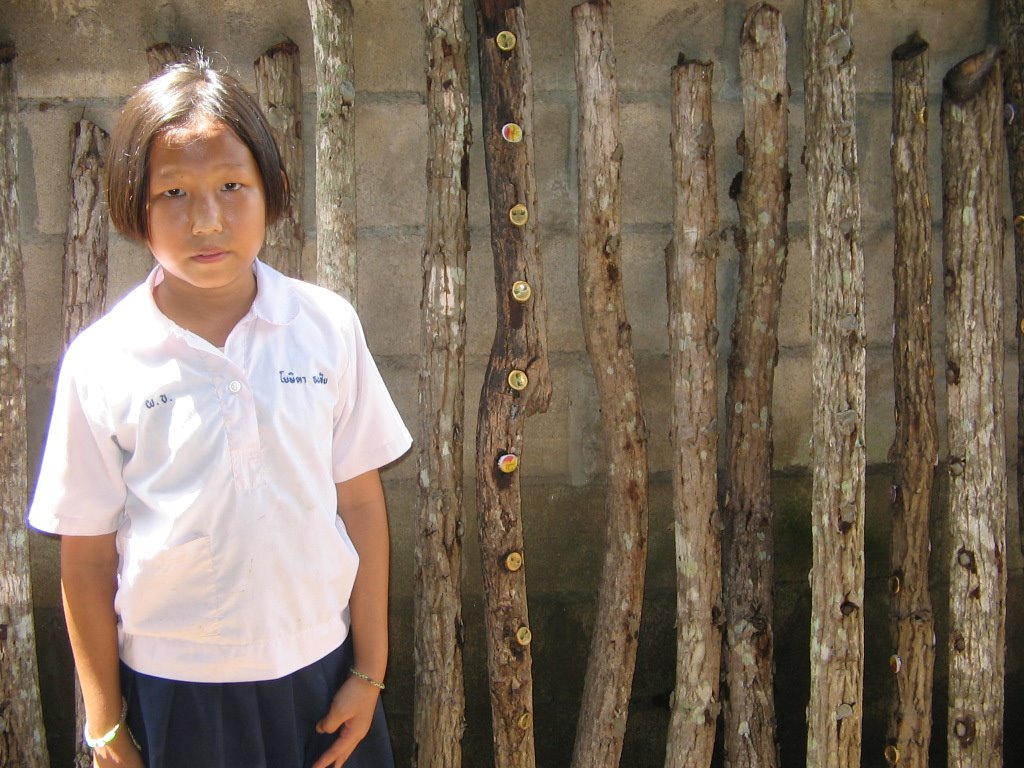
Mushrooms grow mostly during the rainy season, though, so what do you do when you want mushrooms and it hasn’t rained for 4 months? You grow your own on a stick, of course. Here is Yosita, age 12, showing some mushroom sticks at the home of another student. They can be watered to help the fungus grow. The bottle caps, it was explained to me, give an extra boost to the speed of growth as they rust.
Wednesday, August 23, 2006
Flying Coconut

Just returned from a long weekend in Krabi province, southern Thailand. Vacation. Beaches of fine bright sand, rocks rising into the air, caves filled with eerie, spooky things... It didn’t feel like being in Thailand, but then again, it did.
Robert is tossing a coconut shell into the water. I like to catch him doing playful things.
Friday, July 28, 2006
Yeah, Totally
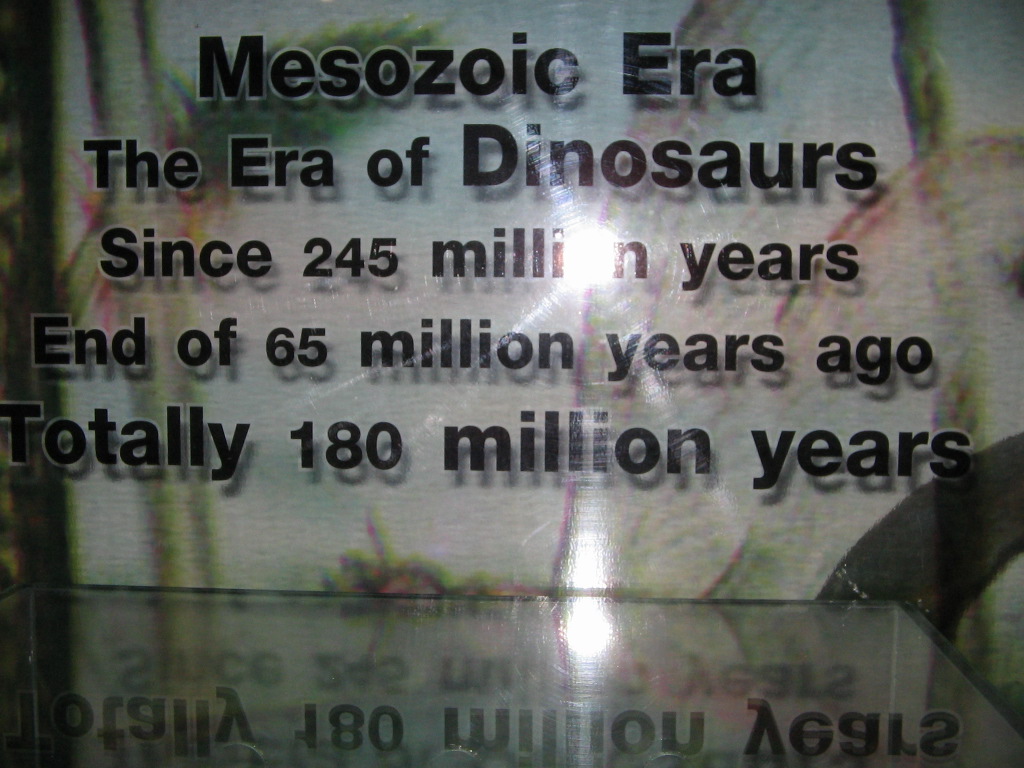
Sometimes signs are a lot of fun in Thailand. The translation from Thai to English can be turned in some interesting directions. This is a sign that Robert saw today while on a field trip with his students at a power plant. The sign was part of the geological museum at the plant.
Wednesday, July 26, 2006
It's Rooster Time II -- The Photo

Some readers of this blog may remember the mass email I sent back in April of 2005, when we had been living at our site for just a few weeks. We were startled to discover that not only did roosters crow at dawn, but they did so at odd hours in the middle of the night as well, and for extended periods of time. After two months we spent $150 to put new windows in our bedroom, helping to block out some of the sound.
At the time I also expressed bewilderment at how there could be so many roosters in such a small area, with a seemingly low relative number of female chickens. It was another couple of months before a friend suggested that perhaps the high rooster population is due to a local love of cockfighting. We did a bit of investigating, and it seems that indeed, this is the case. Many of our neighbors – particularly the young-ish males who have no regular work – spend time training their birds. I’ve been fortunate enough never to see a fight, but we know they happen.
Many of the roosters around town are kept in half-dome cages like the one in the photo. They sit under houses, in yards, and along the road. This one was near the house of one of my students. Of course, many roosters also simply roam free, occasionally wandering into our yard or walking along our perimeter wall until we chase them with a broom.
Sunday, July 23, 2006
Planting Rice
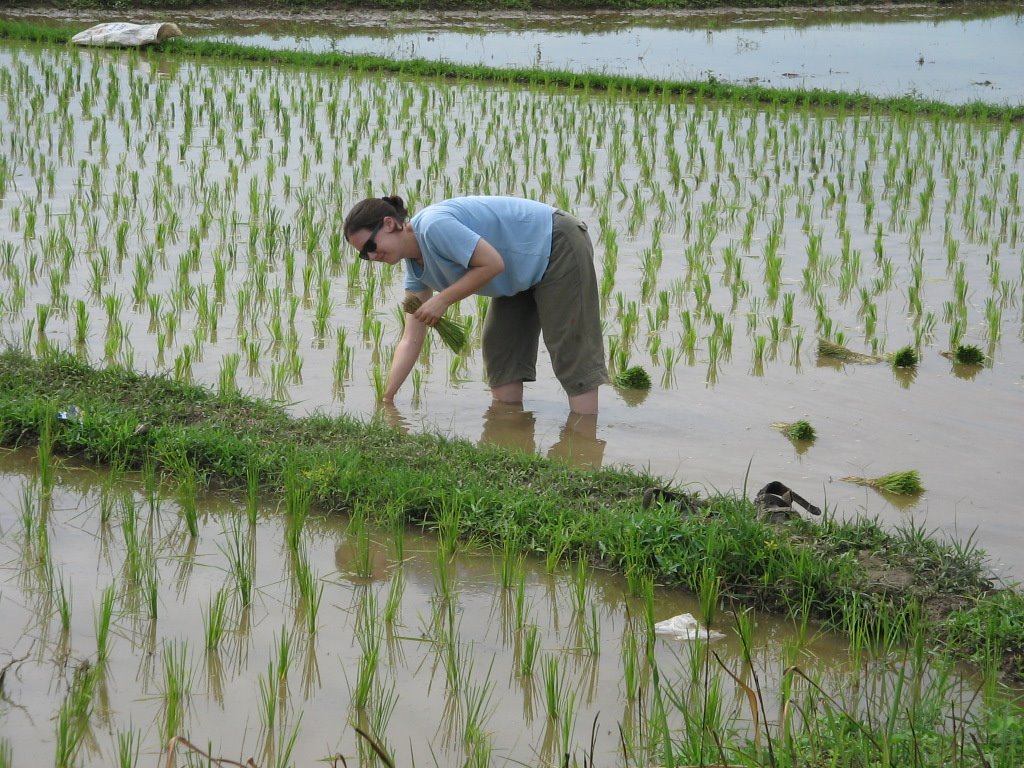
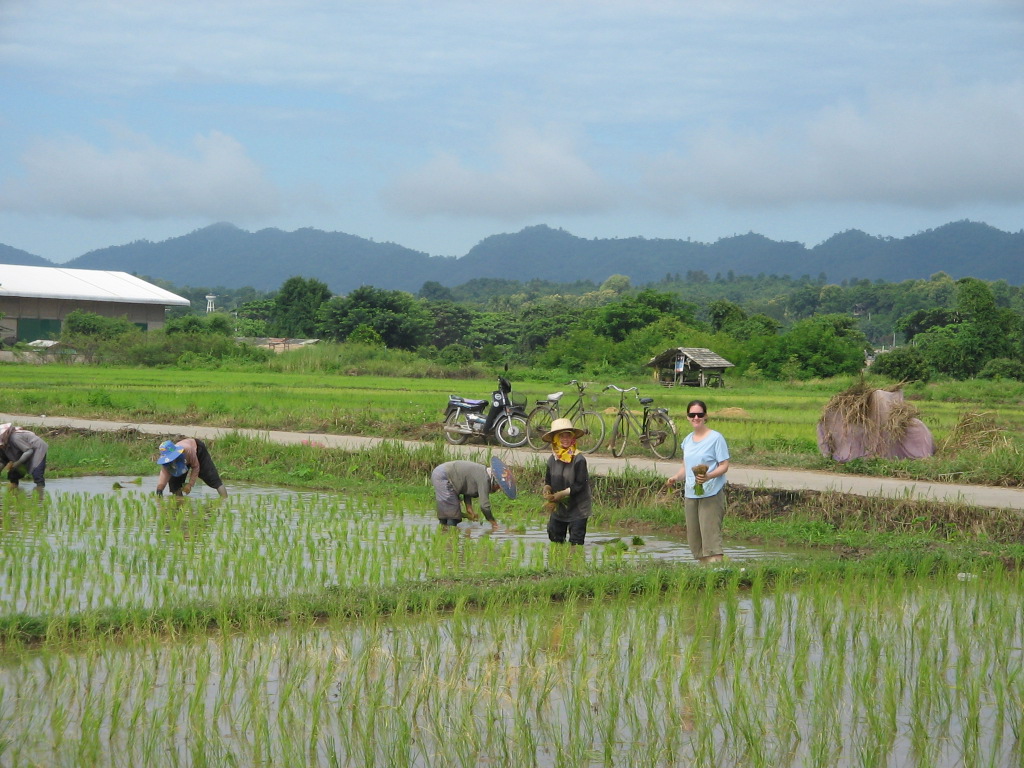
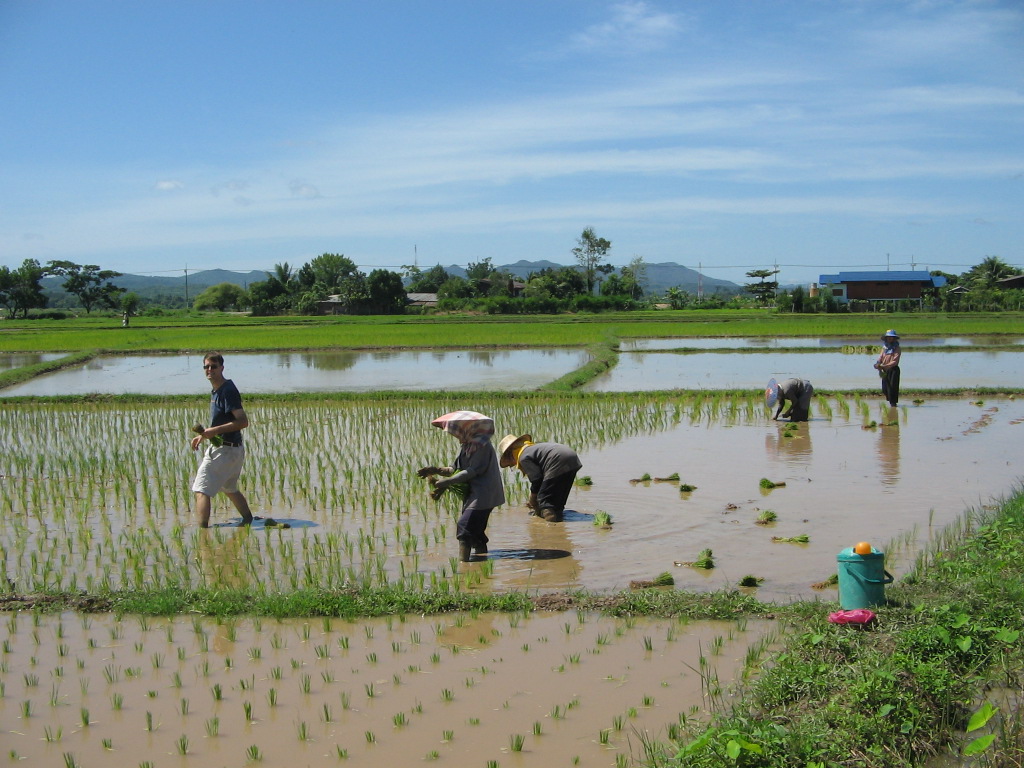
Way back when we first heard we were coming to Thailand, I got it into my head that I wanted to plant rice. Not necessarily often or regularly, but at least once. The thought of living in a country where there is truly a "staple food" made me think that I ought to experience how that staple food is produced.
Today, a hot, sunny day near the end of the planting season, after over 19 months of living in Thailand, I finally had my chance. Robert and I got up around 8am, ate some oatmeal, jumped on our bikes and rode a little ways north of town. We found a spot along the road where a few people were planting, got off our bikes and looked around hesitantly. As I expected, within 20 seconds there were calls to "come help plant!" We said, "Ok!" and they laughed.
Not knowing quite what to do for proper footwear (and having a healthy fear of Asian liver fluke and whatever else might be in there), we encased our feet with plastic bags, socks, and rubber bands. Finally set, we waded in and immediately sank several inches in the mud. The rubber bands helped the bags stay up to our ankles, though, so at least the soles of our feet were protected!
The four women – one of whom is a grandmother of a 2nd grader that I teach, it turns out – showed us how to carefully take a few stalks of rice out of a bundle and stick them into the mud in neat rows. I wasn’t surprised to find that it’s harder than it looks to get it right, but eventually I got into a slow groove. The women, of course, flew by Robert and me and occasionally came to help us finish a row or a section. They seemed happy to have us, though, and kept up a lively conversation. I could see how rice planting is a community activity.
The current wage for a full day’s labor planting rice is 100 baht, or about $2.50. For perspective, a bowl of noodles is 20 baht, a bus ride to the provincial capital is 30 baht, and an electric rice cooker is 400 baht. We lasted only 90 minutes, at which point I was sure I had sweat out all my sunscreen. Three hours later, after a good scrub and some lunch, my legs are still tired from pushing through the thick mud.
As we were leaving, the women said we should come back in October to help with the harvest. I’m looking forward to it!
Thursday, July 20, 2006
Sandwich Gone Strange
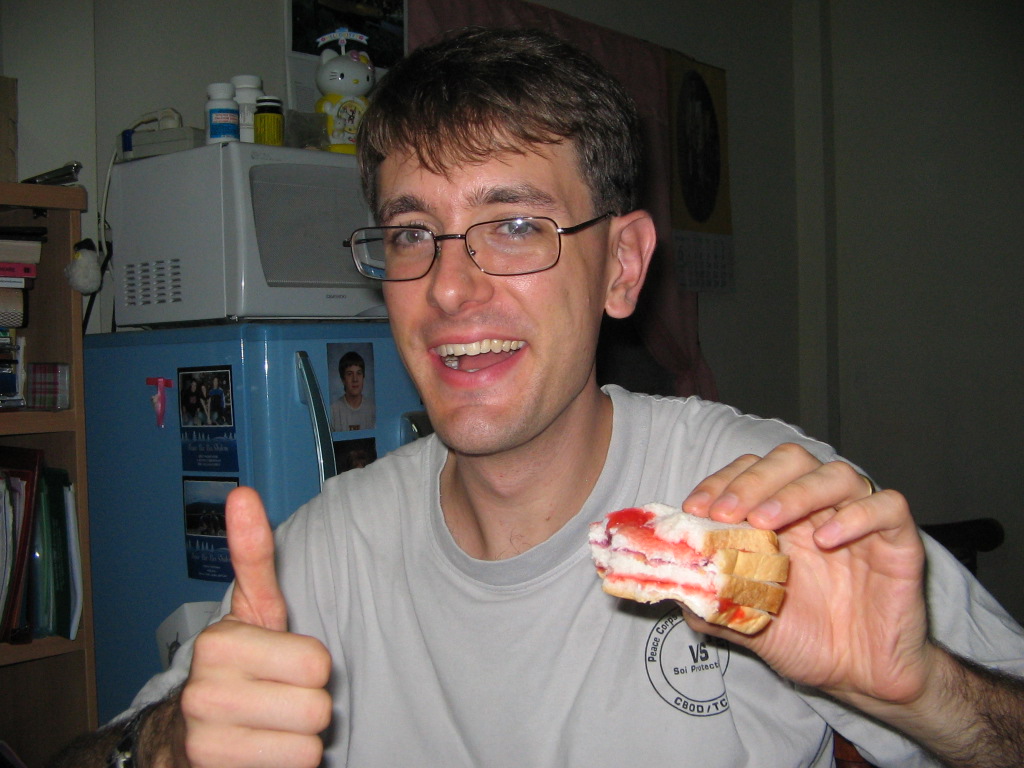
Thai cuisine is becoming increasingly famous throughout the world. When we received our invitation to join Peace Corps Thailand, we were very excited to know we were going to live somewhere which such great food. Thai cooking is said to have blended elements of Chinese and Indian styles and ingredients. This fusion is what gives it such great flavor.
On occasion, however, we discover that "fusion" has gone in strange directions, particularly when Thai and American or European cuisines are blended. Case in point: the sandwich. In America, sandwiches are commonly found made with bread (often whole grain or nicely flavored), a protein filling (meat, peanut butter, cheese, etc.), some veggies or fruit spread, and perhaps a flavoring (butter, mayo, special sauce, etc.).
In Thailand, however, the concept of what makes a good sandwich has been completely changed. Here, only white bread (of the Wonderbread style) is used. The protein filling, if there is one, is likely to be fuzzy pork (think cotton candy, but made of meat) or red bean paste. I don’t think I’ve ever seen a vegetable filling. Instead, you often come across red or green fruity-flavored gels such as the one shown in the photo. I read recently that Thailand is the country with the world’s highest per capita sugar consumption. I’m not sure it’s verifiably true, but my experience would attest to it, and the "sandwich" is a great example.
This particular sandwich was brought home from school from school by Robert, a little "gift" from his co-teacher that day. (Yes, it’s got four pieces of bread. Count them.)
Saturday, July 15, 2006
All in a Day's Work
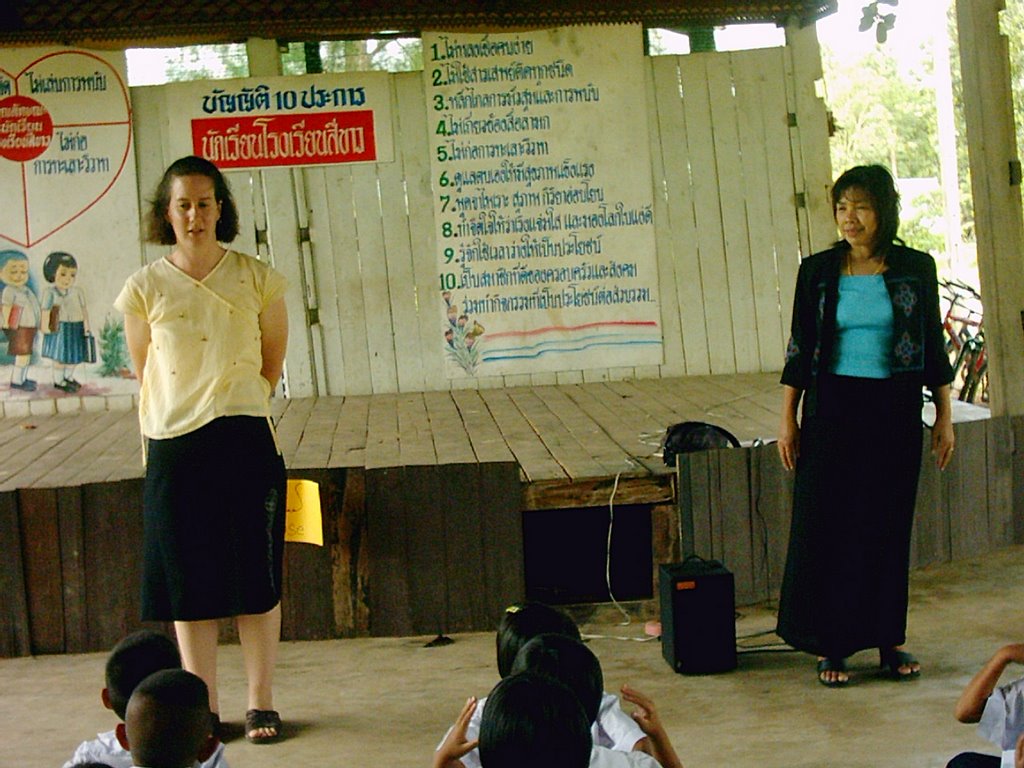
There I was, reviewing "in," "on," and "under," with the 5th graders, when they started jumping and running to look out the door. 6th graders were walking past in the hallway, clutching their arms up near the shoulder. "What’s going on?" I asked my co-teacher, Ajaan Warangkana. "Oh, they’re having their shots in the library," she explained. "German measles."
Once the 5th grade was settled down again, and at work on their pictures, I crept out of the room to peek into the makeshift medical station two doors down. Sure enough, there were my 6th graders, getting shots. Some were huddling nervously as they waited; others were looking relieved to be finished, though a little unhappy about the pain.
Suddenly an excited man with a slightly familiar face was waving his hands excitedly and talking to me. "Can you teach for about 15 minutes?" he asked. "You know, about health and taking care of your body." "Sure," I answered, thinking he meant sometime in the distant future when we could collaborate and plan in advance. "Ok, I’ll let you know when we’re ready and we’ll have all the grades here, 1-6," he replied. "You can do whatever you want. Robert played a game earlier."
Somewhat bewildered, but feeling like I had some idea what had happened, I consulted with Ajaan Warangkana for a minute and then called over to Robert at his school. He said that yes indeed, during the morning he had been asked by Doctor Aig to teach the entire student body about health for 15 minutes, so his response was a vocab-and-action game about different illnesses. ("Stomache!" All kids clutch their stomachs, lean over, and groan.) Feeling like that wasn’t quite our style, Ajaan Warangkana and I got to work composing a song to the tune of "The Limbo" with such great lines as "Wash your hands, brush your teeth," and their accompanying movements. The 6th graders watched with interest.
Finally the moment arrived. Grades 2-6 assembled on the library floor (Grade 1 was too traumatized by their shots, so they remained wailing on the other side of the school) and Doctor Aig introduced my topic as "How Students in America Take Care of their Health." I agreed, in response to his prompting, that students in America do in fact get vaccinations also. I then asked the kids about their handwashing and toothbrushing habits, again stressing that American kids are expected to wash their hands, just like Thai kids. Finally, as the room was getting hotter and hotter, Ajaan Warangkana and I launched into our song. Given that it was after 3pm, about 95 degrees, and 20 percent of the kids in the room had recently received painful shots in the arm, I’d say it was a decent hit.
When we were finally finished with our "lesson," Doctor Aig came back up front for a question-and-answer session with the kids about bird flu, dengue fever, and childhood obesity and its relation to diabetes. Watching as he singled out Sutin and Prapat to draw attention to their overweight-ness, I was reminded of how this was different from America. When Robert and I compared notes over dinner, he noted his surprise at how, when Doctor Aig asked the question, "And how many of you have lice today?" about 12 girls in the 5th and 6th grades raised their hands.
Teaching in a Thai primary school: never dull.
[The accompanying photo is a year old, taken in the meeting hall at an English club session. But I thought it was a cute one of Ajaan Warangkana and I co-teaching together.]
Wednesday, July 12, 2006
Aniversary . . . Party?
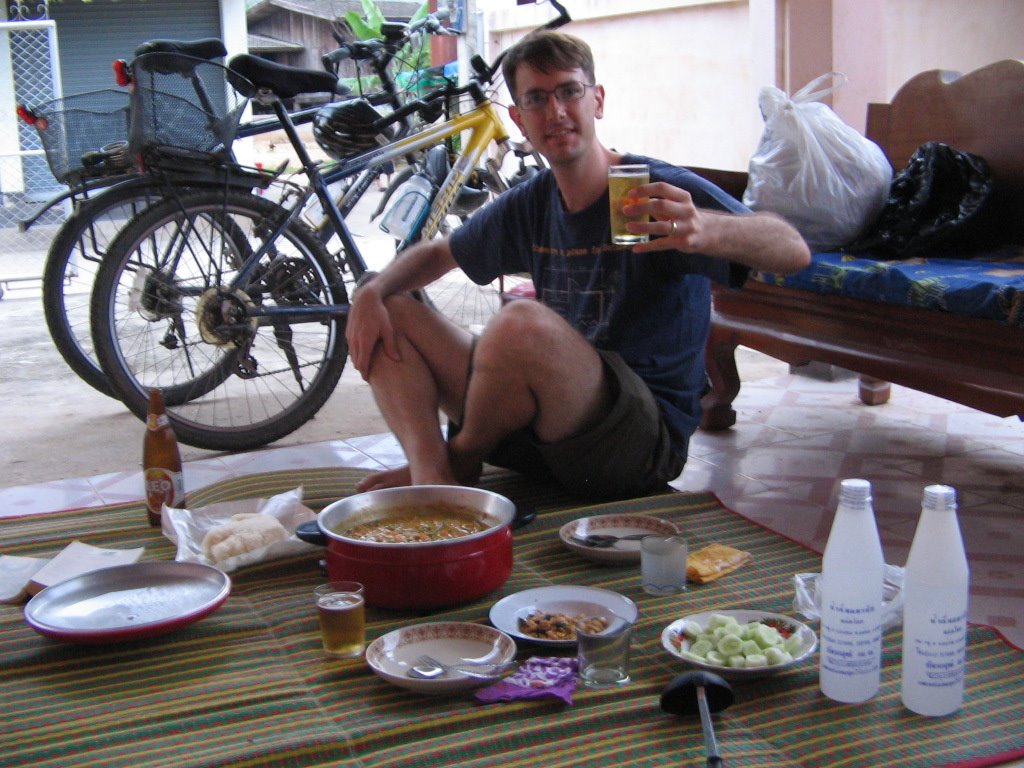 After a quiet dinner for two – Massaman curry, peanuts with ginger and kaffir lime leaves, fresh cucumbers, a bottle of beer, and some sticky rice – eaten on the porch, we decided to take a walk for some fresh air. It was very dark along the river, since the street lamps still aren’t completely repaired from the flood, but a short distance from our house we could hear some gentle northern Thai music coming from a house with a few well-placed lanterns.
We approached the house slowly, wanting to spy for a few minutes on the music but not wanting to get pulled inside, but as we peeked out from a shadow we were spotted anyway. As expected, they called us up... and feeling good-natured, we went, despite not knowing the owners. Not expecting to see any familiar faces, we were first surprised to bump into Ajaan Catawood, an English teacher at the local high school we’ve worked with several times at various events. A minute later, as we reached the open porch where the "party" was happening, we were even more surprised to see that Por Or Samart, the principal at Robert’s small school, was one of the musicians.
Overlooking the river, on the dimly lit beautiful wooden porch, a pair of plastic mats on the floor were covered in different dishes of food, around which were seated about 10 people. Robert sat down on what seemed to be the primarily male side, and I sat down among the 4 women, none of whom I recognized. Drinks were poured (whiskey for Robert, water for me), and the conversation began.
Robert reports that his side of the mats covered many weighty issues, including the current generation of Thai youth’s lack of respect for hard work and the differences between Eastern and Western forms of Buddhism. (He reported that at one point, the man on his left attempted to make a "fulcrum" with his hands to show the comparison, but Robert’s Thai wasn’t quite up to the task of complete understanding.) For my part, the female conversation focused on simpler topics such as the time zone and weather differences between Thailand and America, the Thai foods that one can eat if one is vegetarian, and – slightly more advanced – the teaching of English in Thai primary schools.
Both of us enjoyed ourselves considerably for an hour or so before making a graceful exit. We agreed that it was not the anniversary evening we had been expecting, but it was nice all the same. After all, how many more wedding anniversaries will we spend on a stranger-turned-neighbor’s porch overlooking a river in rural northern Thailand?
Tuesday, July 11, 2006
Da Stefano Review
If you’re in Chiang Mai and in need of a place to go for a romantic Italian dinner, Da Stefano is it. Located near the Tha Pae Gate, from the outside Da Stefano looks like just another one of those little foreign food establishments that you see all over the city. The quality of the food, however, sets it apart.
We went to Da Stefano almost by accident, after our plan to dine by the river was impossible due to rowdy crowds at the first restaurant we chose. Craving Italian, we quickly called a few places in the guidebook that we had along. Da Stefano answered the phone and promised pizza and other vegetarian options.
When we entered the restaurant, we were immediately relieved to find quiet, well-spaced tables half-filled with other couples and small groups looking for a quiet evening. We chose a table next to the wall and eagerly opened the menu. Four reasonably-priced set menu options were presented on the first page, but uninterested we continued. The lists of pizzas and appetizers were long and appealing. In addition, other Italian specialties, including pastas and gnocchi, were offered. After ordering, we settled back to enjoy the atmosphere.
The garlic bread bruschetta arrived first, along with a half-liter of the cheaper of the two house red wines. The wine was great, but although both the bread and topping were very tasty individually, I probably wouldn’t order it as an appetizer again. The complementary dry breadsticks that were placed on the table with some olive dipping oil were flavorful.
The mixed salads were quite large, including lettuce, tomatoes, onions, cucumbers, and shredded carrot, and we were able to put on our own oil and vinegar right at the table. The best part of the meal, however, was the pizza. We shared a margharita, which came topped with fresh basil leaves, and a four-cheese, which had a pleasing blend that included Gouda and just enough Gorgonzola to give it some kick. The crust was perfectly cooked and full of its own flavor, and all of it went perfectly with the wine. I’ve eaten pizza at many different restaurants in six Thai provinces, and Da Stefano beats them all.
For dessert, we skipped the Italian classics and shared a chocolate sundae, just the right end to our meal. As we walked out into the calm night we agreed that we’d choose Da Stefano on our next trip to Chiang Mai.
To get to Da Stefano, walk east across the moat from Tha Pae Gate. Right after Starbucks and Family Mart, turn left onto the little lane that heads north. Da Stefano is a few meters in on the right.
We went to Da Stefano almost by accident, after our plan to dine by the river was impossible due to rowdy crowds at the first restaurant we chose. Craving Italian, we quickly called a few places in the guidebook that we had along. Da Stefano answered the phone and promised pizza and other vegetarian options.
When we entered the restaurant, we were immediately relieved to find quiet, well-spaced tables half-filled with other couples and small groups looking for a quiet evening. We chose a table next to the wall and eagerly opened the menu. Four reasonably-priced set menu options were presented on the first page, but uninterested we continued. The lists of pizzas and appetizers were long and appealing. In addition, other Italian specialties, including pastas and gnocchi, were offered. After ordering, we settled back to enjoy the atmosphere.
The garlic bread bruschetta arrived first, along with a half-liter of the cheaper of the two house red wines. The wine was great, but although both the bread and topping were very tasty individually, I probably wouldn’t order it as an appetizer again. The complementary dry breadsticks that were placed on the table with some olive dipping oil were flavorful.
The mixed salads were quite large, including lettuce, tomatoes, onions, cucumbers, and shredded carrot, and we were able to put on our own oil and vinegar right at the table. The best part of the meal, however, was the pizza. We shared a margharita, which came topped with fresh basil leaves, and a four-cheese, which had a pleasing blend that included Gouda and just enough Gorgonzola to give it some kick. The crust was perfectly cooked and full of its own flavor, and all of it went perfectly with the wine. I’ve eaten pizza at many different restaurants in six Thai provinces, and Da Stefano beats them all.
For dessert, we skipped the Italian classics and shared a chocolate sundae, just the right end to our meal. As we walked out into the calm night we agreed that we’d choose Da Stefano on our next trip to Chiang Mai.
To get to Da Stefano, walk east across the moat from Tha Pae Gate. Right after Starbucks and Family Mart, turn left onto the little lane that heads north. Da Stefano is a few meters in on the right.
Umbrella Village
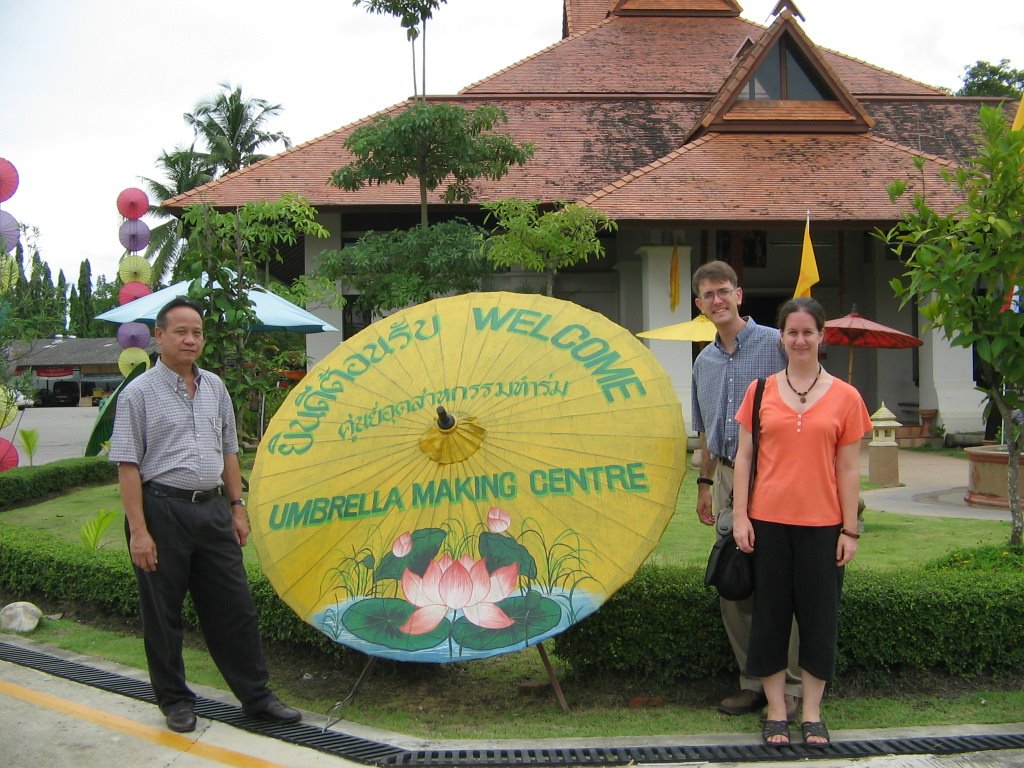
Since our 3-year wedding aniversary is tomorrow, and since we had a rare 4-day weekend here in Thailand, we have just spent three nights in Chiang Mai for a little relaxation, fun, and shopping. Between visits to night markets and hill tribe product shops, ceramics stores and silk roads, we squeezed in several delicious meals (Indian, Italian, American) and Pirates of the Caribbean II. All in all, an excellent trip.
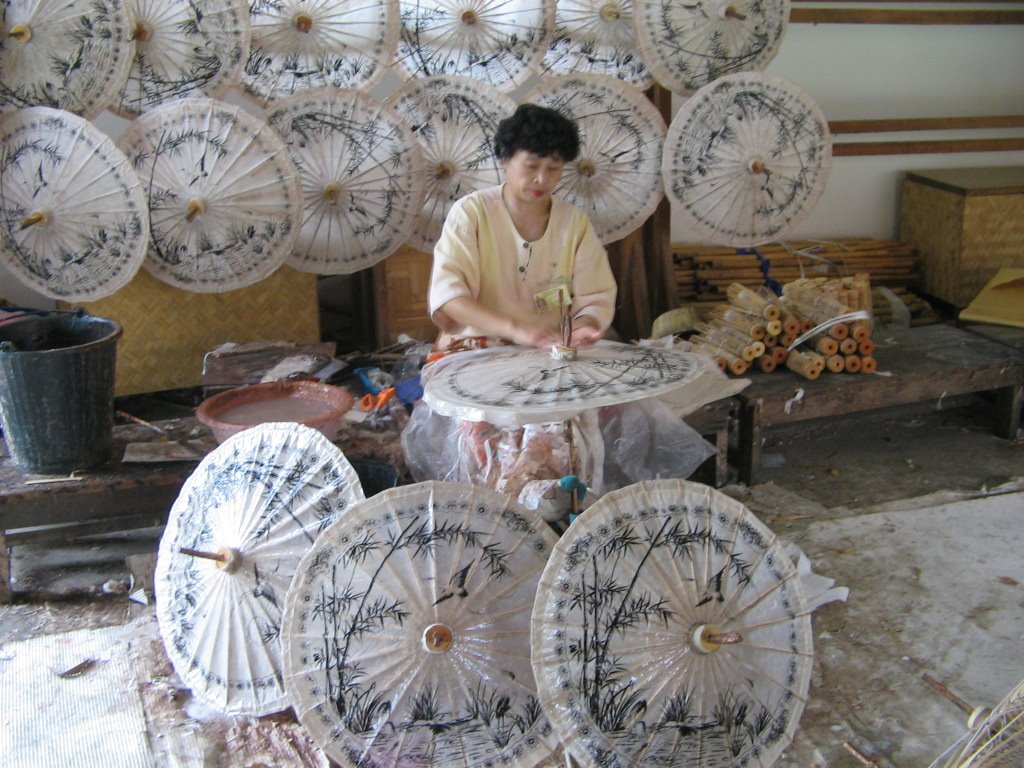
Our landlords, Por Or Sawat (principal of one of Robert’s schools) and Ajaan Warangkana (one of my co-teachers) accompanied us for the day on Saturday. They took us to see Bo Sang, the famous "umbrella village," about 10 kilometers outside Chiang Mai. One building has been set up as an official government-run visitor center. There, you could watch people making paper and cotton umbrellas as well as do some shopping.
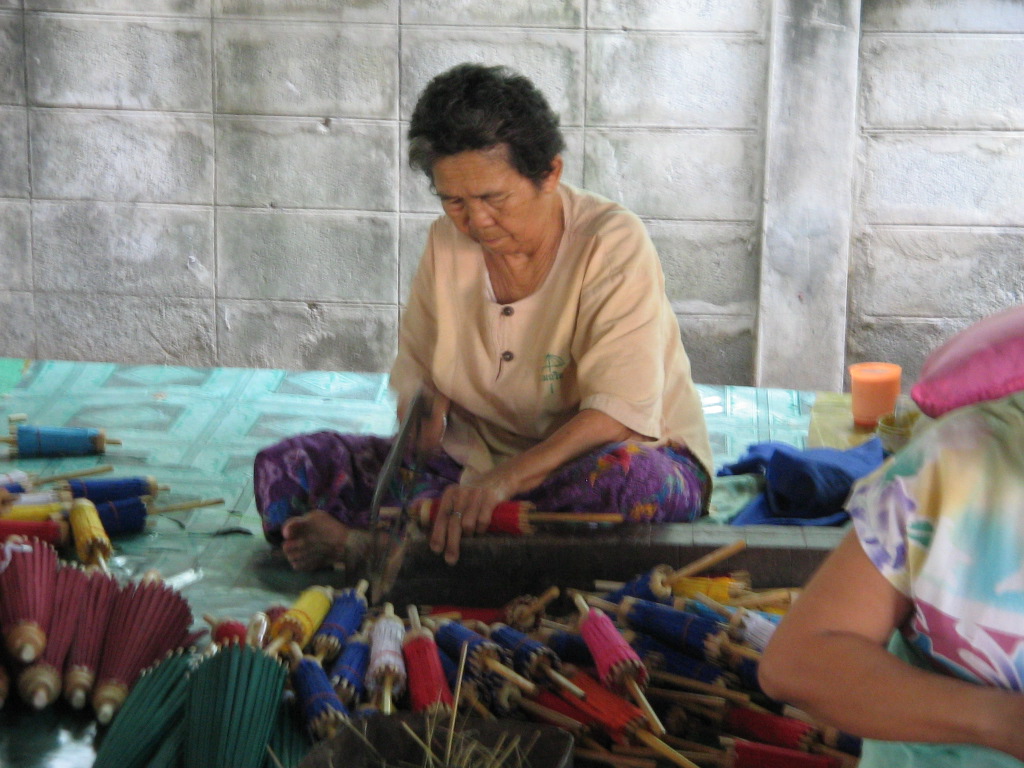
We walked past all the stages of umbrella making: cutting the wood for the handle, arranging the spokes, making and drying the paper, laying the paper over the spokes and coating it with glue, final assembly and painting of the designs. My favorite person to watch was a woman who looped string around the outside of the umbrella spokes while spinning the entire thing around at a rapid pace. I did also enjoy watching the old woman with a saw shown in the photo.
Friday, July 07, 2006
Kow Pansa
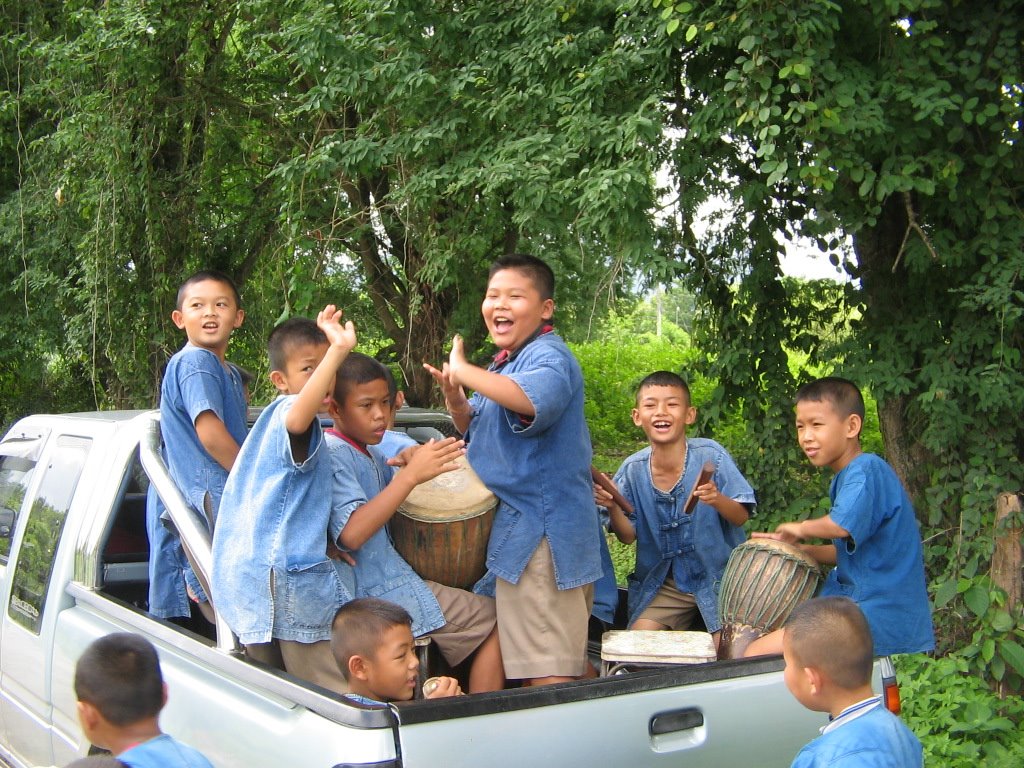
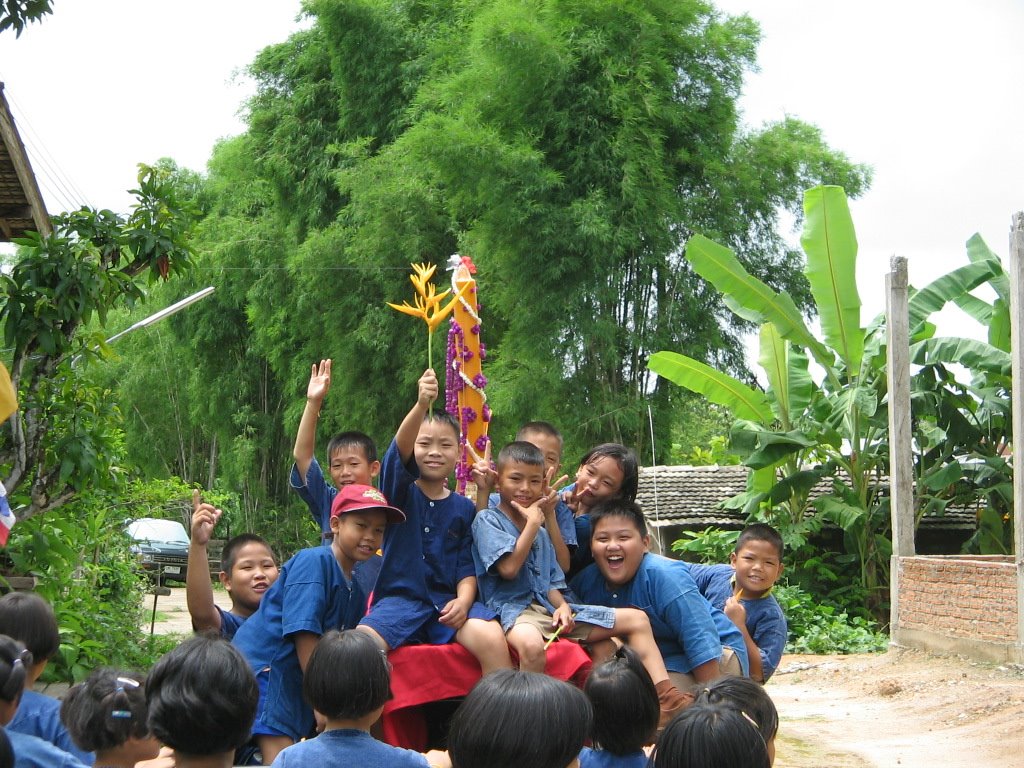
The chance to join in Thai festivals with our community is one of our favorite parts of being Peace Corps Volunteers in Thailand. Monday is "Kow Pansa," or the beginning of Buddhist Lent, so today we celebrated with the schools and villages. ("Kow" means "enter.")
Buddhist Lent lasts 3 months. The timing of it is related to moon cycles and the rainy season. Traditionally, monks walk through the villages every morning to collect food and other necessities. During rice planting time, farmers in olden times would get upset if monks trampled the fields. Pansa evolved into a time when monks are not supposed to leave the wat (temple). In addition, people are expected to abstain from harmful pleasures such as drinking alcohol, smoking, etc., and to visit the wat on certain days related to the moon. Until about 20 years ago, electricity did not extend to all parts of Thailand. My co-teacher explained that during Pansa, the people needed to bring candles to the monks in the wat so that they would be able to see at night.
Candles therefore featured prominently in today’s ceremonies and festivities. At Robert’s Friday school, the students and teachers decorated two large orange candles which they carried through their two feeder villages collecting donations from the people. They then took the donations and the candles to the respective local wats, where they received blessings from the monks.
At my Friday school, the students and teachers converted the back of a pickup truck into a parade float featuring a large orange candle surrounded by flowers. We joined in the afternoon parade down the main street of town. All 9 floats in the parade had candles, and there were competitions for the most beautiful and creative designs. All the students then piled into the back of several teachers’ pickup trucks and went to two different wats to deliver offerings and receive blessings.
The photos show Robert’s students playing northern Thai music and proudly displaying their candle.
Tuesday, July 04, 2006
Pineapple Glut

You know you’re living in a tropical country when...
As you exit the windy road through the mountains and ride along the west side of our valley, you can look out the window of your vehicle at hills covered in pineapples. Actually, you can just see the sprouty tops, because the fruit grows underground. These hills are very pretty, but even though I came to Thailand anxious to eat lots and lots of fresh pineapple, I’ve had more than my fill lately.
Apparently, pineapple growing was so profitable in our province for a while that many people started growing it who hadn’t done so before. As can be expected, the supply has outgrown the demand. About a month ago there were protests in our provincial capital by farmers claiming that the government owed them money for having grown all this pineapple. I don’t know all the details, but I do know that the governor, anxious to stop the protests, agreed to buy the pineapple from the farmers at the price of 80 satang per kilogram.
Now, 80 satang per kilogram is pretty much nothing at all. There are approximately 40 baht to the dollar, and 100 satang to 1 baht. So, 80 satang comes out to be about 2 cents. 2 cents, for 2.2 pounds of fresh pineapple. But even at that rate, and even with the primary schools taking advantage of the low price and buying it like crazy, they still can’t sell all the pineapples so they’re being thrown into big holes. (This is the story I am told.)
Last Friday at our English camp, lunch included stir-fried pineapple for the main course, with fresh pineapple for dessert. I felt a little high on sugar by the end of the meal! The teachers were surprised that I wanted to take a picture of pineapple. They were even more surprised when I explained that it’s a very expensive fruit in the United States.
(Other food items in the photo include red curry, rice and rice noodles, and fish sauce with chilies.)
Saturday, July 01, 2006
Trip to the Doctor
Peace Corps medical philosophy is that Volunteers are largely responsible for our own health care. Our first week in-country, we were given two medical books apiece and large medical kits. We try to handle most small problems on our own, with occasional phone calls to our Medical Officer, Dr. Rit, in Bangkok.
When something comes up that we can't do on our own, however, such as when we came down with bronchitis and sinusitis last summer or when I had tooth problems in January, Peace Corps will arrange appointments for us with appropriate doctors. Sometimes this means a trip to Bangkok, which for us is 12 hours of travel, each way, and a choice between missing school or riding an overnight train, or maybe both. Not feeling tempted by either of those choices, I requested to have my appointment this week in Chiang Mai -- an easier 4-hour trip. I also requested a Saturday appointment so as not to miss any school.
So, my short description of what's involved for this Peace Corps Volunteer to make a trip to the doctor:
The second day of English camp ended at 4pm Friday, and by 4:05 we were out on the highway waiting for the bus. It picked us up 20 minutes later, and we rode in relative -- though non-air-conditioned -- comfort along the windy mountain roads for over an hour until reaching our provincial capital. As it was Friday evening, as we expected, the buses to Chiang Mai were mostly full, but we were able to get standing room on a 2nd-class air-conditioned bus that left the station at 6pm. We stood our way across the next set of mountains, not entirely comfortable, until reaching a mid-point city just after 7. A number of people got off there and we were able to claim two seats for the remainder of the ride -- a huge relief!
We arrived in Chiang Mai shortly before 8pm, found a songtaew to our guest house, and checked in. I took a quick shower while Robert called an Indian restaurant to check their hours. By 10 pm, stuffed with cheap Indian food (see preceeding blog entry), we were back at the guest house preparing for bed.
We checked out at 9:30 the next morning and went off to find breakfast. For a little luxury I wanted good coffee, so we went to the Libernard Cafe for banana pancakes and cinnamon cappucino (orange juice for Robert). After breakfast, Robert went for a walk through the old city while I met with the doctor.
After being pronounced healthy, I met up with Robert in the hospital lobby at 11:30. We jumped in another songtaew, went back to the bus station, and found seats on a 12:00 bus back to our province. Not having to stand, I was able to read my book this time around!
We arrived back in our capital just before 2:00, so it was time for a little lunch. Big C is not far away, so we wandered in for some quick food and a few purchases before getting to our local bus line stop in time for the 4:00 departure. We were back at our house by 5:30pm, giving the entire trip to the doctor a total time of 25 1/2 hours.
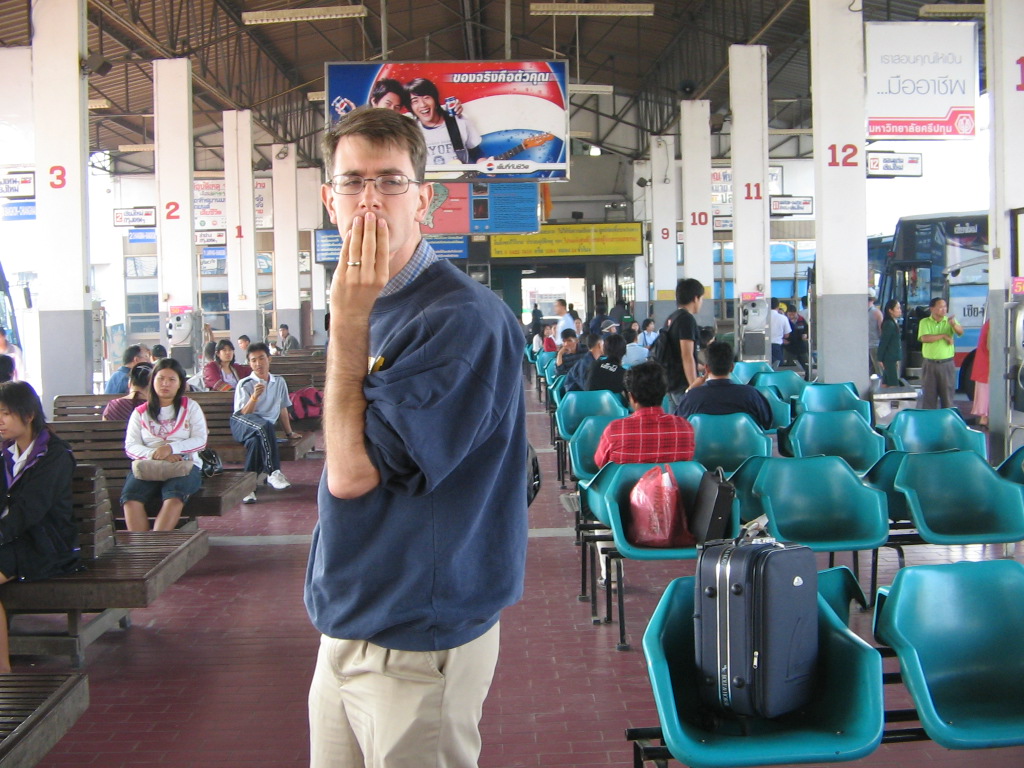
The photo shows Robert at the bus station in our provincial capital. It was taken in January, hence the sweatshirt.
Indian Restaurant Vegetarian Food
We have learned to interpret the recommendations of the Lonely Planet guidebook series with some skepticism. Their descriptions of lodging and food, though never entirely off the mark, will often have some error or omission that we'll wish we had known about sooner. Their listing of "Indian Restaurant Vegetarian Food" in Chiang Mai, however, was right on.
We arrived in Chiang Mai after dark on Friday evening. Hungry for some cheap but moderately healthy food, we called over to the restaurant to make sure they were open. "Oh, yes, come on in," they said. "What time do you close?" we asked. "Oh, whatever time is good for you," the woman replied.
We walked the short distance from our guest house to the restaurant. Located on a busy but quiet lane with many shops catering to the backpacker tourist crowd, Indian Restaurant Vegetarian Food looks like a small cafeteria with about 6 or 7 tables. Bollywood music videos were playing on the television, and the white walls were decorated with an assortment of Thai and Indian posters. Only one table was already occupied when we arrived, but by the time we left an hour later they were all full. A stout gentlemen with grey-black hair brought us our menu. "Are you hungry?" he asked. "Yes, we're very hungry!" we replied. I ordered some samosas to start.
The all-vegetarian menu contained all the standard curries, with a few additional options. We decided to each order a "thali" -- a selection of curries with rice and flatbread. When the stout gentleman arrived with our samosas, he was ready to take our order. "So you'll be having a thali and a dosa?" he asked. "No," we said, "we each want a thali." "Ok, a thali and a dosa, big for you to share," he continued. We looked at each other. "No, we don't want dosa. Just two thalis," we tried again.
"Oh, two thalis!" he answered. "Ok. So you will have some lentils, some paneer, and some capsicum curries?"
"Well, can we choose our own curries?" we asked hesitantly.
"Choose, ok."
"I would like lentils, chickpeas..." Robert started.
"No chickpeas. How about capsicum?" said the gentleman.
"Err... how about these potatoes and peas?" tried Robert. "And some potatoes and tomatoes?"
"Ok, and one more," said the man. "You want capsicum?"
"How about potatoes and paneer?" Robert asked.
"Potatoes potatoes potatoes!" exclaimed the gentleman. "All you are eating is potatoes!"
"I like potatoes," Robert replied.
"Ok," the gentleman turned to me, "and you will have four different curries that I will choose for you?"
"Well, I would like dahl too," I started.
"Ok, dahl too," he replied, "and capsicum?"
Capsicum (bell pepper) curry didn't sound very appealing to me, no matter how much he was pushing it. "Can I have yellow pumpkin?" I asked.
"Ok, he said." "And capsicum?"
"And how about spinach and paneer?" I continued.
"Ok, and then capsicum?"
I gave up. "Ok, I'll try the capsicum." I said. We ordered two mango lassis and dove into our samosas as soon as he was gone. They were outstanding, though better on their own than with the accompanying sauce.
While waiting for the arrival of our thalis, we watched the woman in the kitchen, presumably the wife of the gentleman who took our order, juggle the various pots and pans on the stove. It seemed to be very much a family operation.
When the food came, we were not disappointed. The dahl was fantastic. Although there were a few changes from what we remembered ordering (we both ended up with capsicum), everything was delicious. The individual flavors in each curry stood out well, especially the yellow pumpkin. The flatbread was good, and the rice was an aromatic variety I haven't seen in Thailand. The mango lassies were refreshing and not too sweet.
At the end of the meal, our total bill -- including samosas, 4 scoops of curry apiece, rice, flatbread, water, and mango lassis -- came to just 290 baht, or about $7.50. We were impressed. Completely stuffed, we walked back to our guesthouse and vowed to return to the gentleman's Indian restaurant as often as possible. If he pushes the capsicum, we may take him up on it again.
To get to Indian Restaurant Vegetarian Food, enter Soi 9 off Moon Muang Road (along the moat). A short walk down the soi, the Local pub will be on your right. Turn left to walk away from it and you'll see the big white free-standing sign listing cheap Indian vegetarian foods.
We arrived in Chiang Mai after dark on Friday evening. Hungry for some cheap but moderately healthy food, we called over to the restaurant to make sure they were open. "Oh, yes, come on in," they said. "What time do you close?" we asked. "Oh, whatever time is good for you," the woman replied.
We walked the short distance from our guest house to the restaurant. Located on a busy but quiet lane with many shops catering to the backpacker tourist crowd, Indian Restaurant Vegetarian Food looks like a small cafeteria with about 6 or 7 tables. Bollywood music videos were playing on the television, and the white walls were decorated with an assortment of Thai and Indian posters. Only one table was already occupied when we arrived, but by the time we left an hour later they were all full. A stout gentlemen with grey-black hair brought us our menu. "Are you hungry?" he asked. "Yes, we're very hungry!" we replied. I ordered some samosas to start.
The all-vegetarian menu contained all the standard curries, with a few additional options. We decided to each order a "thali" -- a selection of curries with rice and flatbread. When the stout gentleman arrived with our samosas, he was ready to take our order. "So you'll be having a thali and a dosa?" he asked. "No," we said, "we each want a thali." "Ok, a thali and a dosa, big for you to share," he continued. We looked at each other. "No, we don't want dosa. Just two thalis," we tried again.
"Oh, two thalis!" he answered. "Ok. So you will have some lentils, some paneer, and some capsicum curries?"
"Well, can we choose our own curries?" we asked hesitantly.
"Choose, ok."
"I would like lentils, chickpeas..." Robert started.
"No chickpeas. How about capsicum?" said the gentleman.
"Err... how about these potatoes and peas?" tried Robert. "And some potatoes and tomatoes?"
"Ok, and one more," said the man. "You want capsicum?"
"How about potatoes and paneer?" Robert asked.
"Potatoes potatoes potatoes!" exclaimed the gentleman. "All you are eating is potatoes!"
"I like potatoes," Robert replied.
"Ok," the gentleman turned to me, "and you will have four different curries that I will choose for you?"
"Well, I would like dahl too," I started.
"Ok, dahl too," he replied, "and capsicum?"
Capsicum (bell pepper) curry didn't sound very appealing to me, no matter how much he was pushing it. "Can I have yellow pumpkin?" I asked.
"Ok, he said." "And capsicum?"
"And how about spinach and paneer?" I continued.
"Ok, and then capsicum?"
I gave up. "Ok, I'll try the capsicum." I said. We ordered two mango lassis and dove into our samosas as soon as he was gone. They were outstanding, though better on their own than with the accompanying sauce.
While waiting for the arrival of our thalis, we watched the woman in the kitchen, presumably the wife of the gentleman who took our order, juggle the various pots and pans on the stove. It seemed to be very much a family operation.
When the food came, we were not disappointed. The dahl was fantastic. Although there were a few changes from what we remembered ordering (we both ended up with capsicum), everything was delicious. The individual flavors in each curry stood out well, especially the yellow pumpkin. The flatbread was good, and the rice was an aromatic variety I haven't seen in Thailand. The mango lassies were refreshing and not too sweet.
At the end of the meal, our total bill -- including samosas, 4 scoops of curry apiece, rice, flatbread, water, and mango lassis -- came to just 290 baht, or about $7.50. We were impressed. Completely stuffed, we walked back to our guesthouse and vowed to return to the gentleman's Indian restaurant as often as possible. If he pushes the capsicum, we may take him up on it again.
To get to Indian Restaurant Vegetarian Food, enter Soi 9 off Moon Muang Road (along the moat). A short walk down the soi, the Local pub will be on your right. Turn left to walk away from it and you'll see the big white free-standing sign listing cheap Indian vegetarian foods.
Subscribe to:
Posts (Atom)